Clear Sky Science · en
Unraveling non-monotonic responses of the El Niño–Southern Oscillation to post-2100 global warming
Why this matters for everyday weather
El Niño and La Niña are household names because they reshape weather patterns worldwide, from floods in California to droughts in Australia. This study asks a deceptively simple question with big real‑world stakes: as human‑driven warming continues beyond this century, will these climate troublemakers just keep getting stronger, or will their behavior change in more surprising ways? Using advanced computer models run far into the future, the authors find that El Niño–Southern Oscillation (ENSO) does not respond in a straight line to warming. Instead, it shifts into a new mode where events become weaker but happen more often—complicating how societies prepare for climate swings.
The climate swing we live with now
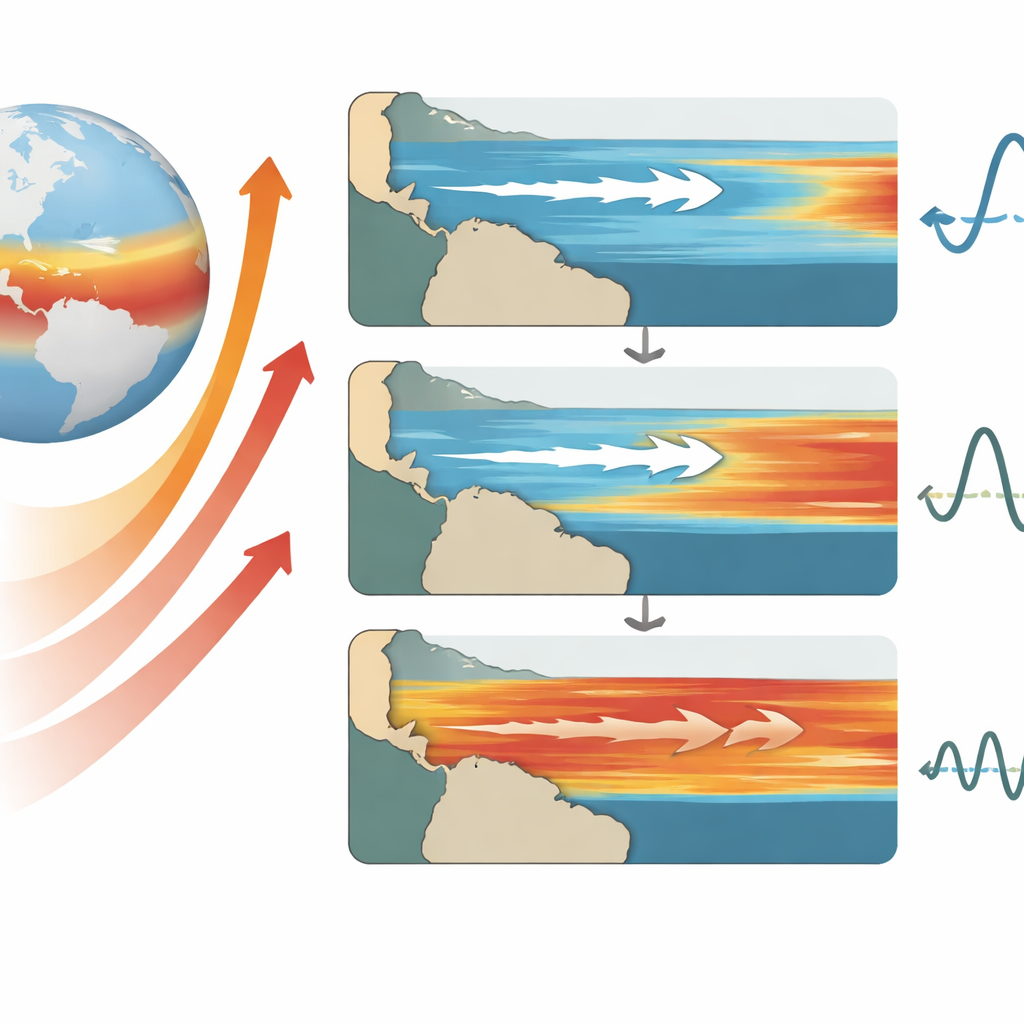
Today’s ENSO grows out of a delicate dance between Pacific Ocean temperatures and the overlying winds. In a normal year, easterly trade winds pile up warm water in the western Pacific and allow cooler water to rise in the east, forming a “cold tongue” along the equator. Every few years this balance tips: in El Niño, warm water spreads eastward and global weather shifts; in La Niña, the cold tongue strengthens. These swings are not perfectly even—strong El Niño events tend to be more extreme than La Niña—so the pattern is slightly “lopsided” toward warm events. They also come in different “flavors,” centered either in the eastern or central Pacific, and typically recur every 2–7 years.
What happens under moderate warming
The authors use an Earth system model to simulate eight future pathways for greenhouse gas emissions out to the year 2500, allowing the climate to reach nearly steady conditions at different global warming levels. Under moderate warming—roughly up to 3 °C above pre‑industrial levels—ENSO becomes stronger. The warm and cold phases grow in size, but their basic rhythm stays close to a four‑year cycle. Both eastern‑ and central‑Pacific‑focused events intensify, and the overall tilt toward strong El Niño events is maintained. This behavior matches many earlier studies, which found that a more strongly stratified upper ocean can amplify ENSO under continued warming through more efficient coupling between surface winds and subsurface temperature contrasts.
A surprising shift in an overheated world
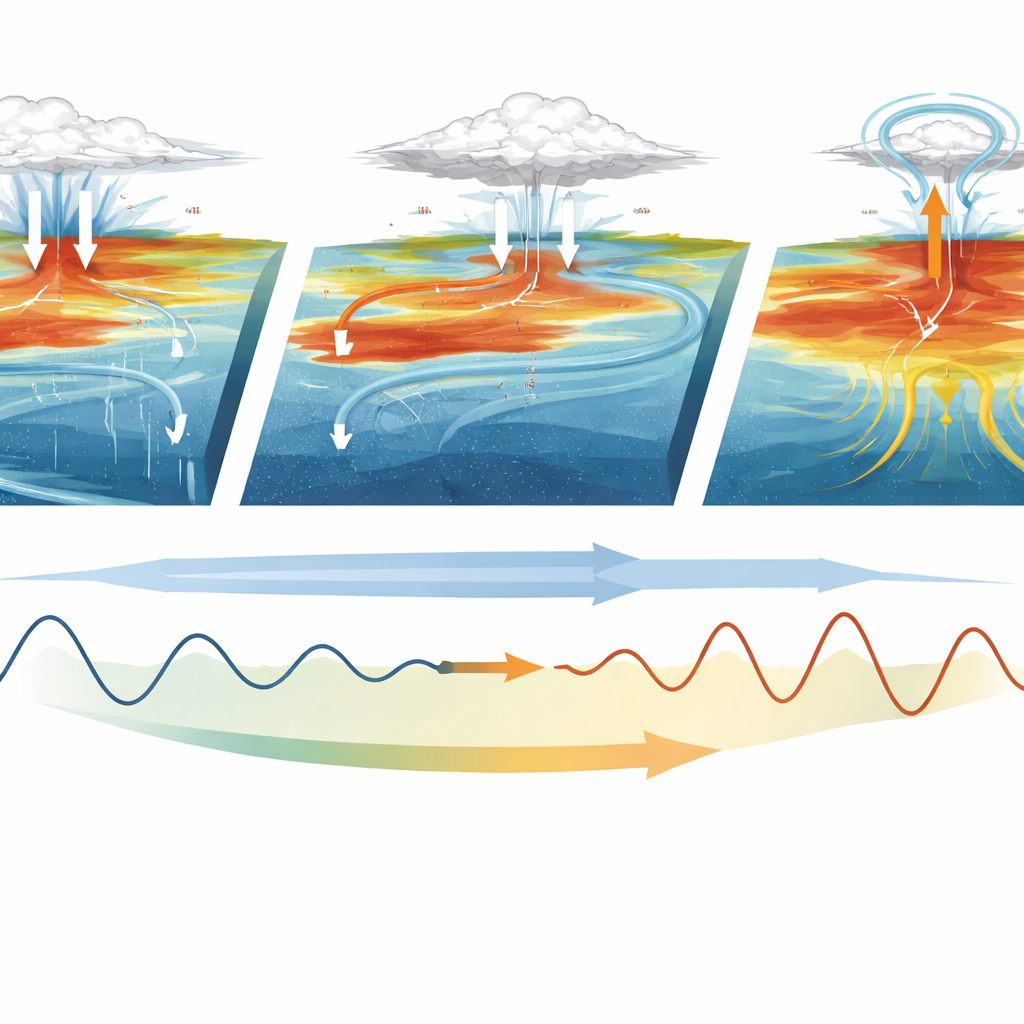
Once global warming pushes beyond about 4 °C, the system changes character. The model’s tropical Pacific gradually loses its sharp east‑west temperature contrast, and the persistent cold tongue in the east weakens or even collapses. At the same time, the band of rising air and heavy rain that usually sits north of the equator slides toward the equator itself. Surface air flows, which once diverged at the equator over the eastern Pacific, begin to converge there instead. This reorganization makes it easier for the ocean to flush excess heat away from the equator after an El Niño‑like warming. As a result, individual ENSO events are more aggressively cut off: their temperature swings become smaller, and the typical period shrinks from about four years to only two or three. Central‑Pacific‑focused La Niña events become relatively more common than extreme El Niño events, flipping the previous warm‑event bias.
Clues from the inner workings and other models
To understand the mechanism, the authors examine how heat builds up and is discharged in the tropical Pacific. In a warmer world, the time lag between changes in subsurface heat content and surface temperatures shortens markedly. Twin swirling wind patterns on either side of the equator—key to draining heat away from the central Pacific—grow stronger and more symmetric between hemispheres once the background atmosphere starts converging at the equator. Theory shows that this faster “recharge–discharge” cycle naturally produces higher‑frequency, lower‑amplitude oscillations. Importantly, when the researchers look across a dozen other climate models run to 2300 under high‑emissions scenarios, most also show ENSO events becoming less intense and more frequent as the eastern Pacific atmosphere shifts from divergence to convergence, lending weight to the single‑model findings.
What this future means for people
For a layperson, the bottom line is that pushing the climate into very high warming levels does not simply give us endlessly stronger El Niño events. Instead, the Pacific appears likely to move toward a regime of more frequent but milder swings, strongly influenced by central‑Pacific events. That may sound like good news, but it comes with new challenges: rapid‑fire, smaller events can still drive serious floods, droughts, and heat waves, and they may be harder to predict and plan for. The study highlights that both the background state of the Pacific and the character of ENSO itself may transform in a high‑warming world—underscoring the need to limit long‑term warming and to design prediction systems that can cope with a climate whose heartbeat is changing.
Citation: Hayashi, M., Yokohata, T., Shiogama, H. et al. Unraveling non-monotonic responses of the El Niño–Southern Oscillation to post-2100 global warming. npj Clim Atmos Sci 9, 84 (2026). https://doi.org/10.1038/s41612-026-01375-y
Keywords: El Niño–Southern Oscillation, tropical Pacific, global warming, climate variability, future climate projections