Clear Sky Science · en
Pacific and Atlantic teleconnections reduce uncertainty in multidecadal projections of the South American Summer Monsoon
Why this matters for people and nature
The South American Summer Monsoon brings most of the rainy season water to the Amazon and surrounding regions, shaping rivers, forests, farms, and cities. Yet scientists still struggle to say how this vital rain system will change over the next few decades. This study explains how slow swings in the Pacific and Atlantic Oceans affect the monsoon and shows a way to cut the uncertainty in future rainfall projections by about one third.
Tracing the heartbeat of a giant rain system
To understand how the monsoon behaves over many decades, the authors assembled a long record stretching back to 1850. Instead of relying only on modern rain gauges and weather models, they combined many clues: tree rings, ice cores from high mountains, river levels, historical documents, and instrumental records. Using a statistical approach that blends these data into an ensemble of 1500 possible histories, they built a robust index of how strong the summer rains were across the core monsoon region of tropical South America. This reconstruction shows clear multidecadal swings, with a strengthening into the mid twentieth century followed by a gradual weakening.
Ocean patterns that tug on the monsoon
Next, the team asked what drives these slow ups and downs. They compared the reconstructed monsoon record with sea surface temperatures and wind patterns over the last century. A strong link emerged with a Pacific-wide pattern known as the Interdecadal Pacific Oscillation, along with changes in the Pacific Walker circulation, a broad loop of rising and sinking air across the tropics. When the central tropical Pacific is relatively cool and the Walker circulation is stronger, air rises more readily over the Amazon and nearby Andes, drawing in moist air from the tropical Atlantic and boosting monsoon rains. When the Pacific flips to a warmer state and the Walker circulation weakens, this engine slows and the monsoon tends to weaken. A temperature contrast in the tropical Atlantic also plays a role, but its influence is smaller and less consistent.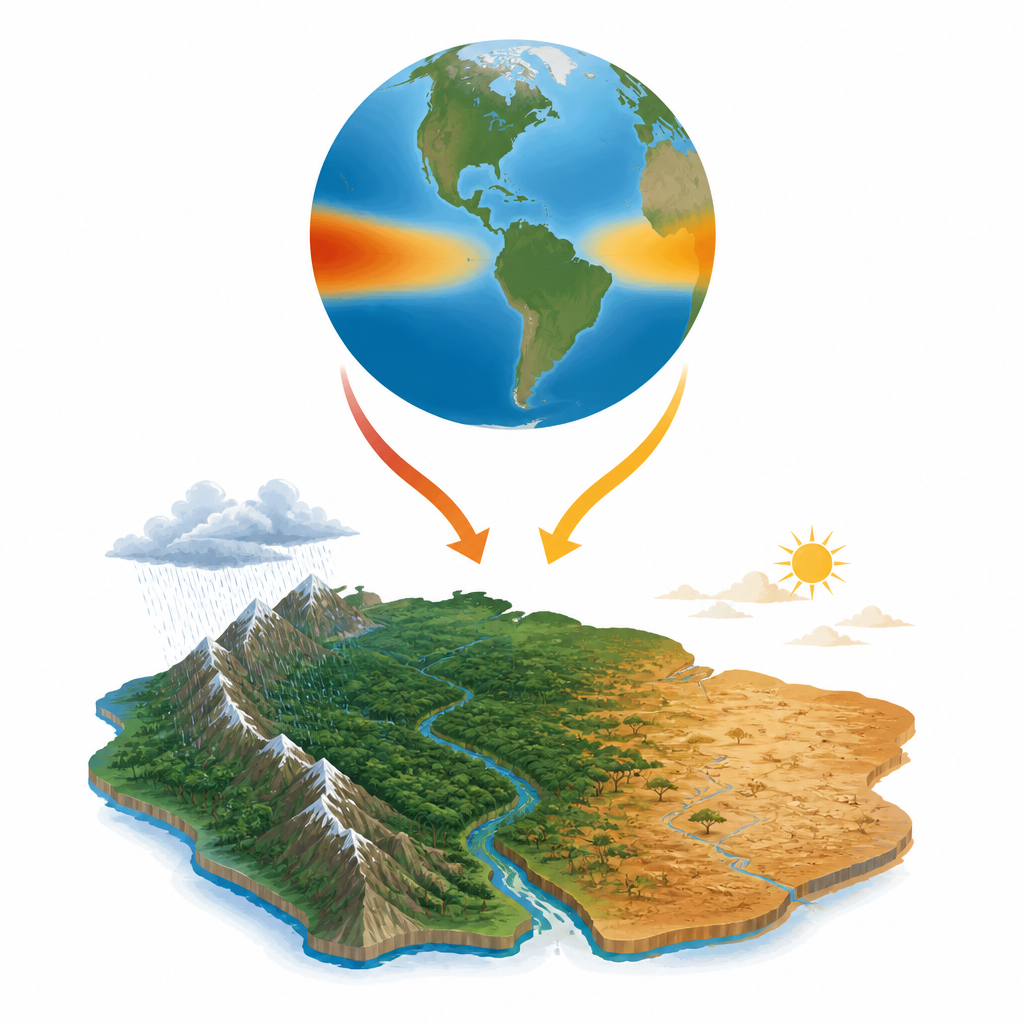
Testing future paths with climate model fleets
To explore what the coming decades might hold, the researchers turned to large collections of climate model runs from two major Earth system models, CESM2 and CanESM5. Each model was run many times with tiny differences in starting conditions, creating ensembles that share the same greenhouse gas pathways but differ in their internal climate variability. Across 100 CESM2 simulations under a high-emissions scenario, the average outcome is a clear weakening of the monsoon and drying across much of the Amazon and tropical Andes by 2044. Yet individual runs vary widely: some show strong drying, others modest wetting in key areas. This spread means that internal climate wiggles can partly mask or amplify the long-term human-driven signal on time scales important for planning.
Pinning down where the uncertainty comes from
By comparing the wettest-future and driest-future members of the ensembles, the authors found that much of the disagreement lines up with Pacific conditions resembling opposite phases of the Interdecadal Pacific Oscillation, along with shifts in the Walker circulation. When the Pacific tends toward a negative phase, with cooler central waters and a stronger east–west overturning of air, the Amazon and Andes are more likely to see wetter trends. A positive phase does the opposite, favoring widespread drying. The team quantified this link by mathematically stripping out the parts of the modelled monsoon trends that are tied to these Pacific patterns. Doing so shrank the statistical spread of future monsoon strength by roughly 30 percent, while removing the Atlantic influence alone made only modest difference. They also showed that if the Pacific were to swing strongly into one phase or the other, the odds of extreme wetting or drying over coming decades would shift dramatically.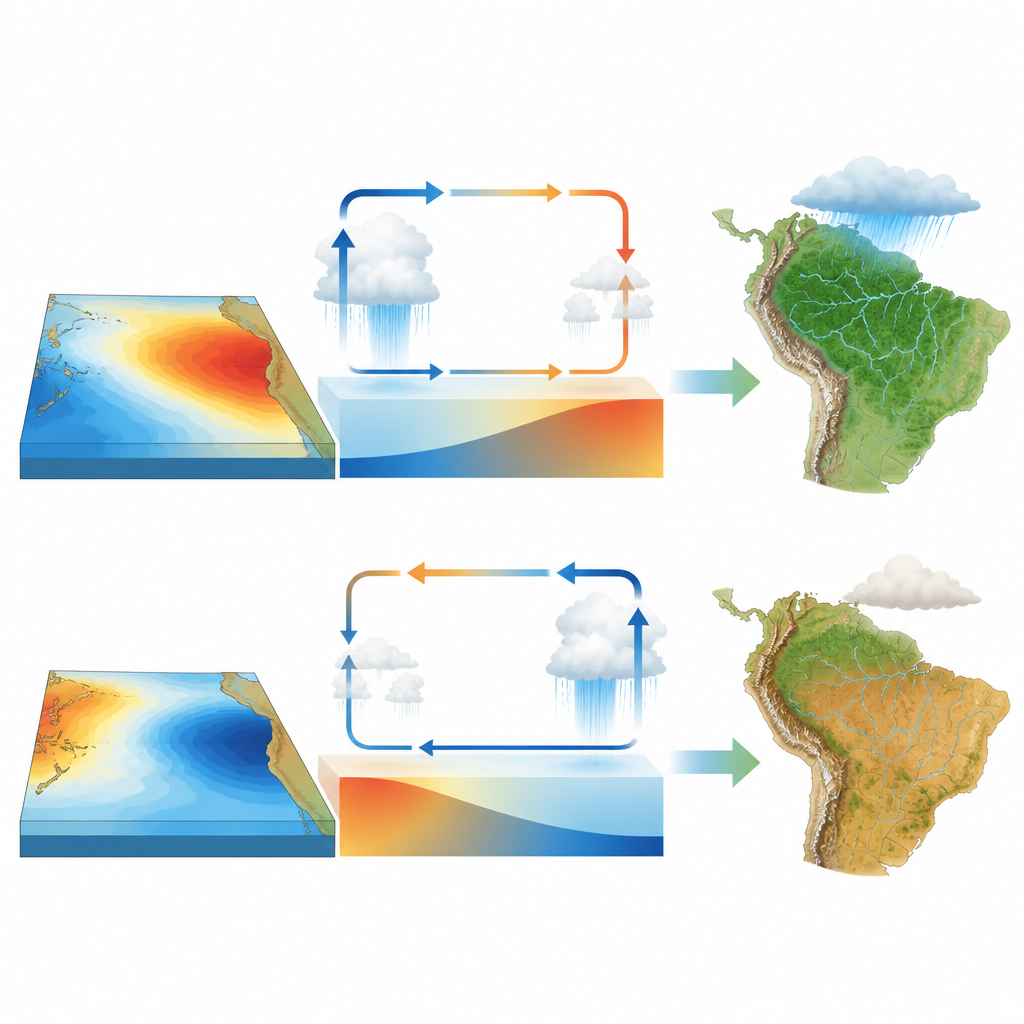
What this means for life under a changing sky
For farmers, city planners, and communities across tropical South America, these findings suggest that some of the uncertainty about future rains can be reduced by better tracking and predicting slow changes in the Pacific Ocean and the linked Walker circulation. Greenhouse gas emissions still push the monsoon toward weakening, but the timing and severity of drying or wetting will depend strongly on which way these natural ocean cycles swing. Improving how climate models simulate and initialize Pacific variability could therefore provide more reliable guidance on future river flows, flood and drought risks, and the resilience of the Amazon and surrounding ecosystems.
Citation: Lyu, Z., Shi, F., Yang, Y. et al. Pacific and Atlantic teleconnections reduce uncertainty in multidecadal projections of the South American Summer Monsoon. npj Clim Atmos Sci 9, 111 (2026). https://doi.org/10.1038/s41612-026-01373-0
Keywords: South American Summer Monsoon, Amazon rainfall, Interdecadal Pacific Oscillation, Pacific Walker circulation, climate variability