Clear Sky Science · en
Decadal-scale thermal memory of permafrost and climatic and topographic modulation on the Tibetan Plateau
Why the Ground Remembers Past Warm Years
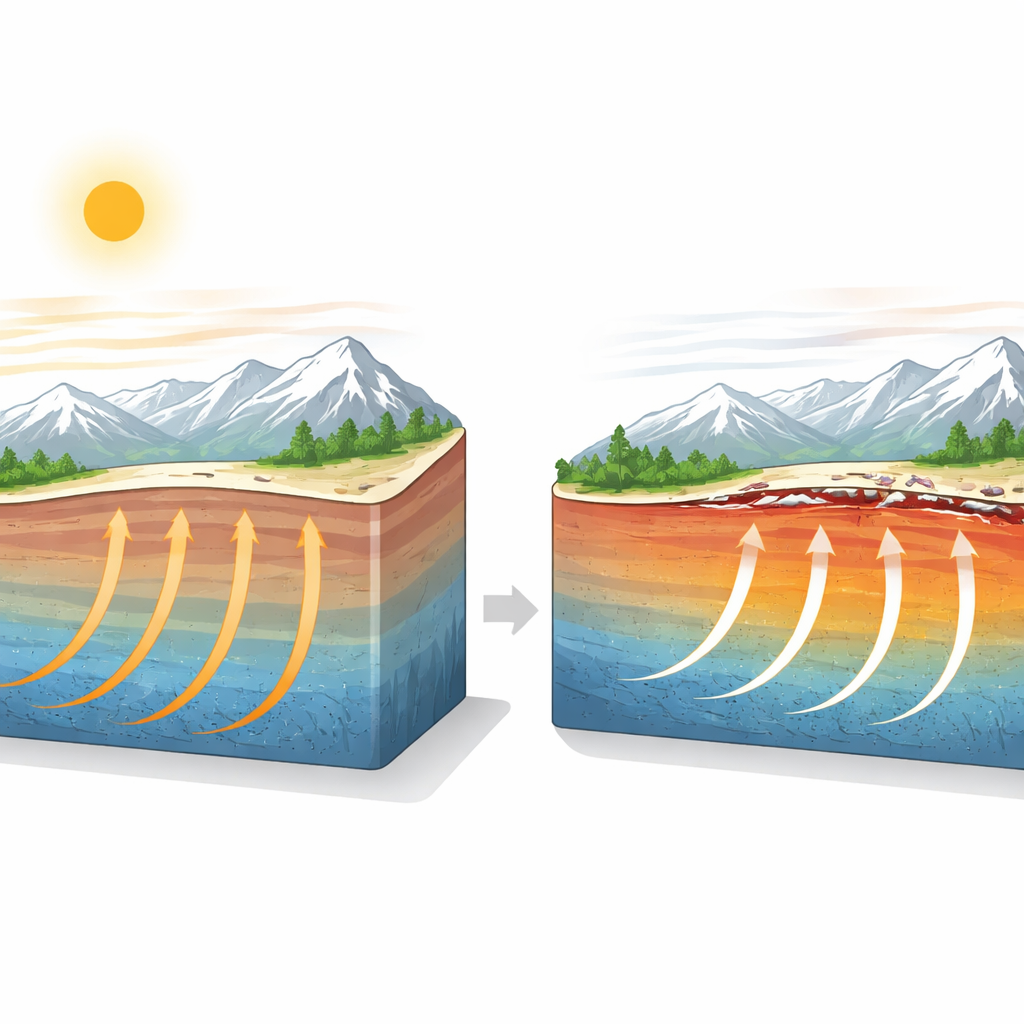
On the Tibetan Plateau, some of the world’s highest mountains hide a slow-moving climate story beneath their surface. Even as weather stations show that air temperatures have recently warmed more slowly, the frozen ground below continues to heat up and thaw. This study asks a deceptively simple question with big consequences: how long does permafrost "remember" past warmth, and what controls that memory?
A Hidden Time Lag in the Frozen Ground
The researchers analyzed 20 years of temperature and thaw-depth measurements from 54 boreholes spread across the central Tibetan Plateau, combined with a detailed climate dataset going back to 1981. They found a clear mismatch between what happens in the air and what happens underground. While air temperatures and other climate factors, such as wind and sunlight, showed a slowdown or even slight decline in warming after the mid‑2000s, the permafrost kept degrading. The seasonally thawed "active layer" continued to deepen, and temperatures several meters below the surface kept rising.
Measuring Permafrost’s Long Memory
To capture this mismatch, the team treated permafrost like a system with memory: instead of reacting instantly to each warm or cold year, it slowly integrates the effects of many years of surface conditions. They compared long-term trends in air temperature with changes in four underground indicators: the thickness of the active layer and temperatures at the top of the permafrost and at depths of 10 and 15 meters. Using statistical tools that track how well past air temperatures line up with later changes underground, they found a typical delay of about 8–11 years across the region. In other words, the state of the frozen ground today most strongly reflects the climate from roughly a decade ago.
How Climate, Landscape, and Soil Shape the Delay
This delay is not the same everywhere. In the cold, dry northwest of the study area, permafrost responds more slowly, with delays of 12–15 years. In the warmer, wetter southeast, the delay shrinks to around 6–8 years. The study shows that broad climate conditions explain about one-third to one-half of these regional differences, with air pressure and rainfall emerging as key statistical markers of where long memories are strongest. Local factors matter too. Steep or rough terrain, soil moisture, and vegetation change how heat and water move at the surface, particularly in the shallow ground where ice repeatedly melts and refreezes. Deeper down, at 10–15 meters, these local quirks fade, and large-scale climate and geography take over as the main controls on how quickly the subsurface adjusts.
Why Shallow and Deep Layers Behave Differently
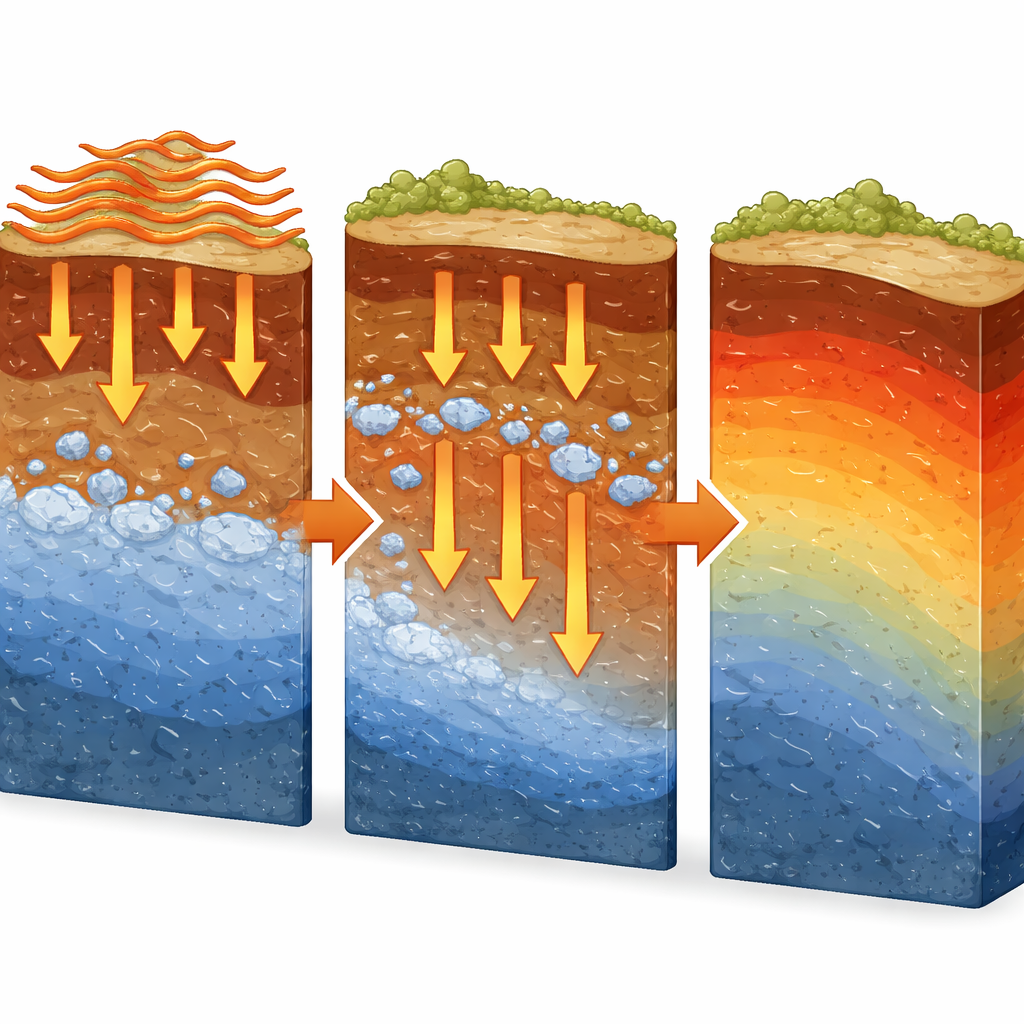
The study also explains why the time lag is actually longer near the top of the permafrost than deeper below. In the upper few meters, much of the extra heat goes into melting ground ice rather than simply raising temperature. This "phase change" acts like a powerful buffer, soaking up energy and stretching out the adjustment period. Vegetation, soil wetness, and microtopography further shuffle heat and moisture around, blurring and delaying the signal from the air. At greater depths, there is much less melting and refreezing, so heat moves mainly by steady conduction. As a result, deep ground temperatures respond more directly to the long-term trend in climate and show a slightly shorter delay and a more consistent pattern over large areas.
What This Means for the Future
By building a simple model that includes this decade-scale memory, the authors show that, even if air temperatures level off, the Tibetan Plateau’s permafrost is likely to keep warming and thawing for at least another decade. The active layer is projected to continue thickening, and deep ground temperatures are expected to remain above recent levels. For society, this means that risks to roads, railways, and buildings on frozen ground, as well as the potential release of long-stored carbon, are already "locked in" for years to come. In plain terms, the ground beneath the plateau is still catching up to past warming, and its slow response ensures that today’s climate choices will shape the stability of this high-altitude frozen landscape well into the future.
Citation: Fu, Z., Wang, L., Jiang, G. et al. Decadal-scale thermal memory of permafrost and climatic and topographic modulation on the Tibetan Plateau. npj Clim Atmos Sci 9, 100 (2026). https://doi.org/10.1038/s41612-026-01368-x
Keywords: permafrost, Tibetan Plateau, climate change, thermal memory, ground thaw