Clear Sky Science · en
A lightweight physics-aware framework for multi-scale marine heatwaves forecasting
Why sudden ocean heat matters to everyone
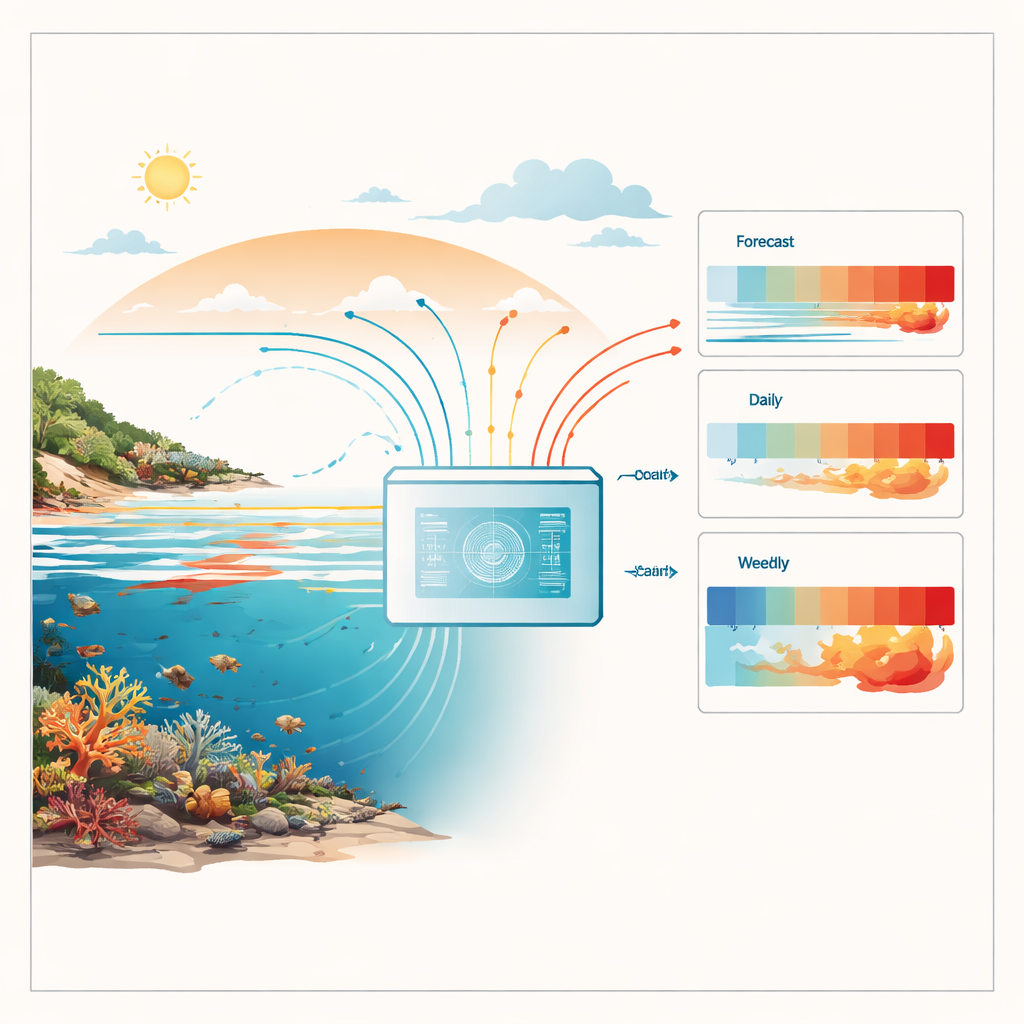
Around the world, stretches of ocean sometimes heat up and stay hot for days, weeks, or even months. These marine heatwaves can bleach coral reefs, disrupt fisheries, and damage coastal economies. Yet most tools for predicting them are either slow, expensive supercomputer models or simple statistical tricks that miss important local details. This paper introduces a new approach, called MARINA, that aims to deliver fast, local, and reliable marine heatwave forecasts across hours, days, and weeks, making early warnings more practical for communities and marine managers.
Hot spots in the sea and why they are hard to predict
Marine heatwaves arise when several weather and ocean conditions line up: clear skies and strong sunlight warm the surface, light winds reduce cooling, and persistent high-pressure systems trap heat near the top of the ocean. These bursts of extreme warmth can lead to coral bleaching, loss of seagrass, fish kills, and cascading changes through marine food webs. Forecasting them is tricky because they depend on fine-scale interactions between air and sea that vary from place to place. Large global simulations can represent the broad climate patterns but tend to smooth out local extremes and are costly to run. Simpler statistical models are cheaper, but they often ignore the physics of how the atmosphere and ocean interact and usually work at just one time scale.
A new lightweight way to blend physics and data
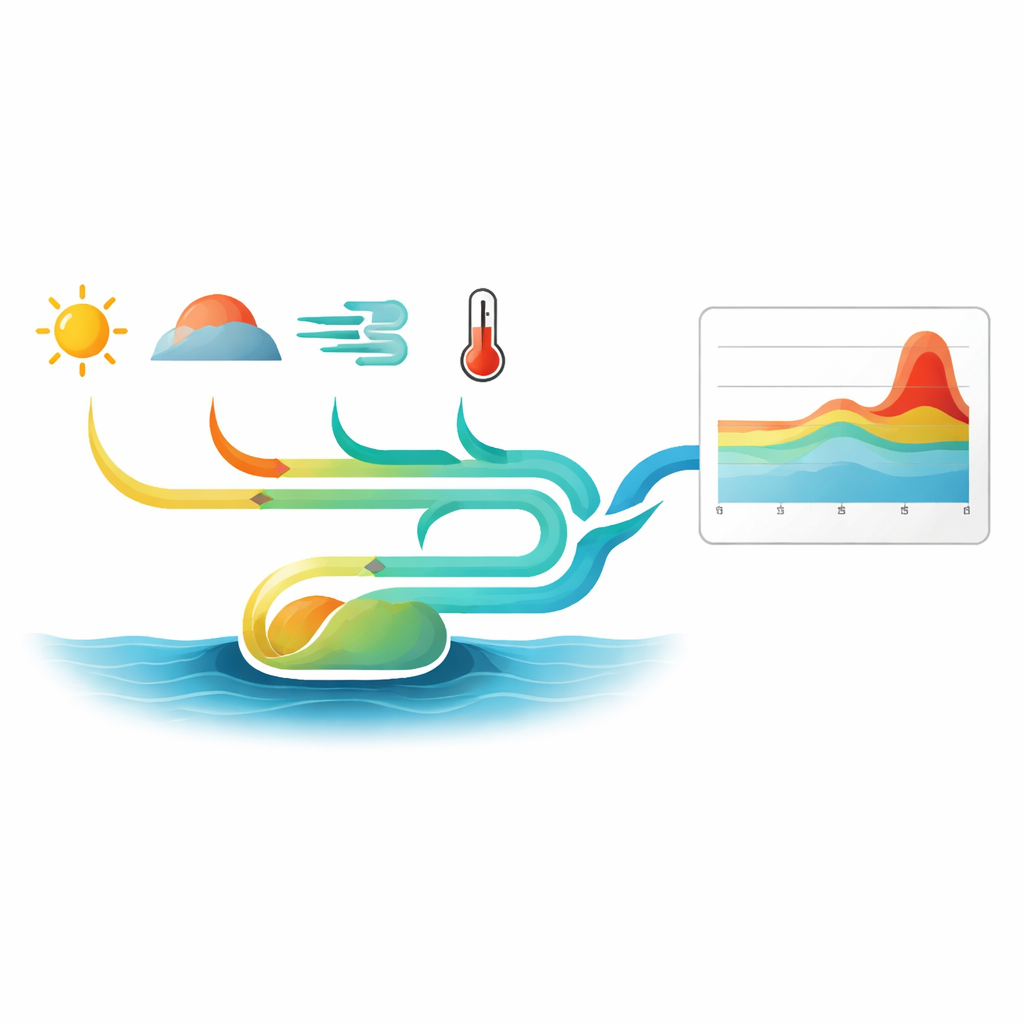
MARINA is designed to bridge this gap by combining physical understanding with data-driven learning in a compact framework. It runs in two stages. First, it searches through combinations of basic weather measurements—such as air temperature, air pressure, wind speed, and sunlight—to discover “interaction factors” that track how these pieces move together to warm or cool the sea surface. This search uses a mix of reinforcement learning and genetic algorithms to build compact formulas that correlate strongly with observed sea surface temperatures and marine heatwave events. Second, MARINA feeds both these learned interaction factors and past temperature records into a dual-branch neural network that predicts future sea temperatures and identifies when they will cross heatwave thresholds.
Looking ahead from hours to weeks
Unlike most existing systems, MARINA is built to work at multiple time steps: hourly, daily, and weekly. The authors assembled a new multi-decade dataset, called MT-MHW, from ten stations along Australia’s Great Barrier Reef, with over three million records that include sea temperature and key weather variables at all three resolutions. Using this dataset, MARINA produced one-week-ahead forecasts that, when averaged in time, effectively give hour, day, and week lead times, respectively. Across three representative reef sites, the model scored highly on standard measures of event detection and temperature accuracy, and it faithfully reproduced important event traits such as duration and intensity. The study also shows that MARINA does more than simply follow the long-term warming trend: when that trend is removed, its skill often improves, meaning it is capturing the higher-frequency swings that matter most for sudden heatwaves.
Beating bigger models at their own game
The authors compared MARINA with a suite of popular time-series methods and with leading global forecast systems from major weather agencies. At all three time scales, MARINA’s predictions of sea surface temperature and heatwave occurrence were more accurate, often with dramatically lower errors. It captured sharp, short-lived spikes seen in local instruments that were nearly invisible in satellite-based global products, highlighting the value of tailored local forecasting. Even at a site with sparse and patchy data, MARINA substantially outperformed global models. Notably, its neural network structures were not hand-crafted; instead, a large language model was used during training to explore many design options and select efficient architectures. The final system can run on a single modern graphics card, cutting computation time by orders of magnitude compared with traditional physics-heavy simulations.
What this means for protecting coasts and reefs
In plain terms, this work shows that it is possible to build a lean forecasting tool that “understands” the physics well enough to rival or beat far more expensive climate models, while providing fine-grained guidance from hourly to weekly views. For reef managers, aquaculture operators, and coastal planners, MARINA and the MT-MHW dataset point toward a future where site-specific marine heatwave warnings can be generated quickly and affordably, even in regions with limited computing resources. With further extensions to include more ocean variables and other regions, similar physics-aware statistical systems could support early warnings for a wide range of extreme ocean and weather events.
Citation: Su, X., Wu, Y., Wu, Z. et al. A lightweight physics-aware framework for multi-scale marine heatwaves forecasting. npj Clim Atmos Sci 9, 104 (2026). https://doi.org/10.1038/s41612-026-01367-y
Keywords: marine heatwaves, climate forecasting, Great Barrier Reef, ocean warming, data-driven climate models