Clear Sky Science · en
Precessional modulation of ENSO strength and spatial structure in a transient CGCM simulation of the past 3 million years
Why distant wobbles in Earth’s path matter today
El Niño and La Niña, the swings of the El Niño–Southern Oscillation (ENSO), can flood some regions, parch others, and shake the global economy. This study asks a deceptively simple question with big implications: how have slow, predictable changes in Earth’s orbit around the Sun shaped ENSO over the past three million years, and what does that tell us about its future in a warming world? Using a powerful climate model run continuously across ice ages and warm periods, the authors show that subtle shifts in when Earth is closest to the Sun can strongly modulate how intense ENSO becomes and where its warmest waters sit in the Pacific.
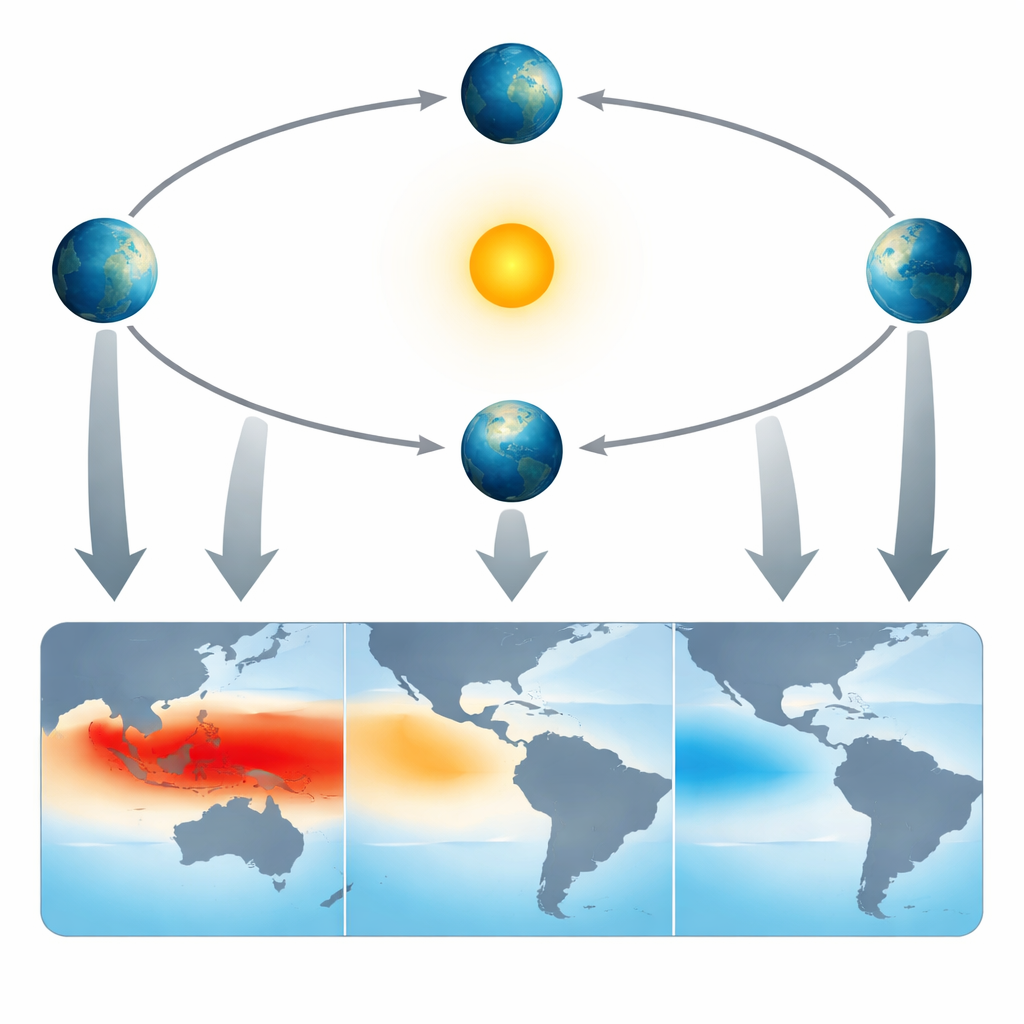
How Earth’s slow wobble steers a restless ocean
Earth’s orbit is not a perfect circle, and over tens of thousands of years the point of closest approach to the Sun drifts through the seasons, a change known as precession. The authors use a coupled atmosphere–ocean model to simulate climate over the last three million years while these orbital parameters, greenhouse gases, and ice sheets all evolve. In their analysis, they focus on how ENSO’s year‑to‑year temperature swings in the tropical Pacific vary in strength and in longitude. They find that among the different orbital cycles, precession stands out: the roughly 19–23‑thousand‑year wobble in the timing of seasons dominates long‑term changes in both how strong ENSO becomes and where in the Pacific its center of action sits.
When winter sun supercharges El Niño–like behavior
The simulations reveal that ENSO is not equally sensitive to all precession configurations. When Earth is closest to the Sun during Northern Hemisphere winter, the model produces the largest boost in ENSO variability, with stronger warm and cool events spanning much of the central and eastern equatorial Pacific. This setup favors an El Niño–like background: the eastern Pacific surface waters are relatively warmer than usual, and the major tropical rainbands over the Pacific become wetter and shift closer to the equator. In that state, even modest temperature anomalies can more easily trigger deep thunderstorms, alter winds, and feed back on the ocean, sharply amplifying ENSO swings. By contrast, when Earth’s closest approach falls in Northern Hemisphere summer, the background pattern looks more La Niña–like, rainbands weaken, and ENSO responds only weakly to the orbital forcing.
How rainbands nudge El Niño east or west
Precession also affects the longitude where ENSO’s strongest temperature anomalies occur. When perihelion aligns with the Northern Hemisphere spring equinox, the model shows a modest eastward shift of ENSO activity from the central to the eastern Pacific. This shift is tied to an imbalance between two key tropical rainbelts: the South Pacific Convergence Zone tends to strengthen and moisten, while its northern counterpart weakens. That north–south contrast in rainfall reorganizes winds and surface currents so that warm water is more effectively transported eastward, nudging ENSO’s center closer to the Americas. In the opposite equinox configuration, these rainband changes nearly cancel one another, and ENSO’s position shifts much less. Throughout, the authors highlight that the pattern of sea‑surface warming and the location of the rainbands are more important than the global average temperature itself.
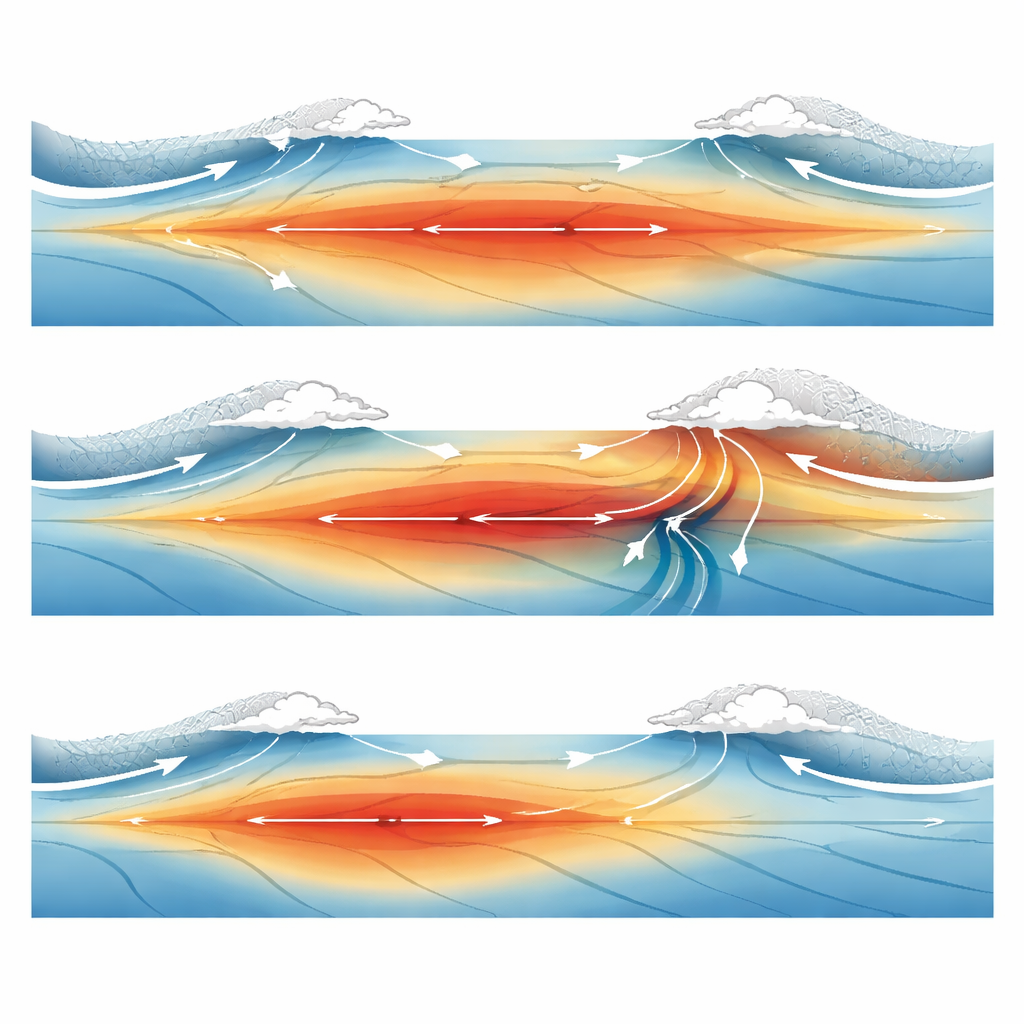
Long‑term trends: a stronger link toward the present
Although ENSO remains active across the entire three‑million‑year simulation, its sensitivity to orbital forcing has changed over time. The model suggests that precession’s grip on ENSO strengthened during the Quaternary period, especially over the last 1.5 million years. This growing influence is traced to a slow intensification of the South Pacific rainband as greenhouse gases declined and large ice sheets grew in the Northern Hemisphere, subtly warming and moistening the tropical South Pacific relative to the north. In effect, the background climate gradually became more primed for precession to imprint on ENSO, so that the ups and downs in ENSO strength more closely follow the waxing and waning of orbital eccentricity that controls how strong precession forcing can be.
What this means for understanding future climate
For non‑specialists, the key takeaway is that ENSO is not just a random quirk of the modern climate; it has been shaped for millions of years by slow, predictable changes in Earth’s orbit that alter where and when the tropical Pacific is warmest and stormiest. The study shows that when the Pacific’s background state resembles an El Niño‑like pattern, ENSO becomes stronger and its impacts more pronounced, and that the exact placement of tropical rainbands can subtly shift where El Niño unfolds. Because human‑driven greenhouse warming is also expected to favor El Niño‑like sea‑surface patterns and altered rainbelts, these long‑term insights help scientists judge whether current models are capturing the right physics and how ENSO’s risks may evolve in the centuries ahead.
Citation: Liu, C., An, SI., Yun, KS. et al. Precessional modulation of ENSO strength and spatial structure in a transient CGCM simulation of the past 3 million years. npj Clim Atmos Sci 9, 87 (2026). https://doi.org/10.1038/s41612-026-01355-2
Keywords: El Niño–Southern Oscillation, orbital precession, tropical Pacific climate, paleoclimate modeling, South Pacific Convergence Zone