Clear Sky Science · en
Effects of pneumatic tube systems on next-generation viscoelastic coagulation test devices in septic patients and healthy individuals: Results of the randomized controlled VETaPT trial
Why this matters for emergency care
In emergencies such as major bleeding or severe infections, doctors need to know very quickly whether a patient’s blood can still form stable clots. Many hospitals use high-speed pneumatic tube systems to rush blood samples from wards to laboratories. This study asks a simple but crucial question: does shooting blood through those tubes change the test results that guide life-saving decisions, especially in patients with sepsis?
Fast blood checks at the bedside
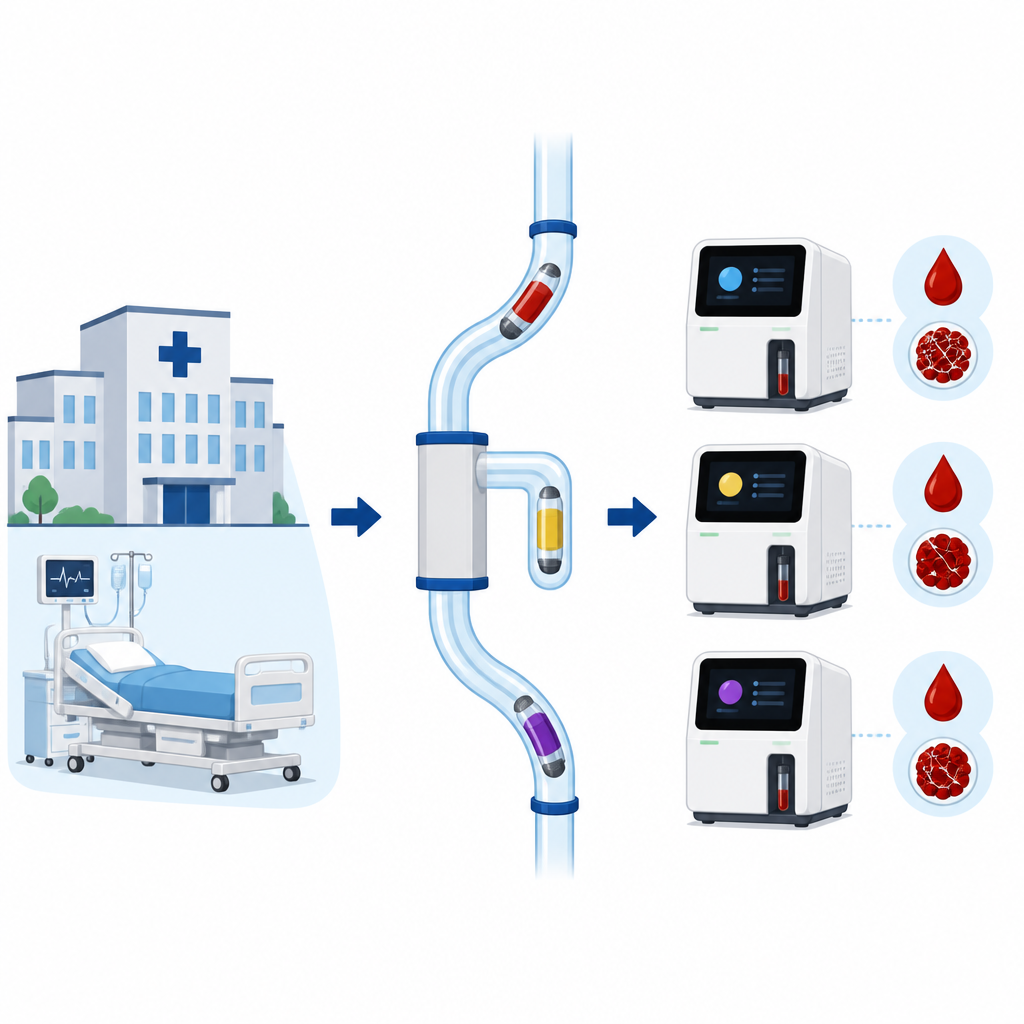
Modern point-of-care blood clot tests can be run close to the patient and give a more complete picture of clot formation than traditional lab checks. They show how quickly a clot starts, how strong it becomes, and how long it lasts, and can also estimate how well platelets are working. These tools help doctors tailor transfusions and clotting drugs instead of relying on one-size-fits-all protocols. Because time is critical, many hospitals send samples by pneumatic tube to wherever these devices are located, raising concerns that the bumps and acceleration might subtly damage cells or proteins and mislead the tests.
How the trial was set up
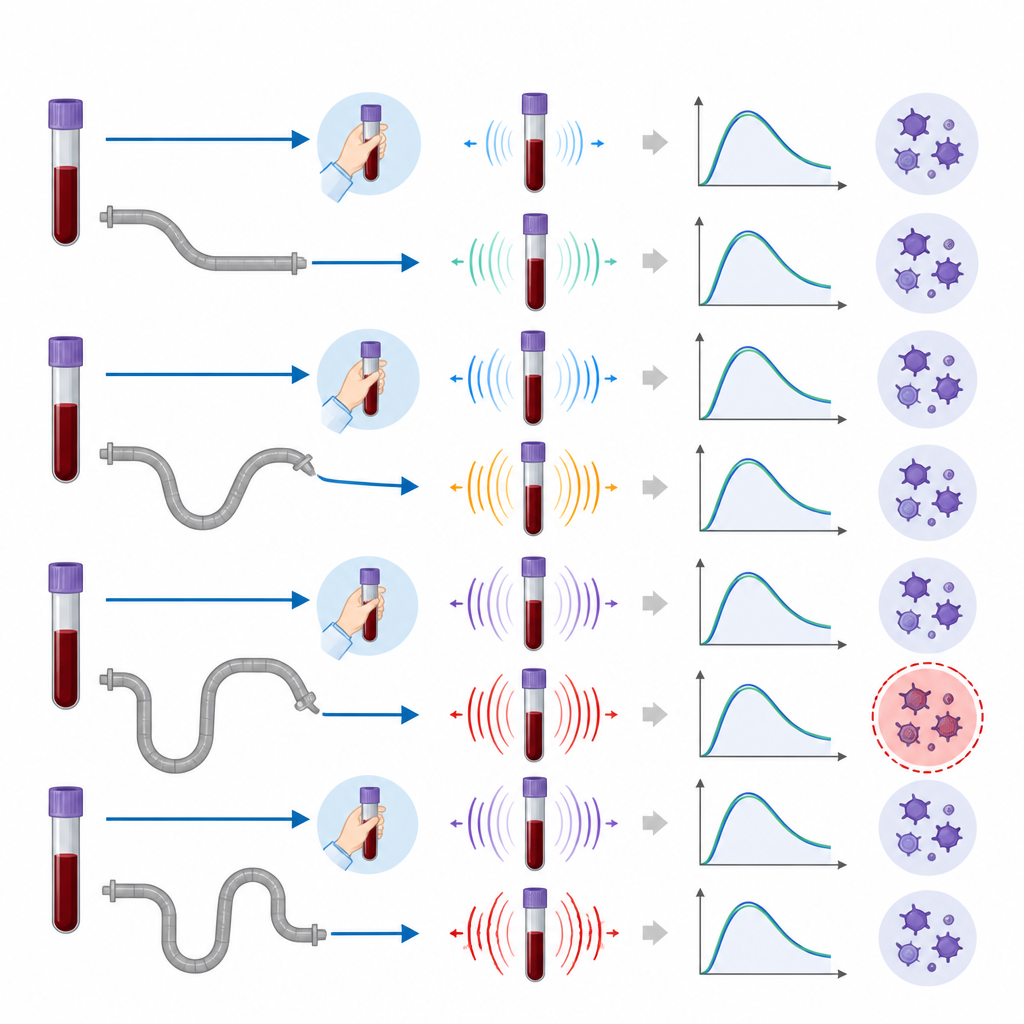
The VETaPT trial enrolled 46 healthy volunteers and 45 critically ill patients with sepsis who were already receiving blood thinners in intensive care. For each person, the team drew blood into identical tubes and randomly sent one tube by hand and the other through a hospital pneumatic tube system. During tube transport, a small three-axis sensor measured how strong and how long the acceleration forces were. The samples were then tested on several next-generation clotting and platelet devices, including viscoelastic analyzers and platelet function tests, under the same laboratory conditions and similar times from draw to analysis.
What the researchers measured
The main goal was to see whether results after tube transport differed meaningfully from those after hand delivery. The team focused on key numbers such as clotting time, how fast the clot grew, how firm it became, and how quickly it dissolved, as well as how strongly platelets responded to common activators. They first used statistical models to check whether stronger acceleration during tube travel made clinically important changes more likely. When these models showed no clear relationship, they turned to equivalence testing, a method that asks whether any differences are small enough to sit within the normal day-to-day variation already expected from the devices themselves.
What they found in healthy people and in sepsis
Across most devices and settings, results from tube-transported samples matched those from hand-carried samples within predefined acceptable limits. In healthy volunteers, every measured variable met strict equivalence criteria, suggesting that tubing the samples did not add any meaningful disturbance beyond routine test noise. In septic patients, who often have more fragile clotting systems, small shifts appeared in some clotting times and clot strengths, but these stayed within clinically acceptable margins for the main devices. Only a subset of values on one platelet mapping system showed larger variability after tube transport, hinting that this specific method is more sensitive to mechanical stress and should be interpreted with care.
What this means for hospitals
The study supports the idea that, for most modern clot and platelet tests, hospitals can safely use pneumatic tube systems without undermining the reliability of results, even in very sick patients with sepsis. While one specialized platelet mapping approach appears more vulnerable to motion, the overall picture is reassuring: fast sample transport and fast decision-making can go hand in hand. For patients, this means their doctors can rely on these rapid tests to guide treatment, without having to choose between speed and accuracy.
Citation: Mirus, M., Buehrer, E., Tiebel, O. et al. Effects of pneumatic tube systems on next-generation viscoelastic coagulation test devices in septic patients and healthy individuals: Results of the randomized controlled VETaPT trial. Sci Rep 16, 16587 (2026). https://doi.org/10.1038/s41598-026-54938-7
Keywords: pneumatic tube system, viscoelastic testing, sepsis, platelet function, point-of-care coagulation