Clear Sky Science · en
Fano-resonant hybrid Metasurface for Carbon Dioxide sensing at telecommunication wavelengths
Why shrinking CO₂ sensors matters
Carbon dioxide is more than a climate headline; it also affects the air in our homes, offices, and factories, and can even help flag spoiled food. Today’s CO₂ detectors are often bulky or hard to integrate into the tiny optical chips that route internet data. This paper presents a new way to build a very small, low-cost CO₂ sensor that works at the same wavelengths used in fiber-optic communication, pointing toward smart, chip-scale monitors for air quality and industrial systems.

A tiny patterned surface that tames light
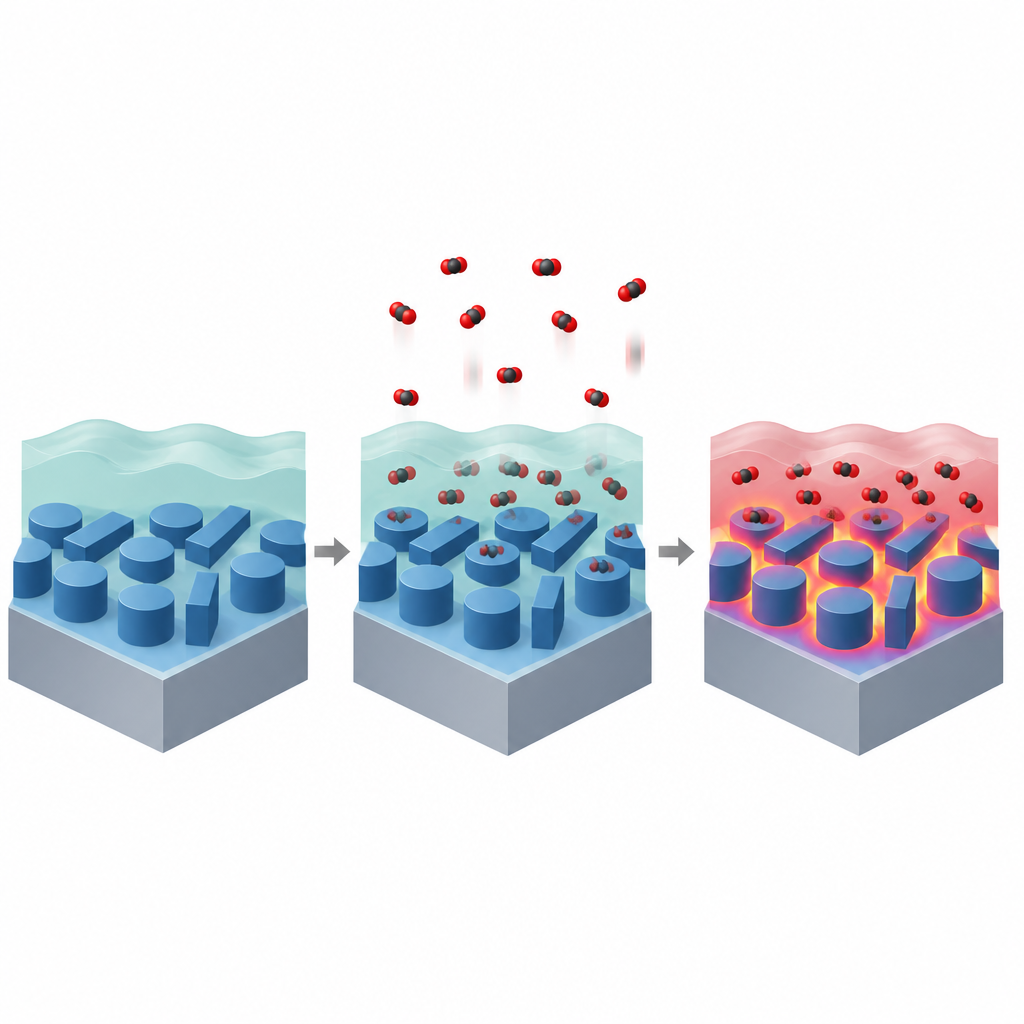
At the heart of the device is a metasurface, a flat chip covered with a carefully arranged pattern of silicon nanostructures. These are tiny disks and bars, hundreds of nanometers across, that act like miniature antennas for light. When light at a specific color hits this pattern, the disk and bar interact in a way that creates a very sharp spectral feature known as a Fano resonance, which shows up as a narrow dip and peak in the reflected light. Because the metasurface is made entirely from silicon on glass, it avoids the energy losses common in metal-based designs and is compatible with standard chip manufacturing.
A smart coating that grabs CO₂
To make the metasurface respond specifically to CO₂, the authors coat and fill the gaps between the silicon nanostructures with a polymer called polyhexamethylene biguanide, or PHMB. This material contains chemical groups that react reversibly with CO₂ at room temperature and normal pressure, forming charged complexes inside the film. When CO₂ molecules are taken up, the way electrons are distributed in the polymer changes, which in turn slightly alters its refractive index, a measure of how strongly it bends light. Because the optical field of the Fano resonance is tightly concentrated in the PHMB-filled gaps, even tiny index changes from small CO₂ concentration shifts can noticeably move the resonance wavelength.
Tuning the geometry for sharp and sensitive signals
The researchers use computer simulations to fine-tune the layout of the disk and bar, especially the small gap between them. By breaking the symmetry between the two gaps, they encourage a “dark” mode of the structure that does not radiate strongly to the outside but couples to a “bright” mode that does. This interplay strongly suppresses energy loss as simple radiation and produces an extremely sharp resonance at around 1.55 micrometers, a key telecommunication wavelength where both silicon and PHMB are nearly transparent. For an optimized gap size, they obtain a quality factor on the order of eighty thousand, meaning the resonance is both narrow and stable, while still showing a useful change in reflected light when conditions vary.
How CO₂ levels shift the light
Using measured data that link CO₂ concentration to PHMB refractive index, the team models how the resonance wavelength shifts as more gas is absorbed. As CO₂ increases, the index of the polymer decreases slightly, leading to a blue shift of the resonance. Around a practical concentration range of a few hundred parts per million, the design reaches a wavelength sensitivity of about 45 picometers per ppm of CO₂, equivalent to roughly 212 nanometers per unit change in refractive index. By adjusting the thickness of the PHMB layer, they further boost the interaction between the guided light and the polymer, raising the refractive-index sensitivity up to 312 nanometers per refractive-index unit, while a figure-of-merit of 12,500 indicates a very favorable combination of sharpness and responsiveness.
Balancing speed, robustness, and practicality
Thicker polymer layers improve sensitivity but slow the time it takes CO₂ to diffuse in and out, and can make it harder to fully reset the sensor between measurements. The authors discuss this trade-off using diffusion models and previous experiments, estimating response times from under a minute to a few minutes depending on thickness. They also compare their design with other optical gas sensors, including metal-based metasurfaces and mid-infrared devices matched to CO₂ absorption lines. While some alternatives achieve higher raw sensitivity, they often suffer from higher losses, bulkier setups, or less compatibility with integrated photonic circuits. The all-silicon, PHMB-coated metasurface stands out for its combination of high quality factor, strong selectivity, and operation at standard telecom wavelengths.
What this means for everyday sensing
In simple terms, the work shows how a flat, silicon-based chip coated with a CO₂-loving polymer can turn tiny changes in gas concentration into precise color shifts of light. Because the sensor operates at the same wavelengths already used to carry data through optical fibers, it can, in principle, be built into compact photonic circuits for smart buildings, industrial safety, or environmental monitoring. With its high sensitivity, low loss, and straightforward fabrication, this metasurface approach offers a promising path toward dense networks of CO₂ sensors that could one day help track and manage the air we live and work in.
Citation: Salama, N.A., Swillam, M.A. Fano-resonant hybrid Metasurface for Carbon Dioxide sensing at telecommunication wavelengths. Sci Rep 16, 16138 (2026). https://doi.org/10.1038/s41598-026-53746-3
Keywords: carbon dioxide sensing, metasurface sensor, telecommunication wavelength, silicon photonics, PHMB polymer