Clear Sky Science · en
Protective effects of colorless carotenoid precursors against UV-induced lipid oxidation in liposomes compared to lycopene
Tomatoes, sunlight and hidden helpers
Many people know tomatoes are healthy, but few realize that some of their most interesting ingredients are actually invisible. This study explores how colorless tomato pigments may help protect fats in our bodies from damage caused by ultraviolet (UV) light, the same type of radiation in sunshine that can harm skin and other tissues. By zooming in on tiny fat bubbles in a lab, the researchers compared two little-known colorless compounds, phytoene and phytofluene, with the better known red pigment lycopene to see which ones really shield fats from UV attack.
Why invisible pigments matter
Tomatoes and other colorful fruits are packed with carotenoids, a family of plant molecules that can soak up light and neutralize aggressive oxygen compounds. Lycopene gives ripe tomatoes their red color, but it is made from earlier, colorless building blocks called phytoene and phytofluene. These precursors are common in many foods, including apricots and papayas, and they show up in human skin, lungs, liver and other organs. Previous nutrition studies suggested that whole tomato extracts, which contain all three pigments, protect skin better from sun-induced redness than lycopene alone. This raised an important question: are these pale precursors quietly contributing to the protective effect, and if so, how?
Testing protection in tiny fat bubbles
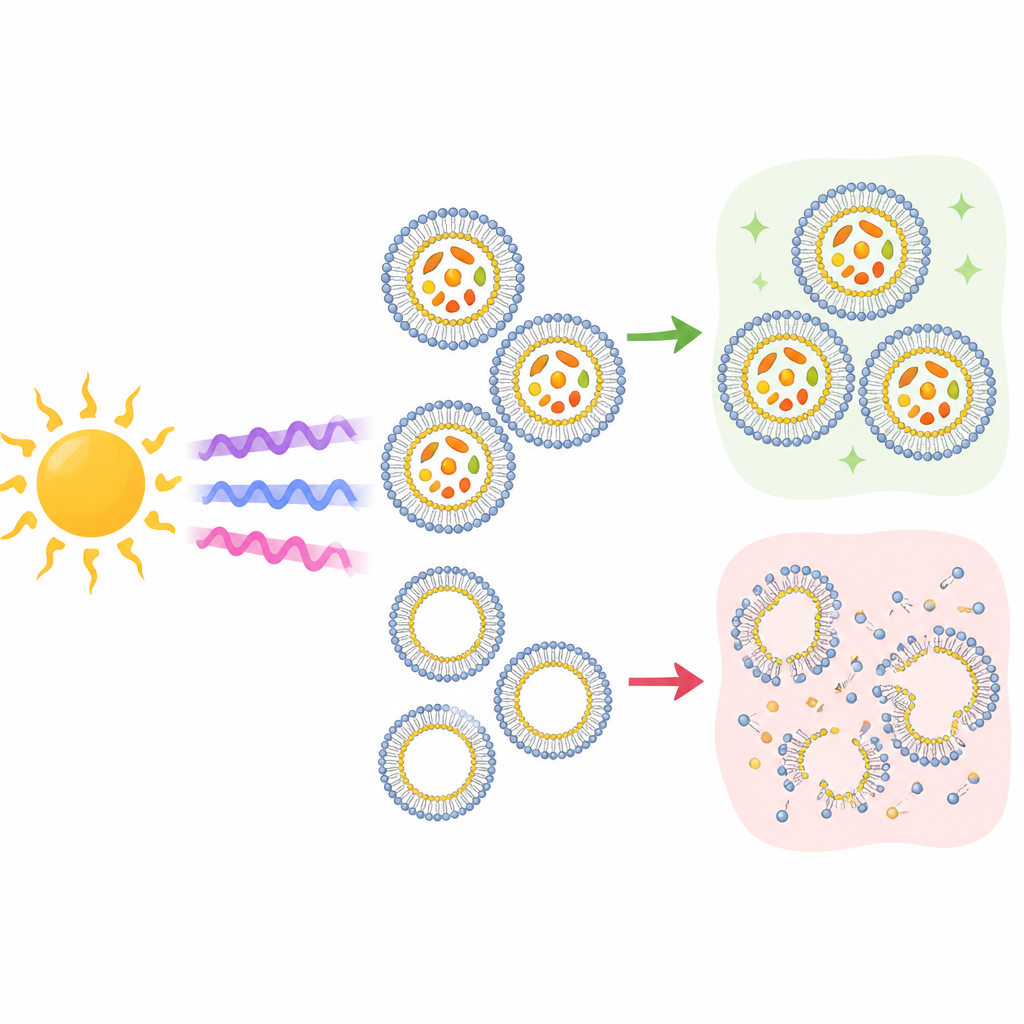
To answer this, the researchers isolated phytoene and phytofluene from tomato powder and added them, or lycopene, to liposomes, which are microscopic bubbles made of fats similar to those in cell membranes. They then exposed these bubbles to three kinds of UV light: short-wave UV-C, medium UV-B and longer-wave UV-A. UV exposure makes the fats break down and form malondialdehyde, a small molecule used here as a marker of damage. By measuring how much of this marker appeared in the presence or absence of each pigment, the team could calculate how well each compound slowed fat oxidation. They also tracked how quickly the pigments themselves were broken down during irradiation.
Which tomato compounds actually shield fats
Phytoene turned out to offer clear protection under the harsher UV-C and UV-B conditions. At carefully chosen test levels, it cut fat damage by around one third, performing about as well as lycopene at those shorter wavelengths. However, under UV-A, which penetrates deeper into skin, phytoene offered no protection at all, while lycopene reduced damage by about two thirds. This pattern matches how these molecules absorb light: phytoene is better tuned to soak up higher energy UV-C and UV-B, whereas lycopene has a more extended electronic structure that not only absorbs some light but also stabilizes the reactive fragments produced when oxygen attacks fats.
When a plant compound turns from shield to risk
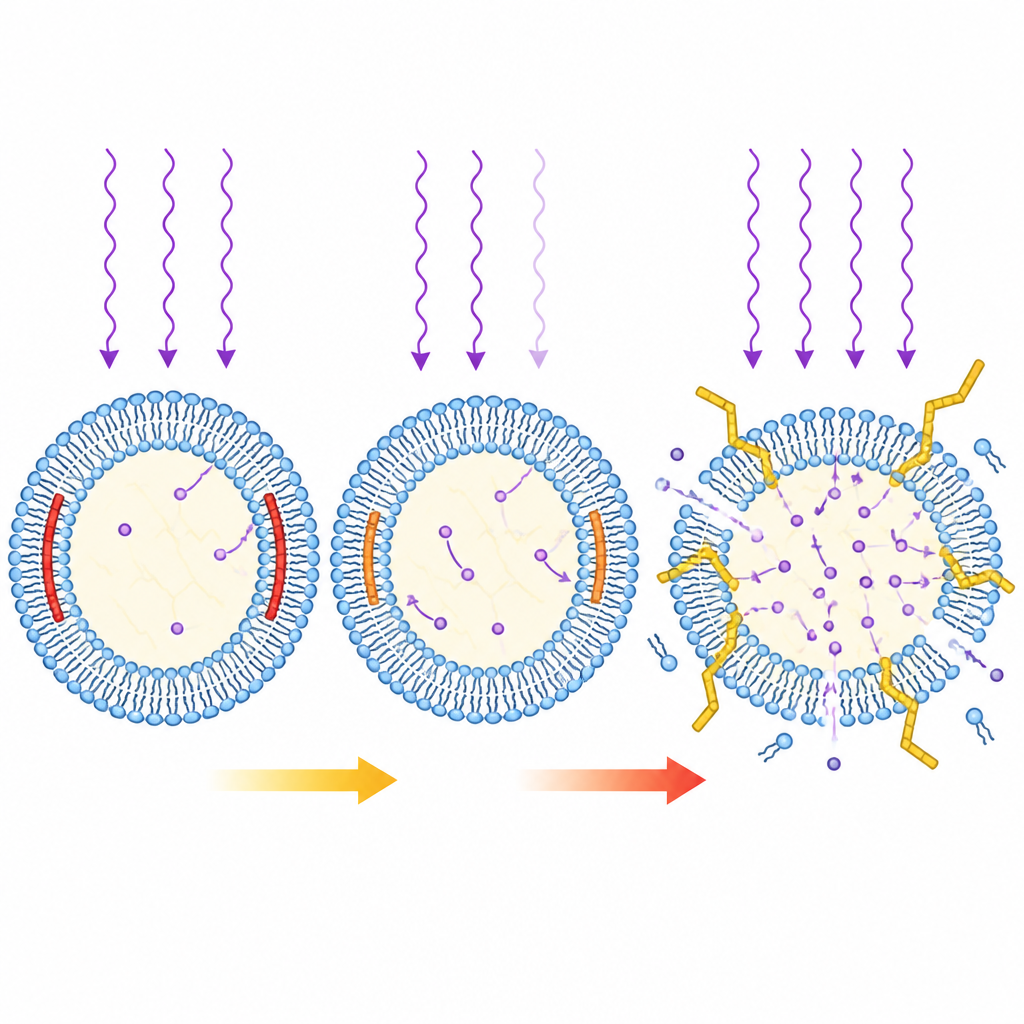
Phytofluene behaved quite differently. Instead of protecting, it actually increased fat damage under both UV-B and UV-A, acting in a pro-oxidative way. Measurements showed that phytofluene was extremely unstable during irradiation; only about one eighth of it survived UV-B treatment, and none could be detected after UV-A. The extract used contained mostly a bent version of the molecule, a so-called cis form, which tends to be less stable than its straight counterpart. The authors suggest that this bent shape may sit awkwardly in the fat membrane, partly sticking into the surrounding watery environment, where it can pick up reactive species and channel them into the membrane interior. In this way, phytofluene could serve as a kind of radical bridge that worsens, rather than reduces, fat damage.
What this means for tomato-based protection
Overall, the study shows that not all tomato pigments behave alike when exposed to UV light. Phytoene can protect fats against more energetic UV rays, mainly by absorbing them, while lycopene combines light absorption with strong radical stabilization and remains effective even under UV-A. Phytofluene, at least in the form tested here, may actually promote damage because of its instability and molecular shape. For everyday readers, this means that the health value of tomato products depends not only on how much of each pigment they contain, but also on the exact forms of those pigments and the type of light exposure. The work suggests that claims about the benefits of colorless carotenoids should be revisited, and that future human studies carefully examining phytofluene on its own and in mixtures will be important before treating all tomato compounds as simple UV shields.
Citation: Heidrich, A., Böhm, V. Protective effects of colorless carotenoid precursors against UV-induced lipid oxidation in liposomes compared to lycopene. Sci Rep 16, 15745 (2026). https://doi.org/10.1038/s41598-026-53721-y
Keywords: tomato carotenoids, UV radiation, lycopene, phytoene, lipid oxidation