Clear Sky Science · en
Consistently longer silent gaps in autistic speaker pairs across three conversational contexts
Why pauses in conversation matter
Everyday talk is full of tiny pauses between people taking turns to speak. They are usually so short that we barely notice them, yet they help keep conversations smooth and comfortable. This study asks what happens when both people in a conversation are autistic adults: do they prefer a different rhythm of talk and silence, and does that change across different kinds of conversations?
Looking closely at real conversations
To explore this, researchers invited pairs of autistic adults and pairs of non-autistic adults to take part in recorded face-to-face conversations. Everyone spoke German and had normal hearing and vision. Each pair first chatted freely to get to know each other, then worked together on a visual puzzle task using abstract shapes, and finally discussed how the task had gone. This mix allowed the team to compare relaxed small talk with a more demanding, goal-focused exchange.

Measuring the tiny gaps between turns
The scientists zoomed in on the exact timing of when one person stopped talking and the other started. Using detailed audio annotation, they marked more than ten thousand turn changes and measured whether the switch involved a brief silence or both people talking at once. They focused on the length of silent gaps, since earlier work suggests people everywhere tend to keep these breaks very short, around a fifth of a second, to maintain a sense of flow and mutual attention.
What was different for autistic pairs
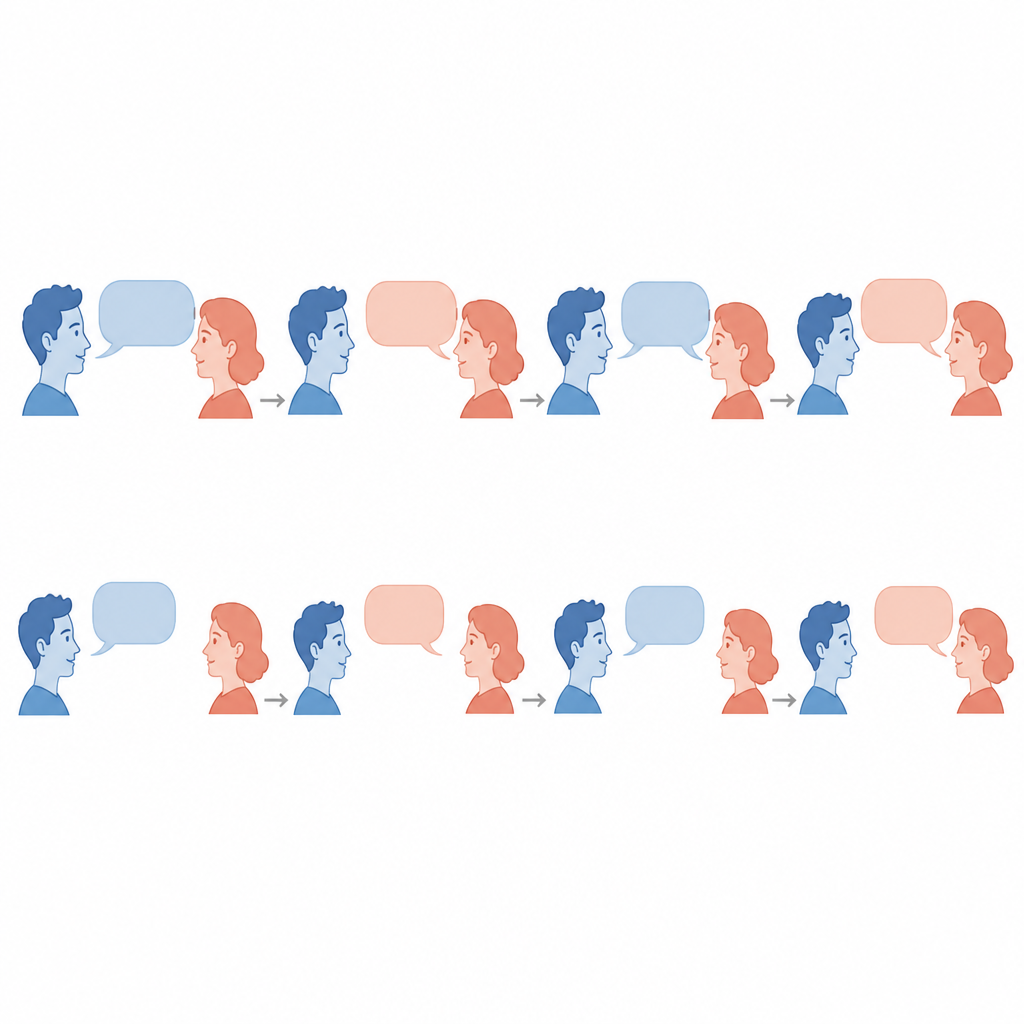
Across all three conversation types, autistic pairs showed consistently longer silent gaps between turns than non-autistic pairs. On average, their pauses were more than twice as long as those in the non-autistic group and often exceeded values usually reported for other speakers of similar languages. Yet these longer silences did not stop conversations from working. Autistic pairs generally reported that they felt fairly good about the interaction, and they cooperated successfully on the puzzle task, solving most of the shape sets correctly even if they completed slightly fewer sets overall in the time available.
How context shapes the pace of talk
Conversation type also mattered. For both autistic and non-autistic pairs, turn-taking slowed down during the structured puzzle task compared with the more open conversations. The task required careful description and checking of visual details, which likely increased mental load and made slightly longer silences helpful for planning what to say next. Interestingly, the largest difference between autistic and non-autistic pairs appeared in the first free "getting to know you" chat, where small talk and social bonding are central.
Rethinking what counts as a good rhythm
The authors argue that longer silences in autistic conversations should not automatically be seen as a problem or deficit. Instead, they may reflect a different but well tuned conversational rhythm that feels more comfortable and still supports effective communication between autistic people. More broadly, the study shows that there is no single ideal pace for turn-taking. The timing of our speech shifts with who we are talking to and what we are trying to do, suggesting that conversation is a flexible dance in which partners adapt the length of pauses to fit both their relationship and the situation.
Citation: Wehrle, S., Spaniol, M., Vogeley, K. et al. Consistently longer silent gaps in autistic speaker pairs across three conversational contexts. Sci Rep 16, 15218 (2026). https://doi.org/10.1038/s41598-026-53132-z
Keywords: autism, conversation, turn taking, silent gaps, social interaction