Clear Sky Science · en
Integrated NSM and GFRP-reinforced ECC/UHPC techniques for strengthening deficient RC columns
Why safer concrete columns matter
Many older concrete buildings quietly lose strength as the steel hidden inside their columns rusts away. This slow damage can reduce how much weight a structure can safely carry and how well it withstands earthquakes or other extreme events. This study explores a new way to give such weakened columns a second life using thin, high-strength outer shells and extra reinforcing bars placed just beneath the surface.
How columns quietly grow weaker
Reinforced concrete columns are the vertical “bones” of a building, carrying floors and roofs above. Over time, moisture and salts can corrode the steel bars inside them. As the steel rusts, it thins, expands, cracks the surrounding concrete, and weakens the bond between steel and concrete. The column then loses strength, stiffness, and the ability to deform without suddenly breaking. Traditional repair methods exist, but they may be bulky, costly, or not efficient enough for heavily damaged members.
New jackets and hidden bars
The researchers studied a combined repair method that adds strength both inside and outside the column. First, they cut shallow grooves along the column surface and bonded in extra reinforcing bars, either traditional steel or corrosion-resistant glass fiber bars. This approach is known as near-surface mounted reinforcement. Then they wrapped the column with a thin outer shell made from special cement-based materials that are far stronger and more durable than ordinary concrete. One type, called engineered cementitious composite, contains fine fibers that control cracking; the other, ultra-high-performance concrete, is even stronger and includes steel fibers. A light glass fiber mesh was embedded in these jackets to help hold everything together. 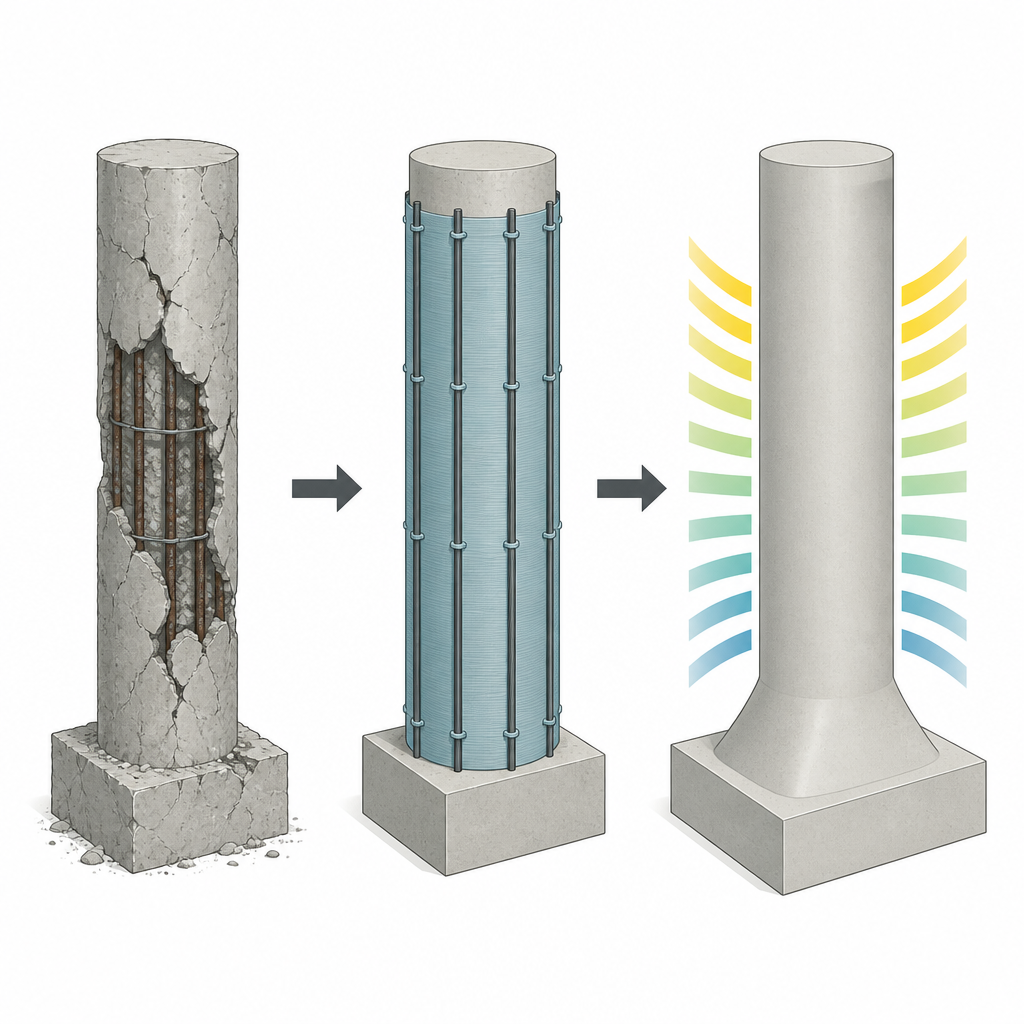
Putting the strengthened columns to the test
To see how well this system worked, the team built and tested eleven short circular columns in the laboratory. One was a sound “master” column, while another was deliberately weakened to mimic corrosion by using smaller steel bars. The rest were weakened columns repaired in different ways: only with outer jackets of the fiber-rich materials, or with both near-surface bars and jackets, using either steel or glass fiber bars and one or two layers of mesh. All columns were then squeezed from top to bottom until failure while instruments recorded how much load they carried and how far they shortened.
What happened under heavy loading
The damaged column without repair failed in a brittle way, with buckling of its inner bars and a sharp drop in strength. Adding only an engineered cementitious jacket with mesh produced modest gains in capacity and a gentler failure. When near-surface steel bars were combined with these jackets, the columns carried 25 to 32 percent more load than the damaged one and absorbed up to almost four times more energy before collapsing. Replacing the outer material with ultra-high-performance concrete gave even better results, raising load capacity by 35 to 44 percent and energy absorption by up to about 4.7 times. The best performance came from near-surface glass fiber bars paired with ultra-high-performance jackets, which boosted strength by about 49 percent while maintaining good ductility. 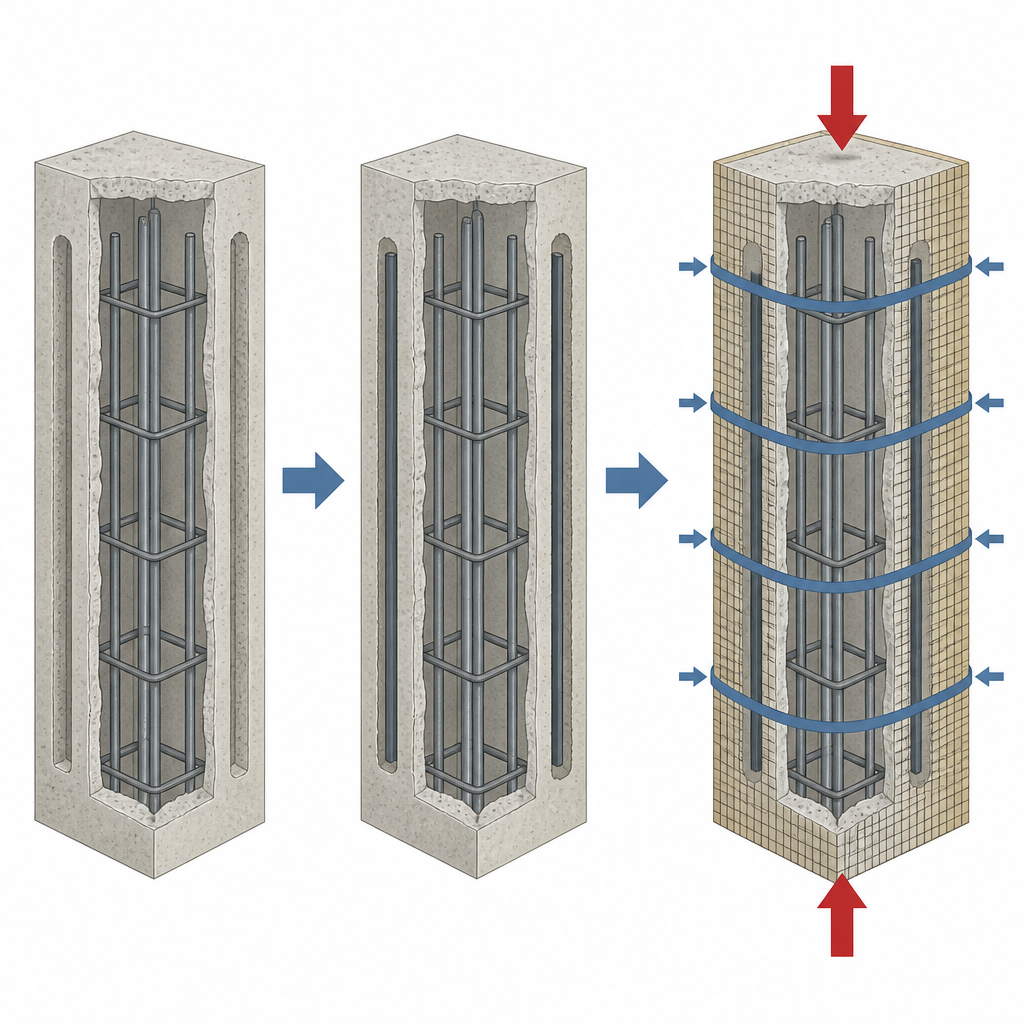
Computer models and design insights
The team also built detailed computer models of the columns to simulate how the materials interacted and to predict cracking, crushing, and debonding at interfaces. These models closely matched the measured strengths, displacements, and visible damage patterns, giving confidence that the approach can be used to explore other designs. A further numerical study showed that using larger internal steel bars increases column strength, but the returns diminish as bar diameter grows, hinting that there is an efficient range rather than a simple “more is always better” rule.
What this means for existing structures
For engineers and building owners, the findings suggest that slim jackets of advanced cement-based materials, teamed with near-surface reinforcement, can restore or even raise the strength and toughness of deteriorated concrete columns without major enlargement. Ultra-high-performance jackets, especially when paired with glass fiber bars, proved especially effective at confining the concrete core and delaying sudden failure. In practical terms, this combined technique offers a promising path to extend the safe life of aging buildings and infrastructure while using relatively thin, durable upgrades.
Citation: Elsamak, G., Bahrami, A., Emara, M. et al. Integrated NSM and GFRP-reinforced ECC/UHPC techniques for strengthening deficient RC columns. Sci Rep 16, 16440 (2026). https://doi.org/10.1038/s41598-026-52870-4
Keywords: concrete columns, structural strengthening, corrosion damage, high performance concrete, retrofit techniques