Clear Sky Science · en
Efficiency of anchorage systems for RC beams strengthened in flexure using basalt fiber reinforced polymers
Why stronger beams matter
Hidden inside bridges, parking garages, and apartment blocks are concrete beams that quietly carry heavy loads for decades. Over time, those beams can crack and weaken, especially when traffic grows or building codes change. This study explores a newer way to give tired concrete beams a second life using thin sheets made from basalt fibers, a material derived from volcanic rock, and focuses on how to fasten these sheets so they truly make structures safer.
New jackets for old concrete
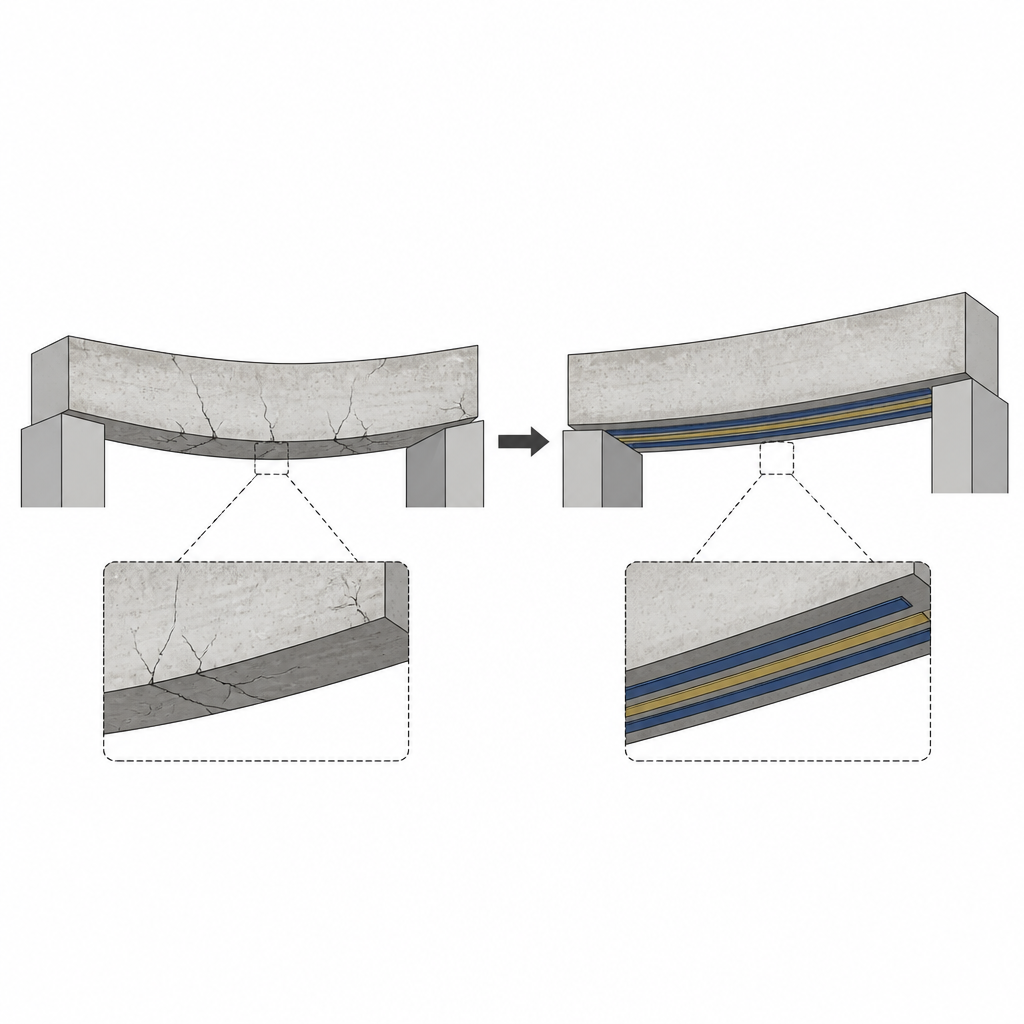
Engineers often strengthen existing beams by gluing fiber sheets to the underside, much like adding a slim, high strength bandage. Traditional sheets use carbon or glass fibers; basalt fiber reinforced polymer, or BFRP, offers a cheaper and more environmentally friendly option with high strength and good durability. The catch is that these sheets can suddenly peel off the concrete before they reach their full strength, a brittle failure that wastes material and limits safety gains. The authors set out to test how different fastening methods, called anchorage systems, could keep BFRP sheets firmly attached so that beams carry more load without unexpected peeling.
How the tests were set up
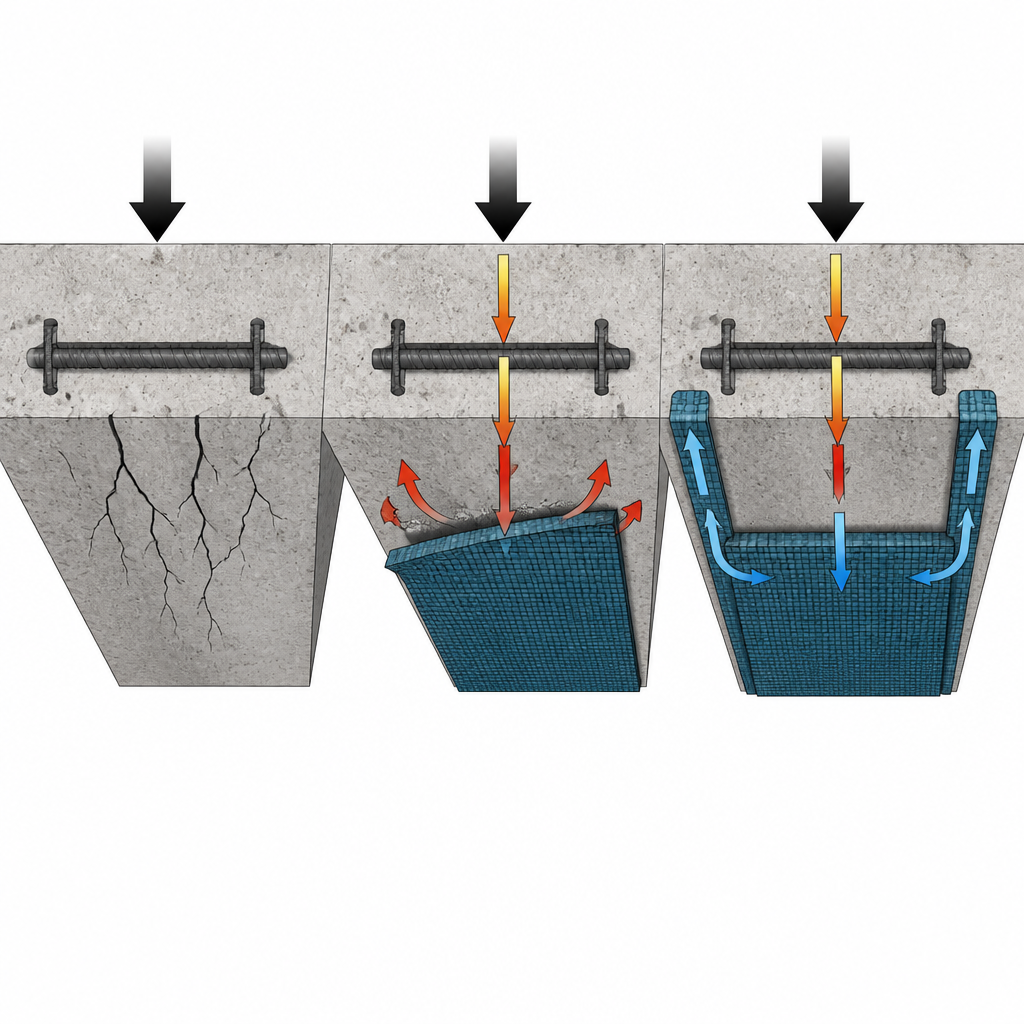
The research team built eight full size concrete beams, each a little over three meters long, with identical steel reinforcement inside. Some beams were left unstrengthened as a reference, while others received two or four layers of BFRP sheets bonded to the underside over different lengths. To hold the sheets in place, the team tried two main anchorage types: U wraps, which loop the BFRP around the sides of the beam like a belt, and spike anchors, which bundle BFRP fibers into dowels inserted into holes in the concrete. All beams were bent in a laboratory setup using two concentrated loads until they failed, while sensors tracked deflection and cracks across the span.
What happened as the beams bent
As load increased, beams first behaved elastically, then developed vertical flexural cracks between the applied loads, and finally softened as the internal steel reinforcement yielded. Strengthened beams were stiffer than the control beam after cracking, and their ultimate bending capacity increased by up to one third. However, adding more BFRP layers did not automatically give much more strength. In several cases, the sheets peeled away from the concrete cover before breaking, so only part of their potential strength was used. Beams with properly anchored sheets showed more closely spaced but narrower cracks, indicating that the BFRP helped distribute tension along the span.
Why anchorage makes such a difference
The heart of the study was comparing beams with similar BFRP layouts but different anchorage details. When BFRP sheets were long enough to meet development length rules from design guidelines, the failure mode shifted from sheet peeling to sheet rupture, and the beam’s flexural strength rose by about 29 percent compared to the control. U wrap anchors produced a similar effect even when the strengthened length was shorter: they changed failure from end delamination to BFRP rupture and boosted strength by about 25 percent. Spike anchors helped only when their embedded depth was large; shallow spikes behaved much like having no anchors at all. Across configurations, strengthening reduced ductility, meaning the beams bent less before failure, but the loss was generally within about 30 percent of the original beam’s deformability.
Takeaways for safer repairs
For non specialists, the key message is that simply gluing strong fibers to a weak beam is not enough. The way those fibers are fastened to the concrete largely decides whether they will actually help in a crisis. Basalt fiber sheets can noticeably increase how much load a beam can safely carry, but only if designers provide enough bonded length or effective anchors, such as U wraps that clasp the beam’s sides. Spike anchors can work, but only when anchored deeply into the concrete. The study suggests that with careful detailing of these anchorage systems, engineers can use basalt based composites as a practical, greener tool to extend the life of many everyday concrete structures.
Citation: Aziz, J., Ragab, M., Elgabbas, F. et al. Efficiency of anchorage systems for RC beams strengthened in flexure using basalt fiber reinforced polymers. Sci Rep 16, 16288 (2026). https://doi.org/10.1038/s41598-026-52540-5
Keywords: basalt fiber reinforced polymer, concrete beam strengthening, FRP anchorage, U-wraps, structural retrofitting