Clear Sky Science · en
Spatial proximity and scene grammar: shaping spatial representations for memory-guided actions in naturalistic environments
Finding Things in Everyday Places
Imagine walking away from the kitchen counter, then coming back and instantly knowing where your coffee cup was, even if you are not looking right at it. This study asks how we pull off that everyday trick in complex rooms full of objects. Using virtual reality, the researchers explored whether our memory for object locations leans more on simple spatial closeness or on our knowledge about which objects “belong together” in a room, such as pans near the stove or shampoo in the shower.
How Our Minds Map a Room
Our brains can keep track of where things are in two main ways. One is centered on ourselves, like remembering that your keys are an arm’s length to your right. The other ties objects to each other, such as recalling that the keys are beside the lamp on the table. This second style uses landmarks in the scene as reference points. In real homes, large, fixed items like stoves, fridges, sinks, and showers act as such landmarks. Smaller “local” items, like cups or toothbrushes, tend to cluster around them in predictable patterns, a kind of informal “scene grammar” that we learn over time. The question is whether this learned grammar or simple distance to these big items matters more when we act from memory.
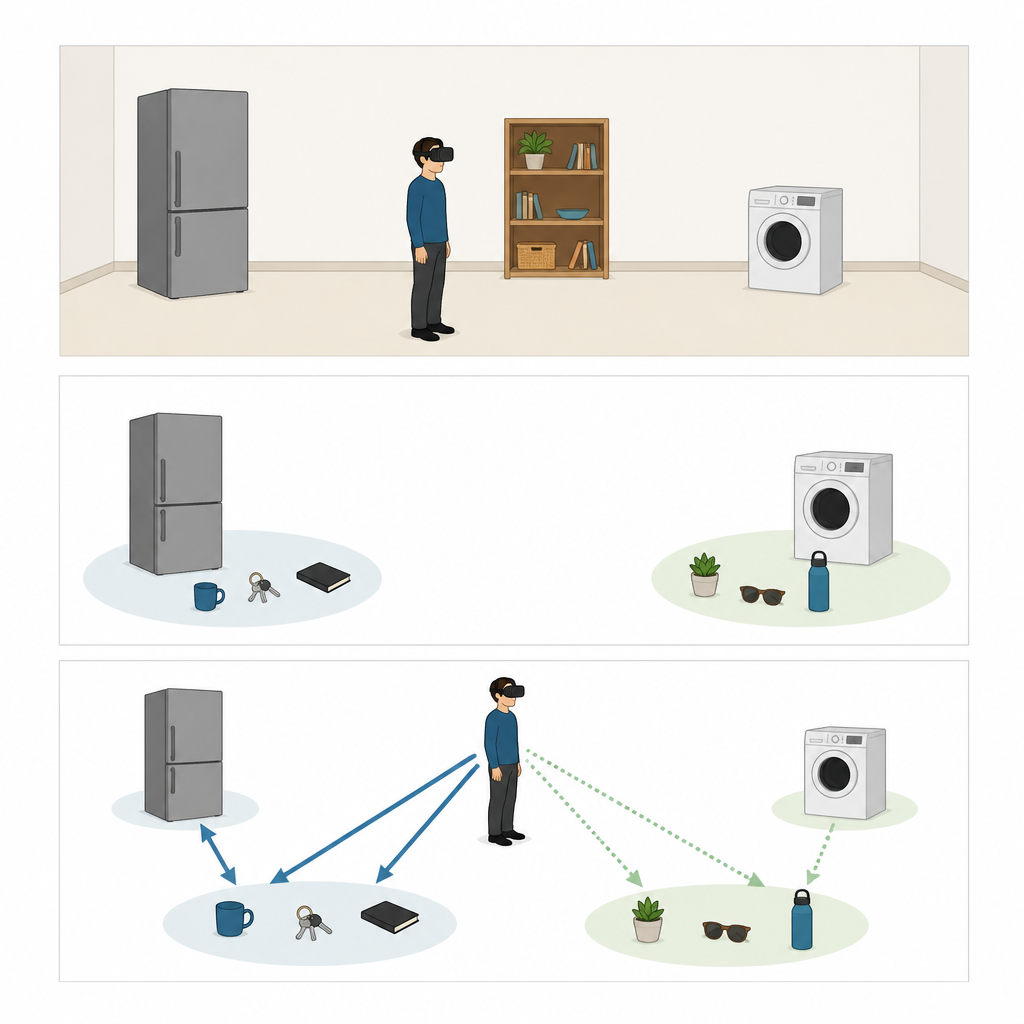
A Virtual Kitchen Test
To probe this, the team built life-sized virtual kitchens and bathrooms that participants explored while wearing a VR headset. Each scene contained two big anchors, for example a stove and a fridge, with three smaller target objects placed on or in one anchor. Sometimes these pairings were typical, like pots on a stove; other times they were odd, like dairy products on a stove. After viewing the scene briefly, participants saw the same room again, but now the small items were gone and, on some trials, one anchor had been subtly shifted sideways without being noticed. Then one of the small objects appeared in front of the participant, who had to grab it and walk over to put it back where they thought it had been.
Close Landmarks Win the Tug of War
By comparing where people placed objects when anchors stayed put versus when they had secretly moved, the researchers could see how strongly memory was pulled by these landmarks. When an anchor shifted, people’s placements shifted along with it, showing that they were using these big objects as reference points for remembering positions. Crucially, this pull was strong only when the anchor was close to the small target objects. Distant anchors, placed much farther away in the scene, had virtually no effect on where participants put things back. In other words, only nearby landmarks seemed to count for guiding memory-based actions.
Meaning Matters Less Than Distance
The researchers also tested whether it helped if the small objects “fit” the anchor in a meaningful way, like bathroom items on a sink, compared with mismatched pairings, such as kitchen tools in a fridge. Surprisingly, whether an object belonged with its anchor in a typical way did not reliably change how strongly that anchor influenced memory. People were just as likely to use an oddly filled fridge as a landmark as they were to use a sensibly stocked one, as long as it was close to the target objects. Measures of overall placement accuracy also did not differ between the meaningful and odd pairings, suggesting that, in this task, learned expectations about which objects go where did not add much on top of simple spatial layout.

What This Means for Everyday Life
These results suggest that when we act from memory in rich, realistic environments, our brains lean heavily on nearby, stable landmarks to keep track of where things are. The exact meaning of those landmarks and how well objects “fit” them may matter less than their physical closeness, at least under the brief viewing and simple placement demands tested here. In practical terms, this hints that arranging important items near clear, stable fixtures in a room may do more for our everyday memory than strictly following the “right” object-to-place pairings, because our spatial system seems to trust distance most.
Citation: Baltaretu, B.R., Võ, M.LH. & Fiehler, K. Spatial proximity and scene grammar: shaping spatial representations for memory-guided actions in naturalistic environments. Sci Rep 16, 15982 (2026). https://doi.org/10.1038/s41598-026-52111-8
Keywords: spatial memory, virtual reality, landmarks, scene perception, object location