Clear Sky Science · en
Characterization of Alternaria alternata alternariol monomethyl ether with a potential antiproliferative activity by topoisomerases inhibition; molecular docking and dynamic simulations
Why a plant fungus could matter for future cancer care
Cancer drugs often lose their punch when tumor cells learn to pump them out or dodge their effects. This study explores an unexpected source for fresh options: a common plant fungus that makes a small natural compound able to slow the growth of several cancer cell types in the lab. By tracing how this molecule affects key proteins that handle DNA, the researchers show why it may be worth further investigation as a starting point for new treatments.

A hidden partner inside a garden plant
The work begins with the rosy periwinkle, a garden plant already famous for cancer drugs found in its tissues. Scientists sampled its leaves to look not just at the plant, but at the microscopic fungi that quietly live inside them. From these leaf samples they isolated many fungal strains and grew them in nutrient broth. One species, Alternaria alternata, stood out for producing high levels of a compound called alternariol monomethyl ether, or AME, which belongs to a family of chemicals known as mycotoxins.
Pinning down the identity of the fungal compound
To be sure they had the right molecule, the team purified AME from the fungal broth and compared it to a known reference using several separation and detection tools. Thin layer chromatography and high performance liquid chromatography showed that the fungal compound moved through test materials just like genuine AME. Mass spectrometry, which weighs molecules and their fragments, revealed the same mass and breaking pattern as authentic AME. Together these checks confirmed that the fungus inside the periwinkle was indeed making AME, and at hundreds of micrograms per liter under the tested conditions.
How AME affects cancer cells in the lab
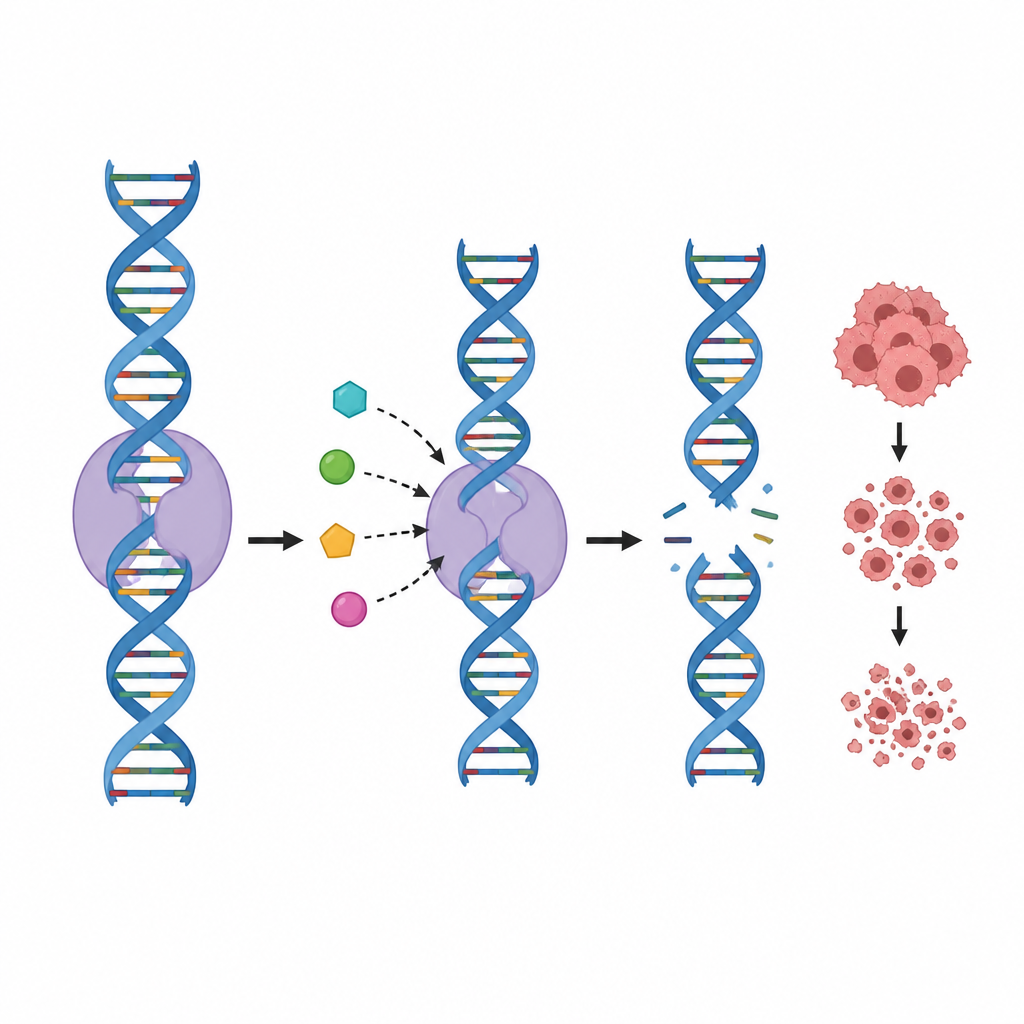
The researchers then asked how this purified AME influences human cells grown in dishes. They exposed breast (MCF-7), liver (HepG-2), and colon (Caco-2) cancer cells, as well as normal oral cells, to different doses of AME. Cancer cells were much more sensitive than normal cells, showing strong drops in growth at low micromolar levels. Detailed tests of the cell cycle revealed that AME caused breast cancer cells to pile up at the stages just before and during division, suggesting that it interferes with the machinery needed to copy and separate DNA. Flow cytometry, a way to count cells in different states, showed that AME greatly increased the number of cells undergoing programmed cell death and, to a lesser extent, necrosis.
Targeting DNA helpers inside the cell
To understand why AME has these effects, the team focused on enzymes called topoisomerases, which help untangle DNA so it can be copied and read. Many existing cancer drugs work by blocking these enzymes. In test-tube reactions, AME inhibited both main human forms, topoisomerase I and II, at very low nanomolar concentrations, with a stronger impact on type II. Computer docking studies, which simulate how molecules fit together, suggested that AME nestles into the active pockets of these enzymes in a way similar to well known cancer drugs such as camptothecin and etoposide, forming comparable contacts with key amino acids and DNA. Additional dynamic simulations indicated that these complexes are stable and that AME can stay bound as the proteins move.
What this could mean for future therapies
Taken together, the findings paint AME as a fungal molecule that can slow the growth of several cancer cell lines, stall their division, and drive them toward programmed death, likely by blocking DNA-handling enzymes inside the cell. While many steps remain before any clinical use, including safety assessments and further chemical tuning, the study suggests that AME, or relatives inspired by its structure, could add to the pool of candidate compounds aimed at overcoming resistance to current topoisomerase-based drugs.
Citation: El-Sayed, A.S.A., Aboelez, M.O., Ezelarab, H.A.A. et al. Characterization of Alternaria alternata alternariol monomethyl ether with a potential antiproliferative activity by topoisomerases inhibition; molecular docking and dynamic simulations. Sci Rep 16, 15352 (2026). https://doi.org/10.1038/s41598-026-51757-8
Keywords: alternariol monomethyl ether, Alternaria alternata, topoisomerase inhibitor, anticancer natural product, cancer cell apoptosis