Clear Sky Science · en
Numerical backup protection scheme based on alienation indices of voltage and current measurements practically applied to synchronous generators
Keeping the Lights On When Generators Misbehave
Modern power grids depend on large rotating generators to keep electricity flowing smoothly. If one of these machines is damaged or its protection system fails, whole regions can lose power in an instant. This study explores a new digital safety layer for generators that quietly watches their electrical signals, spots trouble early, and steps in when the main protection misses a fault.
Why Generators Need a Backup Safety Net
Large generators are already guarded by fast primary relays that compare currents at both ends of the stator windings and trip almost instantly during internal faults. However, these primary devices are not perfect: they can fail, be mis-set, or be confused by odd conditions such as instrument transformer errors or high resistance faults. The authors therefore propose an additional numerical backup scheme that looks only at the three-phase voltages and currents at the generator terminals. If the main protection does not act during a dangerous event, this secondary layer takes over and disconnects the machine from the grid.
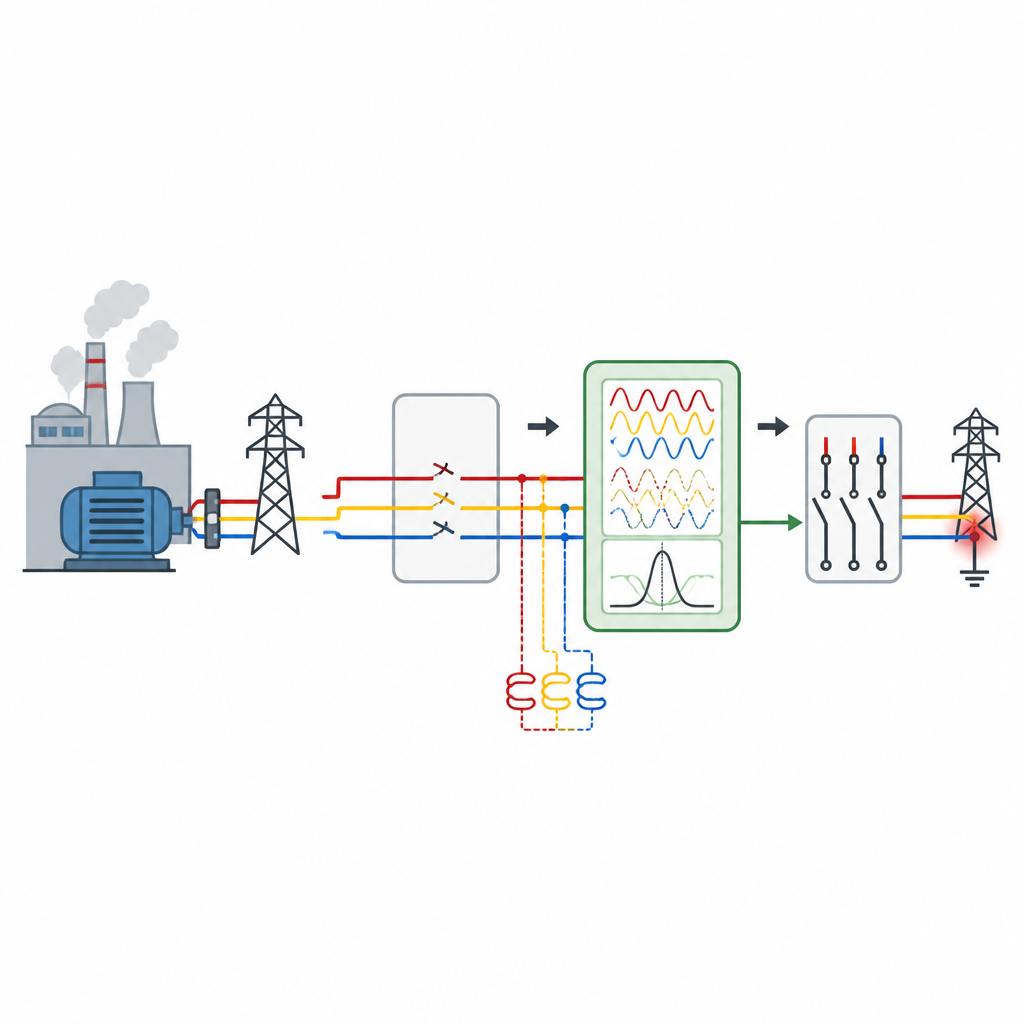
Reading Trouble from the Shape of Waves
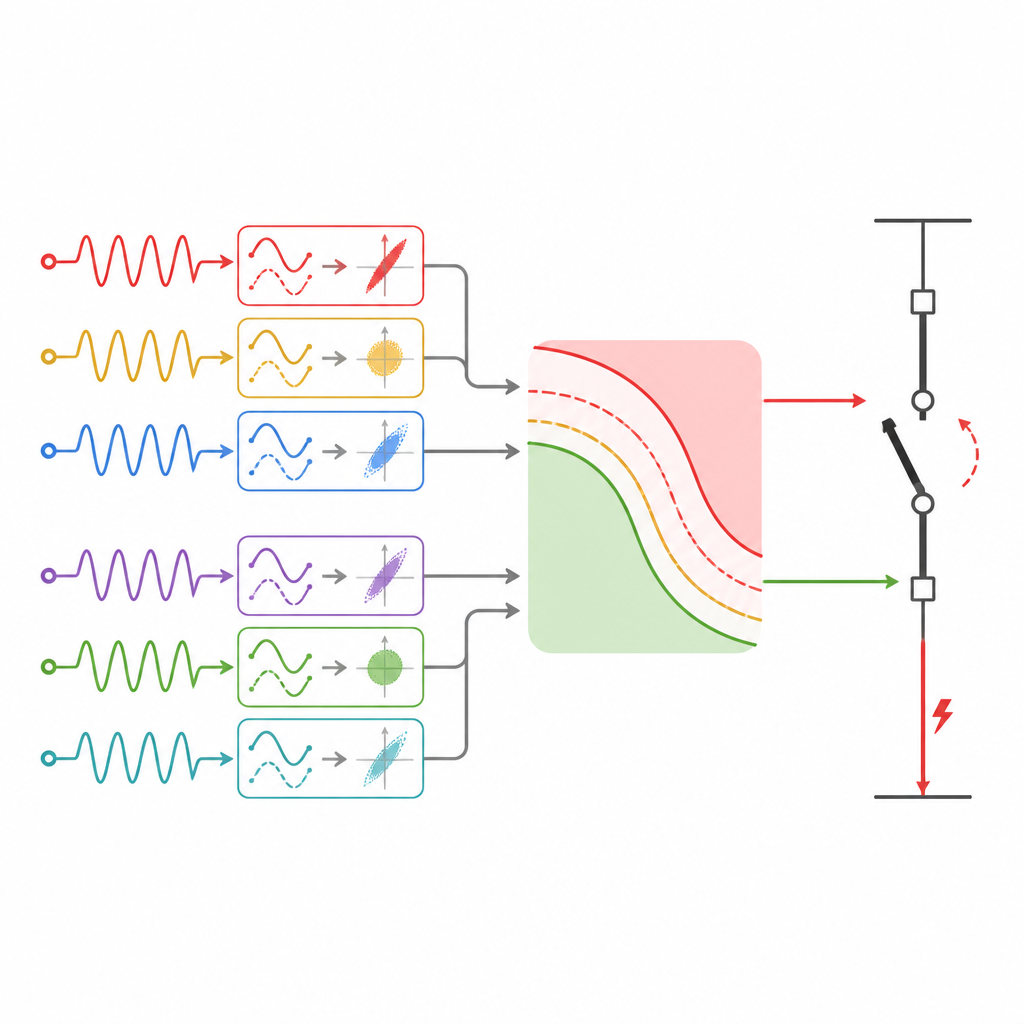
The core idea is to judge how closely different electrical signals follow each other over short time windows. Instead of relying on absolute magnitudes or complex spectral analysis, the method uses simple statistical measures based on correlation to build “alienation indices.” These indices describe how dissimilar two signals are: values near zero mean they move together, while values nearer one indicate that their relationship has broken down. By forming fifteen such indices from all combinations of phase voltages and currents, the system can assess both the health of each individual phase and the balance among phases.
From Indices to Smart Trip Decisions
The authors group these indices into five protection modules. Some focus on comparing voltages between phases to detect voltage imbalance, others compare currents between phases to detect current imbalance, and another set compares voltage and current in the same phase to sense shifts in power factor. Additional modules track how each single signal changes over time, flagging sudden distortions that can indicate series or shunt faults. For each module, the team defines closed “tripping curves” in terms of the alienation values. Inside the restraining region the relay remains quiet, even if there is mild imbalance. When one or more indices move into the tripping region, the backup protection issues a command to open the relevant breaker after a controlled delay.
Testing on a Real Motor–Generator Setup
To move beyond simulation, the researchers built a laboratory motor–generator set. A single-phase induction motor drives a three-phase synchronous generator feeding a test load. Voltage and current transformers at the generator terminals provide scaled signals to a data acquisition card and a computer running the algorithm in a LABVIEW environment. The team then created a wide range of realistic conditions: normal operation with slight current imbalance, open-circuit faults in individual phases, single line to neutral short circuits, and double line faults, some combined with severe current transformer saturation that often confuses traditional relays.
How Fast and How Trustworthy the Method Is
During these experiments the alienation indices stayed stable in the healthy, slightly unbalanced case, so the relay did not trip. When faults were introduced, the indices shifted rapidly into the tripping zones, and the backup scheme correctly ordered disconnection in every scenario except for a handful of carefully examined edge cases involving arc resistance or extreme measurement distortion. Using a data window of one electrical cycle, the typical operating time was about one third of a second, appropriate for backup duty. Quantitative analysis across 2,465 test scenarios showed security and dependability above 99.80 percent, reliability and accuracy above 99.60 percent, and an overall malfunction rate of only 0.37 percent.
What This Means for Future Power Grids
For non-specialists, the main message is that the authors have turned a compact statistical idea into a practical safety tool for big generators. By watching how well the three-phase voltages and currents “move together” rather than relying on heavy signal processing or large trained data sets, this backup scheme can be tuned easily, adapted to different machine sizes, and implemented on standard digital relays. It does not replace primary protection but offers an extra, highly reliable safeguard that can help keep generators and grids stable when things go wrong.
Citation: Mahmoud, R.A., Salama, M.A.E. Numerical backup protection scheme based on alienation indices of voltage and current measurements practically applied to synchronous generators. Sci Rep 16, 15355 (2026). https://doi.org/10.1038/s41598-026-51239-x
Keywords: synchronous generator protection, fault detection, backup relay, voltage current imbalance, power system reliability