Clear Sky Science · en
The homozygous founder Psmb8 variant of Nakajo-Nishimura syndrome/proteasome-associated autoinflammatory syndrome causes panniculitis-associated lipoatrophy and a shortened lifespan in mice
Why this mouse study matters to human health
Nakajo-Nishimura syndrome is a rare inherited illness in which children develop repeated fevers, skin rashes, loss of fat and muscle, stiff joints, and often die young. Because the disease is so rare, it has been difficult to study and to test new treatments. This research describes a new strain of mice that carries the same key gene change as affected patients. These mice show many of the same body changes, offering scientists a living model to investigate how the disease develops and how it might be treated.
A fault in the cell’s cleanup crew
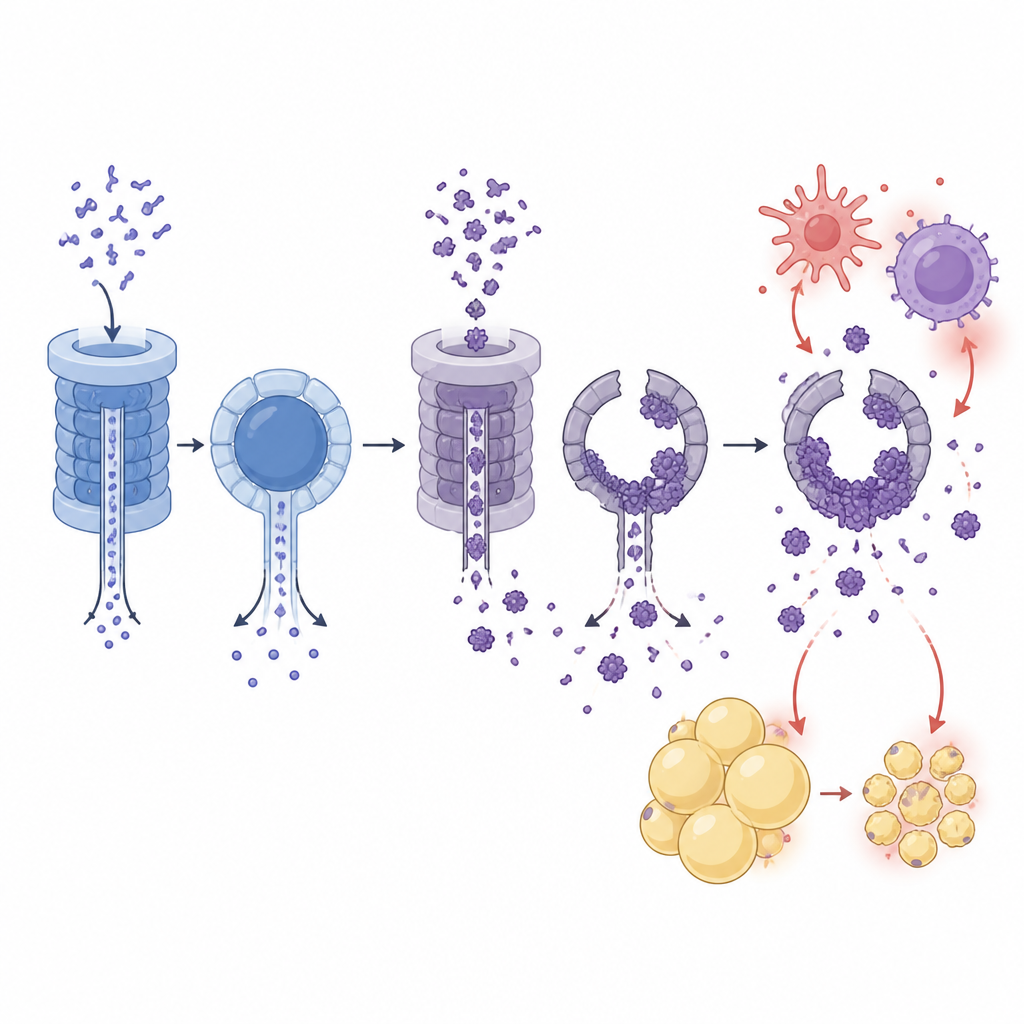
Our cells constantly break down old or damaged proteins using a molecular machine called the proteasome, a kind of tiny shredder and recycler. People with Nakajo-Nishimura syndrome share a specific change in a proteasome-related gene called PSMB8. The authors recreated this same change, named G201V, in the mouse version of the gene, Psmb8. They then examined how well the cellular cleanup system worked in these mice. They found that one part of the proteasome, which is usually switched on during infections and helps shape immune responses, did not mature properly, and overall shredding activity in one core unit of the proteasome was clearly reduced.
Consequences for body fat and lifespan
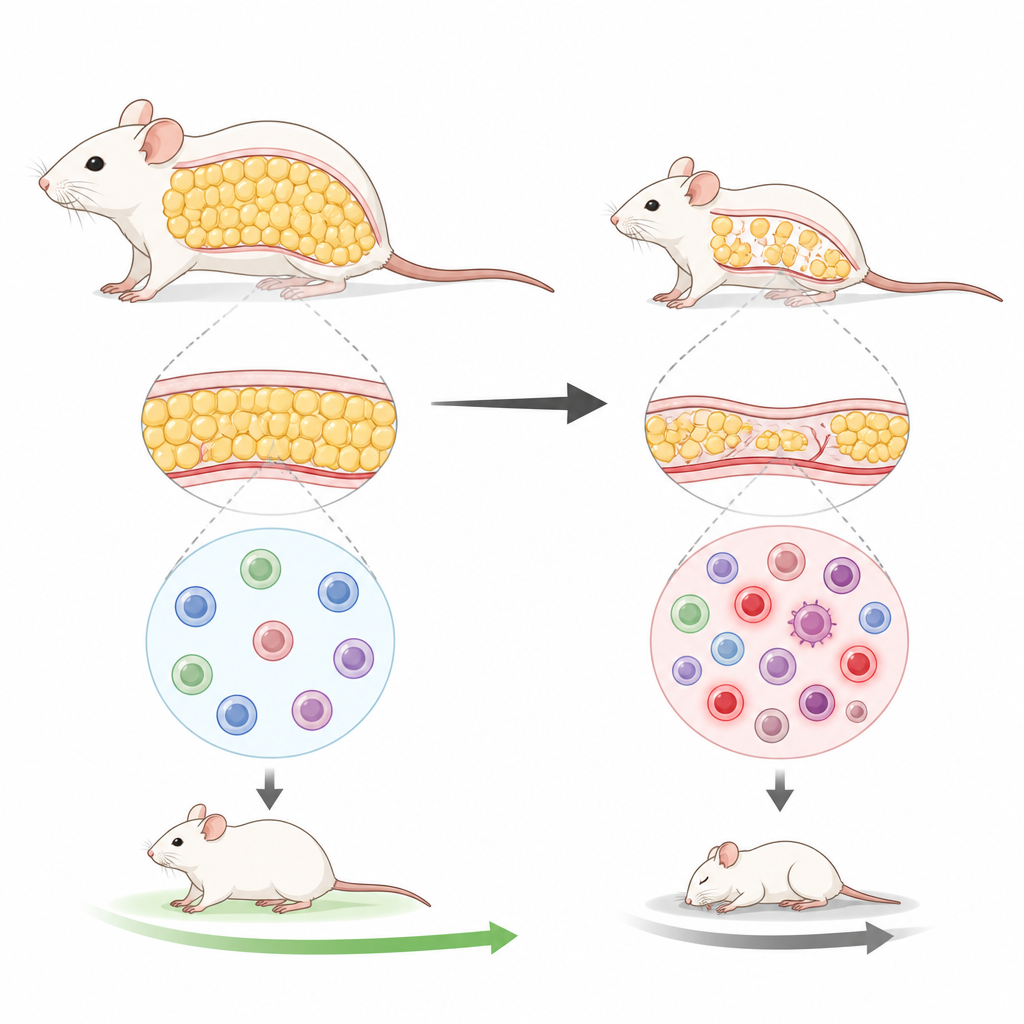
Although young mutant mice looked healthy, problems appeared as they aged. Compared with normal mice kept in the same clean facility, mice carrying two copies of the faulty Psmb8 gene gained less weight and died sooner. When the researchers inspected fat tissues, they saw that older mutant animals had smaller fat cells both under the skin and around internal organs. Their fat tissue contained many more immune cells, especially macrophages, and showed signs of local alarm signals being switched on. This pattern suggests an ongoing inflammatory attack on the fat layer, called panniculitis, which fits with the fat loss seen in people with the syndrome.
Changes in immune cells and signaling
The team next looked at the immune system. In the spleen of young mutant mice, the share of certain infection-fighting T cells, especially naive CD8 T cells that have not yet seen germs, was reduced, while CD4 T cells made up a larger proportion. With age, these differences became less striking, but the pattern resembled what is usually seen in older animals, hinting at premature immune aging. The surface display of molecules that present protein fragments to killer T cells was also modestly reduced on several immune cell types, consistent with altered proteasome function. In the blood of older mutant mice, levels of inflammatory messenger proteins IL-6 and IL-1α were higher, again pointing to smoldering inflammation, although a broad antiviral alarm signal known from patients was not clearly raised in these mice.
How closely do the mice mirror human disease
Cells from patients with Nakajo-Nishimura syndrome show widespread failure of both major proteasome forms and build up large amounts of tagged waste proteins. In the mutant mice, only one core unit was strongly affected while a second major unit kept working well enough to prevent obvious waste accumulation. Despite this difference at the molecular level, the mice still developed several hallmark features of the human disease, including inflammatory damage to fat, loss of body fat with age, skewed T cell populations, and shorter lifespan. The authors propose that this combination resembles a “progeroid,” or early aging, version of the human condition.
What this means for future research and care
By creating mice that carry the same Psmb8 change as people with Nakajo-Nishimura syndrome, the researchers have provided a powerful new tool. These animals develop key aspects of the human illness in a natural setting, allowing scientists to probe how faulty protein recycling leads to chronic inflammation, fat loss, and early death. Just as important, the model can be used to test drugs, including compounds already shown to reduce inflammation in patient-derived cells, in a living organism. While no direct treatment advice comes from this work, it lays essential groundwork for understanding this family of rare autoinflammatory disorders and for guiding future therapy development.
Citation: Hara, T., Kinoshita, A., Hamazaki, J. et al. The homozygous founder Psmb8 variant of Nakajo-Nishimura syndrome/proteasome-associated autoinflammatory syndrome causes panniculitis-associated lipoatrophy and a shortened lifespan in mice. Sci Rep 16, 15039 (2026). https://doi.org/10.1038/s41598-026-51190-x
Keywords: Nakajo-Nishimura syndrome, autoinflammatory disease, Psmb8 mutant mice, panniculitis lipoatrophy, proteasome dysfunction