Clear Sky Science · en
Deformation mechanisms of an existing tunnel adjacent to deep basement supported by circular beams in soft clays
Why digging deep next to tunnels matters
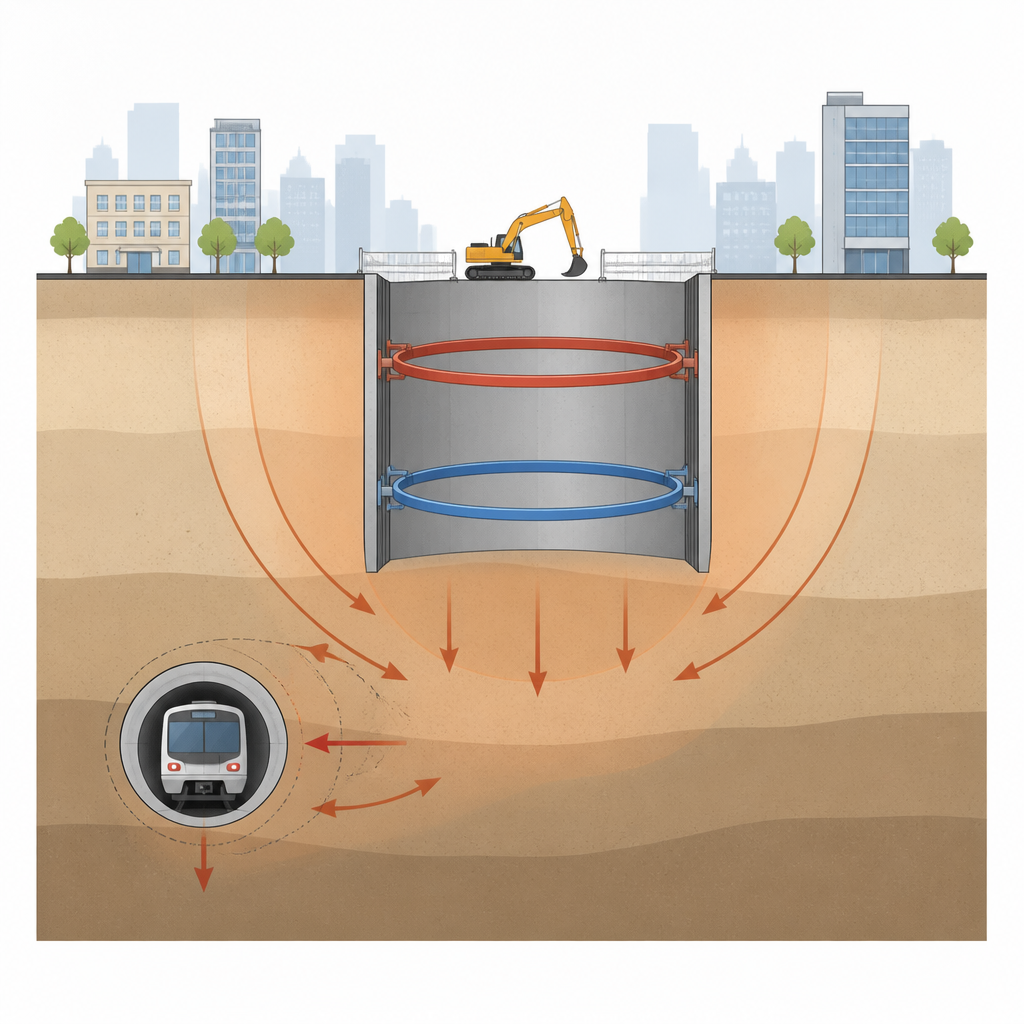
As cities grow downward instead of outward, engineers must carve large underground basements right next to operating subway tunnels. Removing soil in soft ground can cause nearby tunnels to shift, crack, or go out of alignment. This study looks at how a new type of support system using circular beams inside deep basements changes the way the ground moves and how much nearby tunnels are affected, offering guidance to keep urban rail systems safe during construction.
Watching a giant pit in soft clay
The researchers began with a real construction project in soft clay, where a very large basement was excavated using an unusual retaining system. Instead of traditional straight support beams, contractors used two large circular concrete beams to brace the surrounding walls. The site was heavily instrumented, with sensors tracking how much the walls bent and how the ground surface settled as soil was removed in stages. Using this detailed field information, the team built a three-dimensional computer model that mimicked the exact ground layers, wall and beam layout, and excavation sequence used on site.
Matching computer predictions to real ground movement
To make sure the computer model reflected reality, the authors compared its predictions with what the instruments recorded. They used an advanced soil model tuned for the way soft clay stiffens at very small strains and then softens as it is disturbed. The calculated sideways movement of the retaining walls and the sinking of the ground surface almost perfectly matched the measurements. The maximum ground settlement predicted by the model differed from the observed value by less than two percent, and the model also captured where the largest settlement occurred and how far the disturbed zone extended behind the excavation. This close agreement gave the team confidence to use the model to explore many other tunnel and basement layouts that would be difficult or impossible to test in the field.
How nearby tunnels actually move
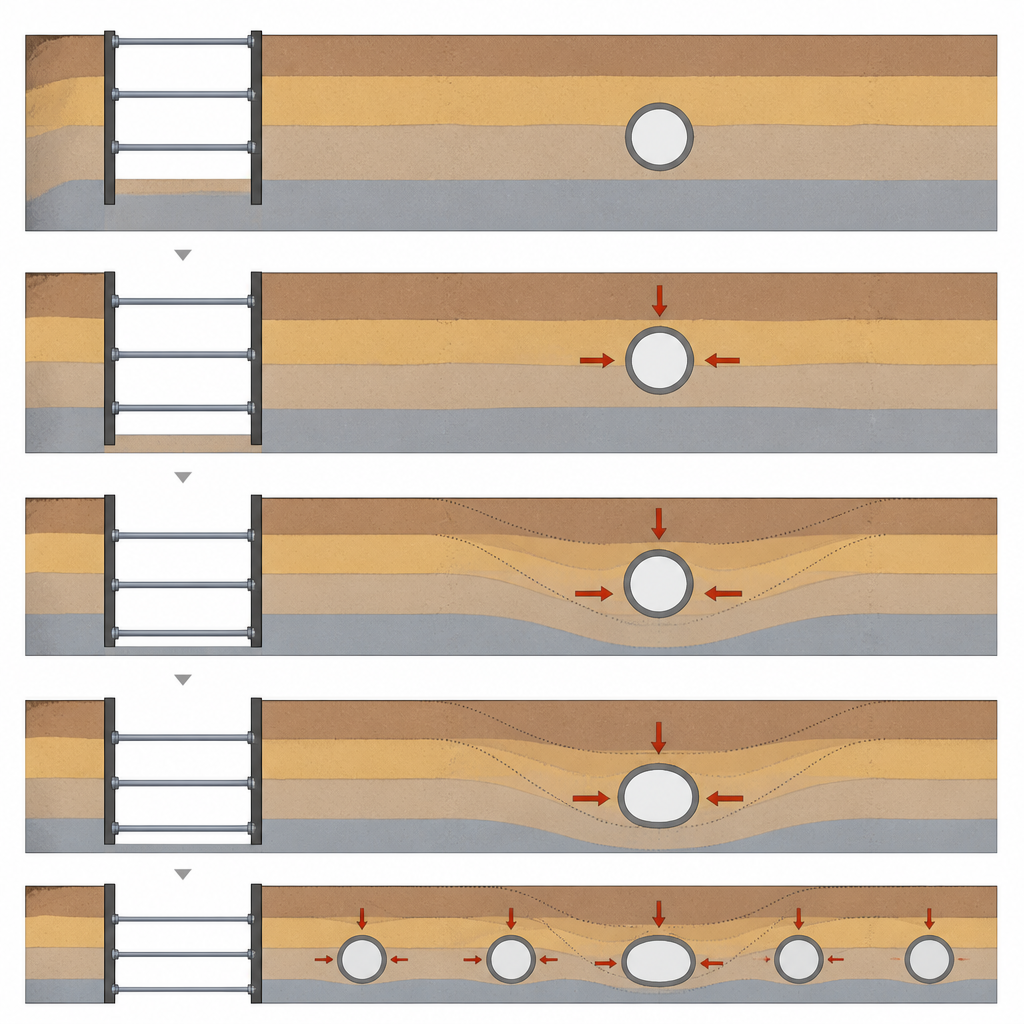
With the verified model in hand, the researchers simulated a typical subway tunnel running close to one side of a deep basement supported by circular beams. They varied three main factors: how much soil lay above the tunnel roof, how far the tunnel was from the basement, and how long the basement was compared with its depth. The simulations showed that the tunnel does not simply sink; instead, it moves in three dimensions, with sideways bending playing the dominant role. The largest tunnel shifts occur directly opposite the middle of the basement, and for many realistic layouts the sideways movement was almost twice as large as the settlement. As the distance between tunnel and basement increased, both sideways and vertical movements dropped sharply, especially within a range of roughly one to two excavation depths.
Depth of burial and basement size change the risk
The amount of soil covering the tunnel turned out to have a non-intuitive effect. As the tunnel was placed deeper, movements at first grew larger and then decreased again, with the strongest response typically when the tunnel roof lay at a depth a little over half the excavation depth. The shape of tunnel distortion around its cross-section also rotated as depth changed, shifting where the largest strains would occur. Basement size was equally important: longer excavations released more stress in the surrounding clay, causing both sideways tunnel movement and settlement to increase almost linearly with basement length. When the basement became more than about six times as long as it was deep, predicted tunnel movements exceeded common service limits unless special protective measures were included.
A simple chart for engineers to use
To turn these complex three-dimensional results into a practical tool, the authors combined their simulations into a simple design chart. The chart divides the space around a basement into zones where expected tunnel movements are negligible, modest, or large enough to be of concern. These zones depend mainly on how far the tunnel lies from the basement and how deep it is compared with the excavation. For each combination, the chart indicates whether tunnel movement is likely to stay within five, ten, or twenty millimeters, or to exceed these thresholds.
What this means for urban construction
For non-specialists, the key message is that deep basements supported by circular beams in soft clay can be built safely near subway tunnels, but tunnel movement is controlled most strongly by distance, depth, and basement length. Sideways pushing of the tunnel is usually more critical than simple sinking. The design chart proposed in this work gives engineers a quick way to judge when a planned excavation will probably be harmless and when extra protection such as soil improvement or isolation walls is needed before digging begins.
Citation: Qi, S., Wang, B. Deformation mechanisms of an existing tunnel adjacent to deep basement supported by circular beams in soft clays. Sci Rep 16, 14633 (2026). https://doi.org/10.1038/s41598-026-50853-z
Keywords: tunnel deformation, deep excavation, soft clay, basement construction, subway tunnel safety