Clear Sky Science · en
Enhancing photovoltaic efficiency in arid climates using cooling strategies
Keeping solar panels cool in desert heat
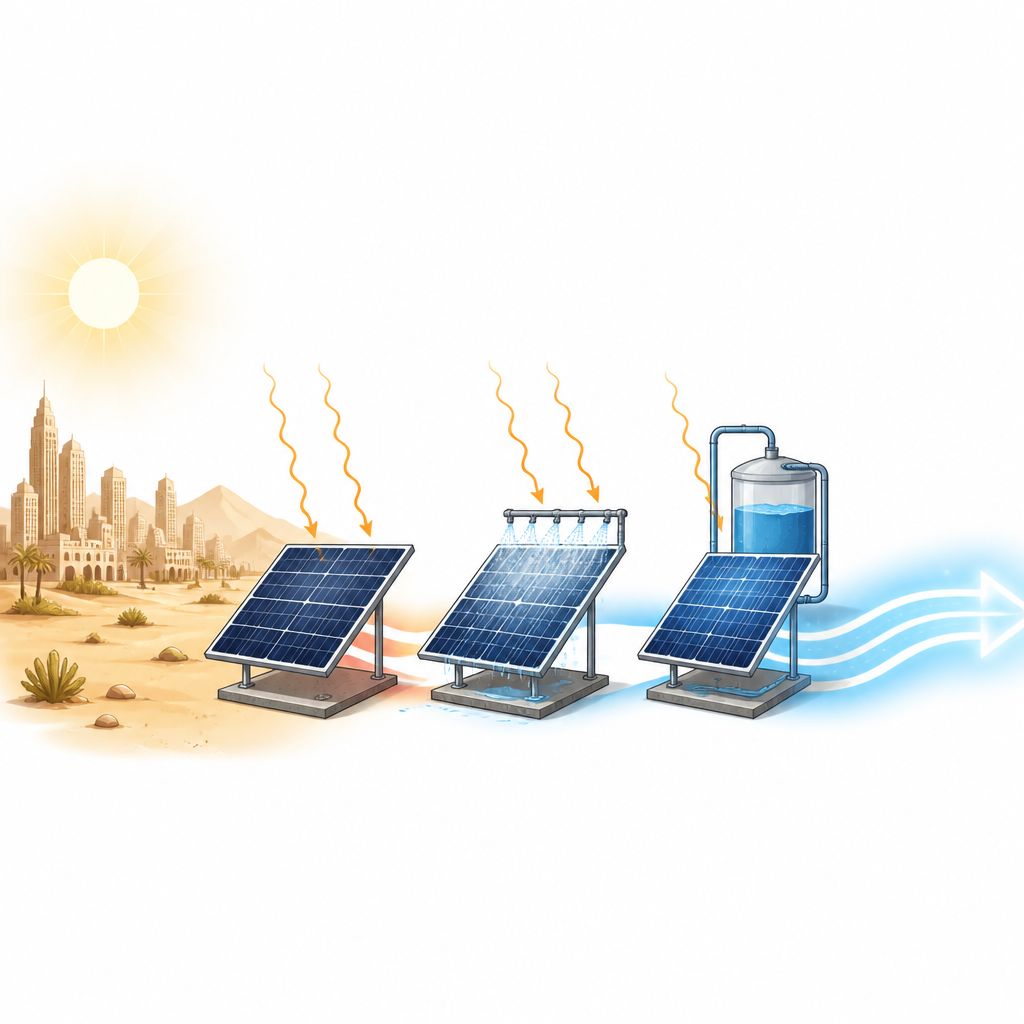
In hot, sunny regions, the very sunlight that makes solar power attractive can also work against it by overheating solar panels and cutting their output. This study looks at simple ways to cool rooftop panels in Upper Egypt’s harsh climate so that households and utilities can squeeze more electricity from the same hardware without turning to complex or costly technology.
Why heat hurts solar panels
Solar panels are tested at a standard temperature of about room level, but on a rooftop in an arid city their surface can soar well above 50 degrees Celsius. For common silicon panels, each extra degree above the standard knocks roughly half a percent off their efficiency. In places like Asyut in Upper Egypt, where summer days bring intense sunlight and scorching air, much of the incoming energy ends up as heat rather than electricity. That raises the stakes for any practical method that can shed heat while still letting plenty of light reach the cells.
Three ways to cool a rooftop panel
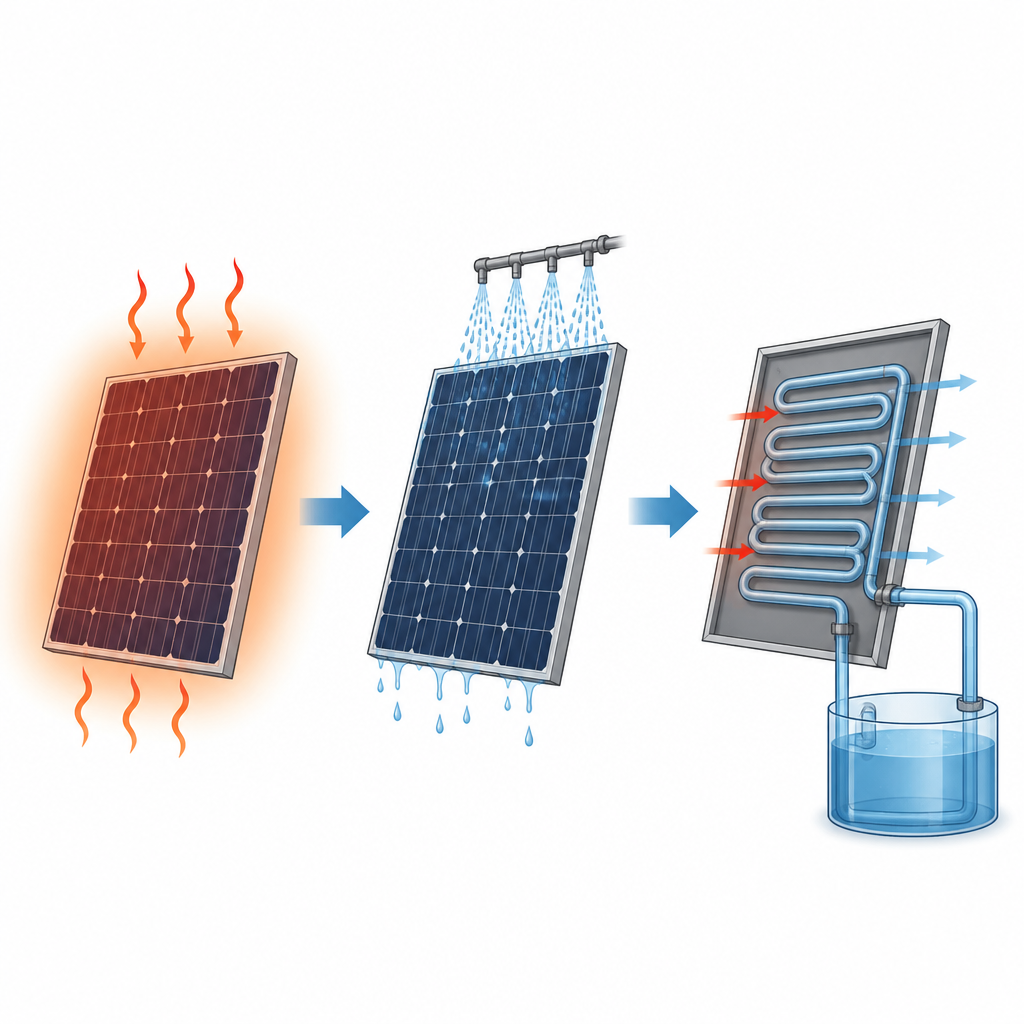
To explore this challenge, the researchers mounted four identical solar panels on a university rooftop and operated them side by side during hot late-summer days. One panel served as a reference with no cooling. The second was cooled from the front with a gentle water spray fed by a small pump and storage tank. The third used a narrow metal tube arranged in a serpentine pattern across the back of the panel, with chilled water circulating in a closed loop. The fourth panel sat under a special tinted glass sheet held a short distance above its surface, intended to act as a passive shield that cut glare and heat without using any energy.
How the tests were carried out
Between early September and early October, the team recorded data every hour from mid-morning to mid-afternoon, when both sun and air temperature were highest. At each interval, they measured panel surface temperature, sunlight intensity, current and voltage, and then swept through a range of electrical loads to map the full power curve for each panel. This careful procedure allowed them to pinpoint the maximum power that each setup could deliver under nearly identical outdoor conditions, and to link changes in output directly to changes in panel temperature.
What cooling did for power output
The two active water-based methods significantly cooled the panels and boosted their power. The spray system, which wets the front surface in short bursts, produced the largest drop in surface temperature during the hottest hours and raised peak power by around 20 percent compared with the uncooled reference panel. The serpentine loop on the back delivered slightly smaller peak gains but often gave the best average power across the day, thanks to its steady, closed-loop cooling and modest water use. In striking contrast, the glass-covered panel ran cooler than the bare panel but suffered large power losses, in some cases more than one-third, because the tinted glass and its clamps blocked or scattered much of the incoming light.
Balancing water, cost, and performance
Beyond raw power, the team weighed practical questions a homeowner or system designer might ask. The spray system had low equipment cost but used the most water, which could be a concern in dry regions unless non-potable sources are available. The serpentine loop required more up-front hardware and pump energy but used very little water, since it recirculated in a closed tank. The glass shield, while simple and passive, clearly showed that cooling which relies on shading can backfire: any gain from lower temperature was overwhelmed by the loss of usable sunlight.
What this means for solar in hot regions
The study shows in plain terms that cooling can help solar panels work better in extreme heat, but only if it preserves the light they need to do their job. In the tested conditions, active water-based cooling, especially spray and serpentine designs, offered worthwhile power gains, while the glass cover reduced output despite lowering temperature. For sun-drenched, arid climates, the authors recommend using serpentine cooling during moderate heat and switching to water spray during the hottest hours, while avoiding shaded-glass approaches that cut irradiance. Their results give planners and installers a clearer picture of how simple cooling add-ons can make solar power more reliable and productive where it is needed most.
Citation: Abdelsattar, M., Saleh, O.M.A., Ali, A.F.M. et al. Enhancing photovoltaic efficiency in arid climates using cooling strategies. Sci Rep 16, 16141 (2026). https://doi.org/10.1038/s41598-026-50636-6
Keywords: solar panel cooling, photovoltaic efficiency, arid climates, water spray cooling, serpentine cooling