Clear Sky Science · en
From blur to blueprint: a fuzzy delphi methodology for evaluating early-stage emerging technologies—the case of end-of-life automotive traction battery disassembly
Why old car batteries matter
As electric cars multiply on our roads, their powerful batteries eventually wear out and need a second life. What happens to these hefty packs is crucial for cutting climate pollution and avoiding shortages of metals like lithium, nickel, and cobalt. This study looks at how best to take apart used automotive traction batteries and introduces a step‑by‑step way to judge brand‑new, still‑uncertain technologies long before they are widely used.
From scrap to resource
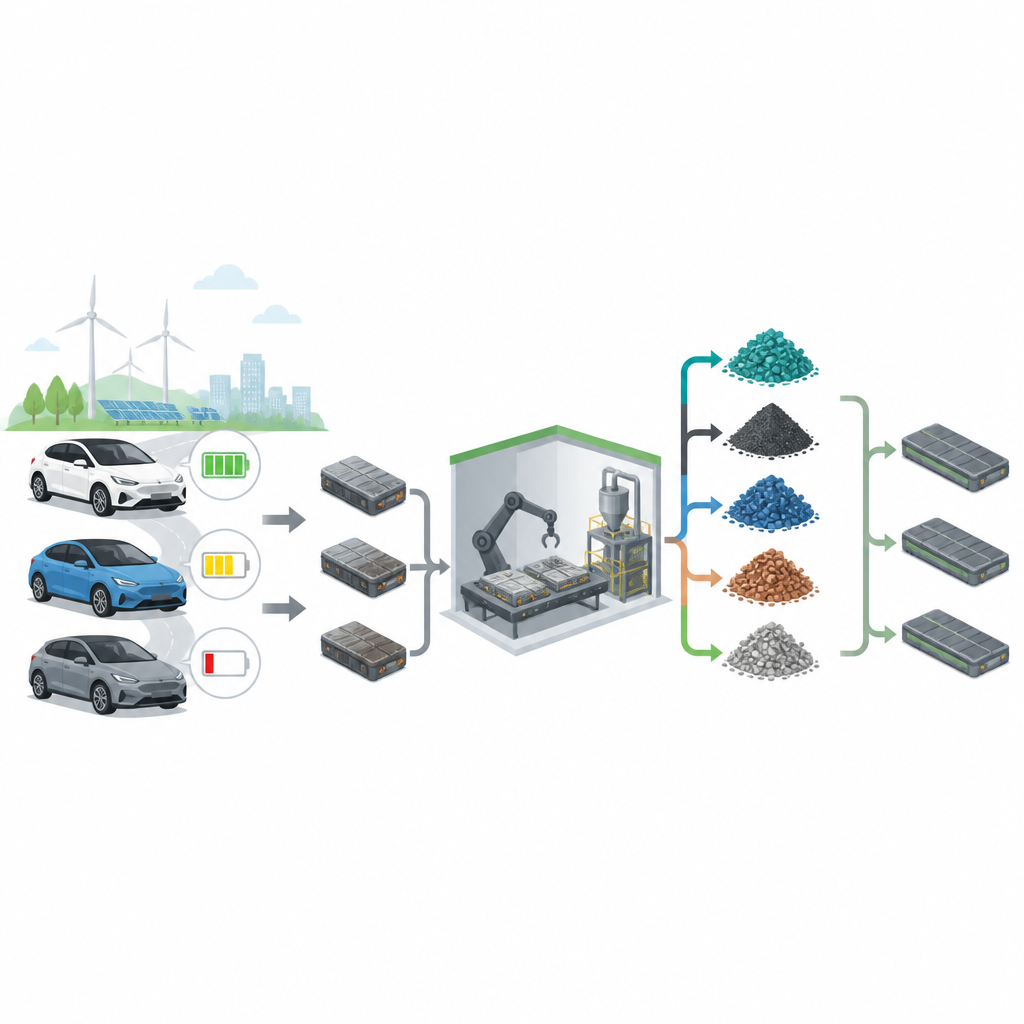
Electric vehicle batteries are packed with metals that the European Union classifies as critical or strategic because they are hard to source but vital for clean technologies. Making a single battery can account for up to half of an electric car’s total manufacturing emissions, much of it from mining and refining raw materials. Recycling end‑of‑life battery packs can ease pressure on mines, strengthen supply security, and lower greenhouse gas emissions, but only if the packs are prepared properly before the actual recycling steps. Disassembly is the key pretreatment stage: it opens the pack, separates modules and structural parts, and delivers cleaner material streams to downstream recyclers.
Why taking packs apart is so hard
Real battery packs are not designed like Lego blocks. They vary widely in shape and layout, contain many glued or welded joints, and often have parts that are hard to reach. At the same time, the packs may be damaged, electrically unstable, or contaminated with flammable electrolyte, posing safety risks. Today, many operations are still done by hand, with few trained workers and little automation. Past research tended to examine just one disassembly technique at a time, such as unscrewing or milling, making it hard for companies or policymakers to compare options fairly. The authors argue that a broad, structured benchmark is needed so that investments and rules can favor solutions that are efficient, safe, and environmentally sound.

Listening to experts, step by step
To build such a benchmark, the researchers first mapped all relevant stakeholders along the battery recycling value chain, from carmakers and machine builders to recyclers, regulators, and researchers. They then interviewed 65 experts to collect the criteria that matter most when judging disassembly technologies. Sixteen criteria emerged, including safety, process robustness, productivity, cost, environmental impact, purity of recovered materials, and how easily a technology can be automated or scaled. Next, a smaller panel of 13 specialists in battery disassembly took part in several rounds of structured questioning using the “Delphi” method, in which experts revise their answers after seeing anonymous summaries of the group’s views. To handle uncertainty and vague judgments, the team combined this with “fuzzy” logic that treats opinions as ranges rather than fixed numbers.
Ranking the ways to cut
Using this fuzzy Delphi framework, the experts first agreed on how important each of the 16 criteria is, then rated eight different disassembly approaches against them. The methods ranged from destructive shredding of whole packs to semi‑destructive cutting with tools such as lasers, knives, and milling heads, as well as non‑destructive unscrewing and manual separation. The final weighted scores showed laser cutting as the most promising option overall, followed by shredding, knife or shear cutting, milling, rotary cutting tools, robotic unscrewing, toolless manual dismantling, and last, water‑jet cutting. Laser systems scored well on productivity, cleanliness of outputs, and potential for automation, though they still face challenges related to safety, heat damage, and investment cost. Shredding benefitted from simplicity but was penalized for low material purity and limited opportunities to reuse components.
What this means for the road ahead
For a layperson, the takeaway is that how we open up old car batteries strongly shapes how green and secure electric mobility can become. This study suggests that carefully controlled cutting, especially with lasers, may offer a better balance of safety, efficiency, and resource recovery than simply grinding packs to pieces, although both will likely coexist. More broadly, the authors provide a reusable “blueprint” for judging early‑stage technologies in any field where hard data are scarce but decisions cannot wait. By systematically gathering views from diverse experts and using fuzzy mathematics to blend them, their approach helps turn today’s blurry picture of emerging tools into a clearer guide for industry planners and policymakers.
Citation: Rettenmeier, M., Möller, M. & Sauer, A. From blur to blueprint: a fuzzy delphi methodology for evaluating early-stage emerging technologies—the case of end-of-life automotive traction battery disassembly. Sci Rep 16, 15516 (2026). https://doi.org/10.1038/s41598-026-50592-1
Keywords: battery recycling, electric vehicles, technology evaluation, Delphi method, laser disassembly