Clear Sky Science · en
A novel shifted Vieta–Lucas spectral collocation approach for multidimensional generalized Benjamin–Bona–Mahony–Burgers equations
Why waves and math matter to everyday science
From ocean swells and sound waves to signals in plasmas and optical fibers, many natural and technological systems are governed by waves that both spread and fade. Capturing these behaviors on a computer is essential for designing coastal defenses, quieter engines, and advanced communication systems. This paper introduces a new, highly accurate way to simulate such complex waves, focusing on a widely used wave model and a modern mathematical tool that lets computers track these motions with remarkable precision and stability.
A flexible equation for real-world waves
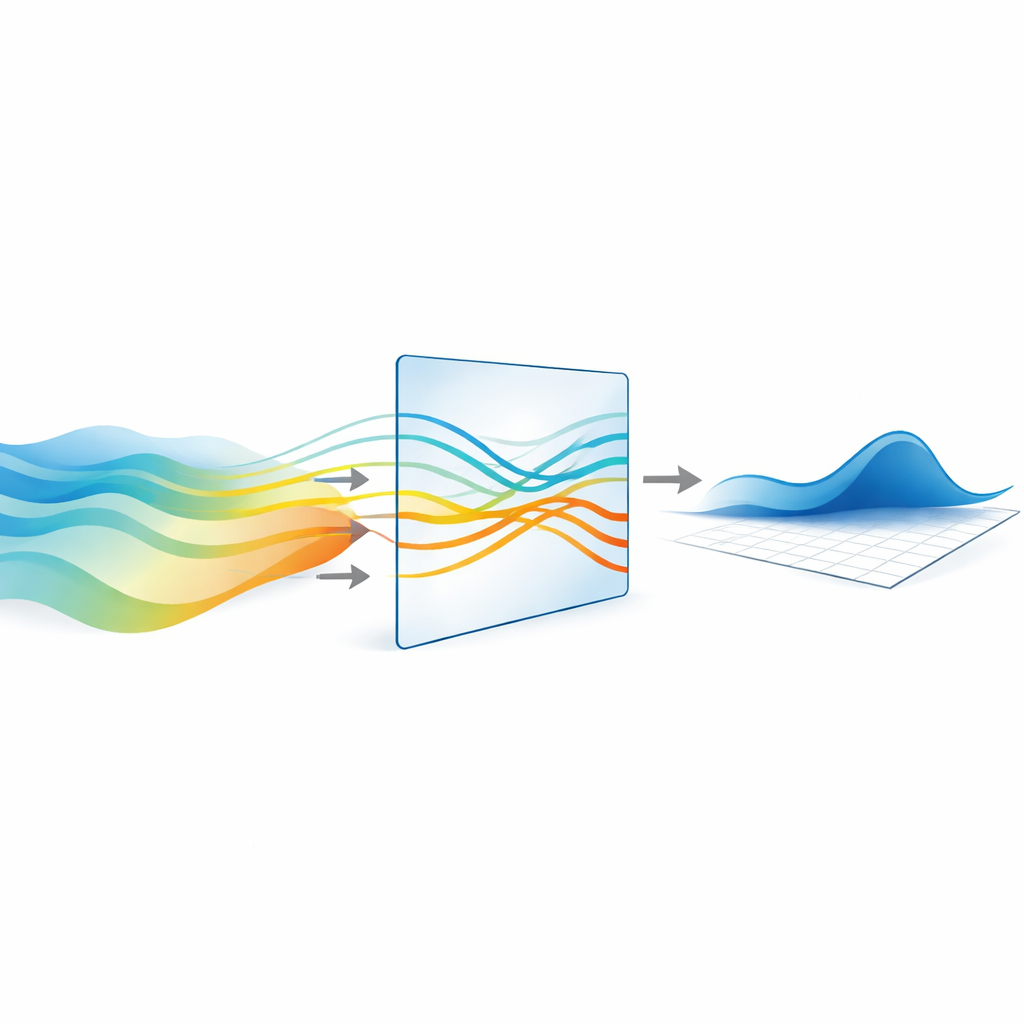
The study centers on a family of equations known as generalized Benjamin–Bona–Mahony–Burgers (GBBMB) equations. These equations describe one-way, long waves moving through media where several effects act at once: transport, spreading, and energy loss. As a result, they are used to model shallow water waves, fluid flow in channels, nonlinear sound, and transport processes in plasmas. In their generalized and higher-dimensional forms, these equations become too complicated to solve exactly, especially when they include mixed high-order derivatives and strong nonlinear terms. Reliable numerical methods are therefore crucial to explore their behavior and make quantitative predictions.
New building blocks for wave approximation
To tackle this challenge, the authors build on a special family of mathematical functions called Vieta–Lucas polynomials. By shifting these polynomials to the standard interval used for computation, they obtain shifted Vieta–Lucas polynomials, which serve as smooth building blocks for approximating unknown wave profiles. Compared with more familiar polynomial families such as Chebyshev or Legendre, these shifted Vieta–Lucas functions offer faster convergence, greater flexibility on finite intervals, and an easier way to handle boundary conditions. They also form an orthogonal system, which helps keep numerical calculations stable and reduces the amplification of rounding errors.
How the new collocation method works
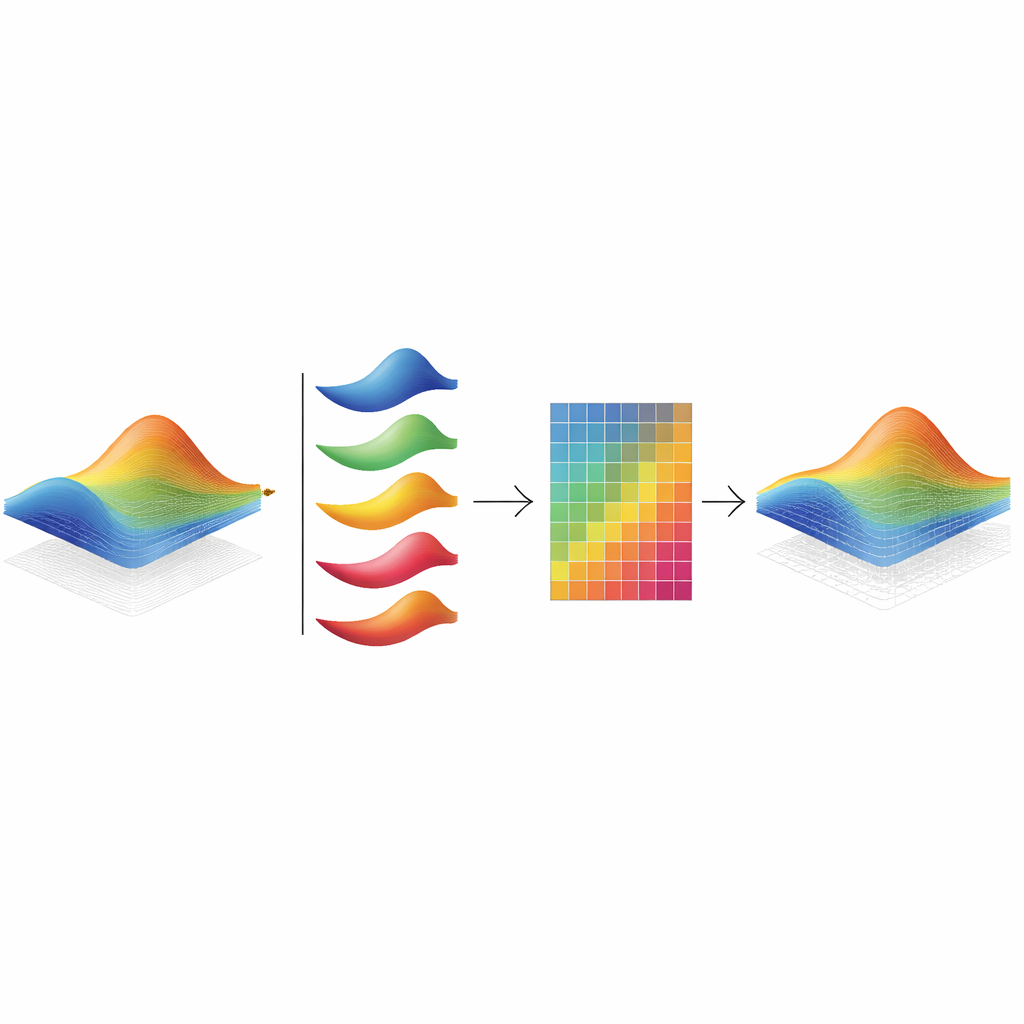
The proposed Vieta–Lucas Collocation Method (VLCM) represents the solution of the GBBMB equation as a finite combination of these shifted polynomials in space and time. The key idea is to force the equation to hold exactly at a carefully chosen set of points, called collocation points, which are taken from the roots of higher-degree polynomials in this family. By expressing all required derivatives of the wave field in terms of the same basis functions, the continuous wave problem is transformed into a nonlinear algebraic system for the unknown coefficients. This system is then solved iteratively using a Newton scheme until the residual errors fall below a very strict tolerance, ensuring an extremely accurate fit to the original equation and its boundary and initial conditions.
Proof of reliability and performance
Beyond presenting the algorithm, the authors rigorously analyze its error and convergence. Assuming the underlying wave solution is smooth, they prove that the approximation error decays faster than any power of the number of basis functions, reflecting a super-algebraic, almost factorial drop in error. They extend this analysis from one space dimension to two spatial dimensions plus time, showing that accuracy and stability persist even for fully multidimensional problems. Numerical experiments on three test cases—one-dimensional and two-dimensional GBBMB models with different nonlinearities—confirm the theory. When compared against high-order finite difference schemes, spectral element methods, finite elements, and meshless approaches, VLCM consistently produces errors several orders of magnitude smaller, often down to 10^−11, while keeping computation times reasonable.
What this means for future simulations
For non-specialists, the takeaway is that the authors have designed a new numerical lens that can focus sharply on complicated wave behaviors without distorting their shape. Their shifted Vieta–Lucas collocation method delivers very accurate and stable solutions to a challenging class of wave equations in one and two spatial dimensions. Because the approach is both flexible and efficient, it can serve as a reliable baseline for more advanced models, including those that incorporate memory effects through fractional derivatives or that couple multiple interacting fields. In practical terms, this work provides a powerful tool for scientists and engineers who need trustworthy wave simulations to understand, design, and optimize real-world systems.
Citation: Hafez, R.M., Ahmed, H.M., Alburaikan, A. et al. A novel shifted Vieta–Lucas spectral collocation approach for multidimensional generalized Benjamin–Bona–Mahony–Burgers equations. Sci Rep 16, 14671 (2026). https://doi.org/10.1038/s41598-026-50432-2
Keywords: nonlinear waves, numerical simulation, spectral methods, wave modeling, partial differential equations