Clear Sky Science · en
Signal averaging in cryogenic fast-field-cycling NMR experiments
Sharper views of spinning atoms
Modern medical scans and chemical tests often rely on nuclear magnetic resonance, a technique that watches tiny atomic magnets inside matter. For certain advanced applications, scientists need to rapidly change the strength of the magnetic field while keeping measurements extremely precise. This study shows how a redesigned control system lets researchers switch magnetic fields at very low temperatures while still collecting clean, repeatable signals from the atoms they want to study.
Why changing the field matters
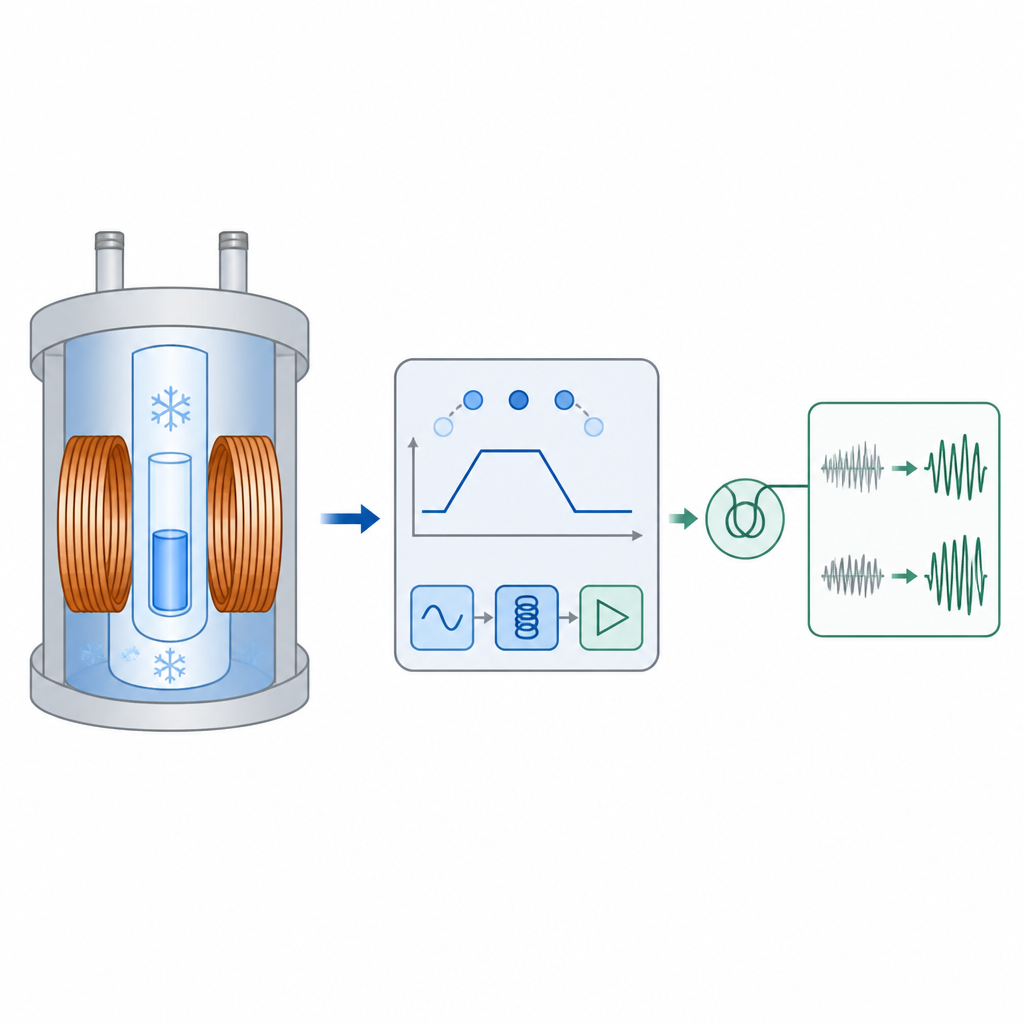
In NMR, atoms behave like spinning tops that slowly relax back to rest after being disturbed. The time this takes, called the relaxation time, depends on both the strength of the magnetic field and the temperature. By changing the field, scientists can tune in to different kinds of molecular motion, from fast local wiggles to slow tumbling of large molecules. This is especially important for methods that boost weak NMR signals by creating highly polarized samples at very low temperatures, which then have to be moved and measured before the extra order fades away.
The challenge of a restless magnet
The experiments in this work use a powerful superconducting magnet whose field is controlled by an electric current. Previously, the system could change the field quickly, but it struggled to land neatly on the desired value. After a ramp, the field would creep toward its target over more than a second and would differ slightly from one experiment to the next. These drifts were large compared to the natural width of the NMR signals, so the measured frequencies and phases shifted from scan to scan, making it difficult or impossible to average many measurements together to improve sensitivity.
A smarter feedback loop
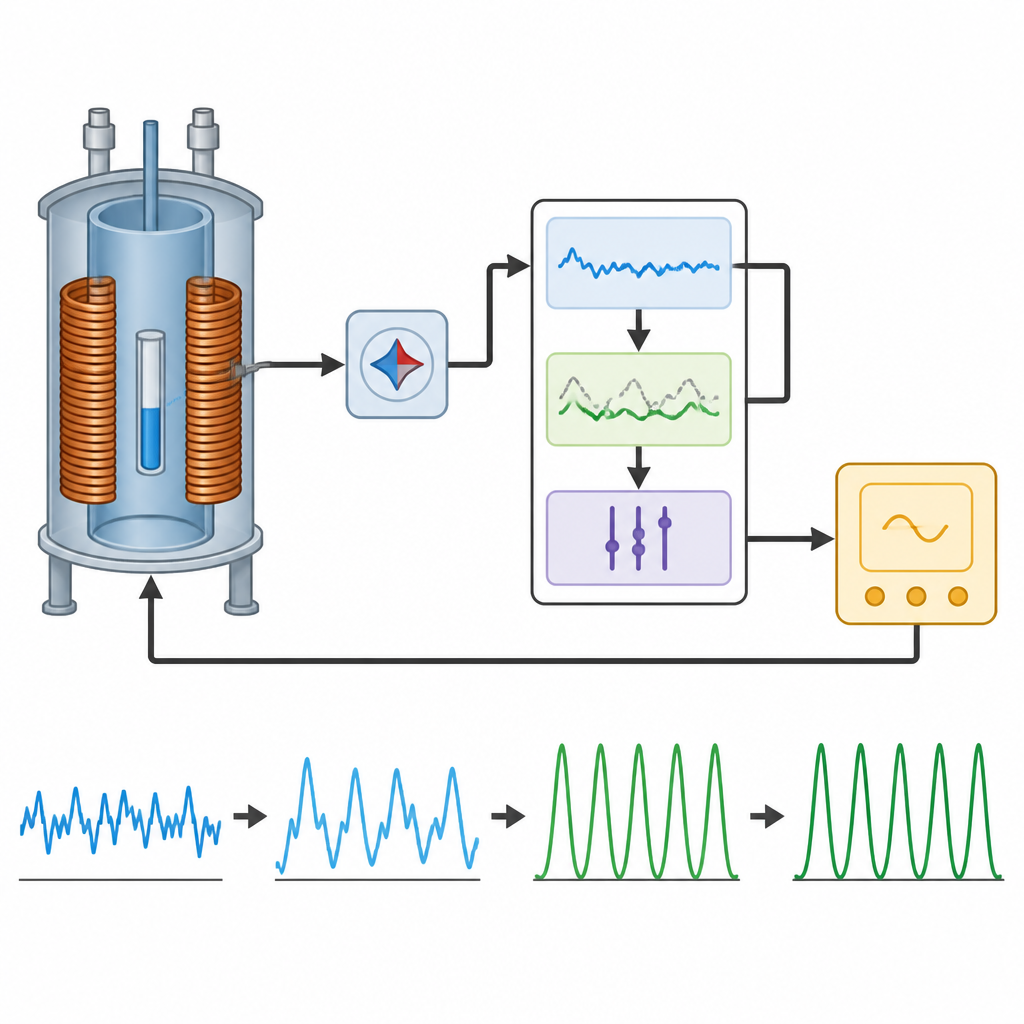
To tame these fluctuations, the authors added a new control architecture built around a programmable digital board. Simple timing signals from the NMR instrument tell the board when to raise or lower the field, so the magnet’s behavior can be scripted as part of the pulse sequence. At the same time, a Hall sensor near the magnet continuously measures the actual field. A feedback algorithm compares this reading to the desired value and gently adjusts the power supply in real time. This proportional-integral-derivative control loop acts like a smart thermostat for the magnet, shortening the settling time and shrinking the remaining field error by about an order of magnitude.
Cleaner signals at icy temperatures
The team tested the improved setup on a common model compound, pyruvic acid, containing carbon-13 atoms and a stable radical used in hyperpolarization research. With the old behavior, small field errors could shift the signals enough that adding many scans together would partly cancel the signal instead of just reducing the noise. With the new feedback, the remaining field jitter is only a fraction of the natural line width for carbon-13, so averaging 100 scans boosts the signal-to-noise ratio by a factor of about six. The authors also show that they can reliably track how the carbon-13 signal decays when the field is briefly dropped to a low value, allowing them to measure relaxation times as short as one tenth of a second at low temperature.
What this means for future experiments
By making the magnetic field more stable and more tightly synchronized with the NMR timing, this work turns a demanding low-temperature instrument into a far more sensitive probe. Researchers can now explore how strongly polarized samples lose their extra order during rapid field changes and can study weaker signals from less concentrated samples. Although further refinements are possible, such as better calibration of the field sensor, the new control scheme already opens the door to more precise measurements of fast processes in advanced NMR and hyperpolarization experiments.
Citation: Jurkutat, M., Safiullin, K., Singh, P. et al. Signal averaging in cryogenic fast-field-cycling NMR experiments. Sci Rep 16, 14866 (2026). https://doi.org/10.1038/s41598-026-50382-9
Keywords: fast field cycling NMR, magnetic field control, hyperpolarization, cryogenic experiments, signal averaging