Clear Sky Science · en
Genus hologram antenna for MIMO applications
Why this new antenna design matters
Streaming ultra‑high‑definition video to trains, guiding drones and missiles, or connecting countless sensors in smart cities all demand wireless links that move vast amounts of data without bulky hardware. This paper introduces a new kind of flat "hologram" antenna that can steer and split its radio beam in clever ways, while remaining thin, lightweight, and inexpensive. It is designed to serve next‑generation 5G and 6G systems and to fit onto curved surfaces such as vehicles and aircraft, offering a practical path to faster and more reliable wireless connections.
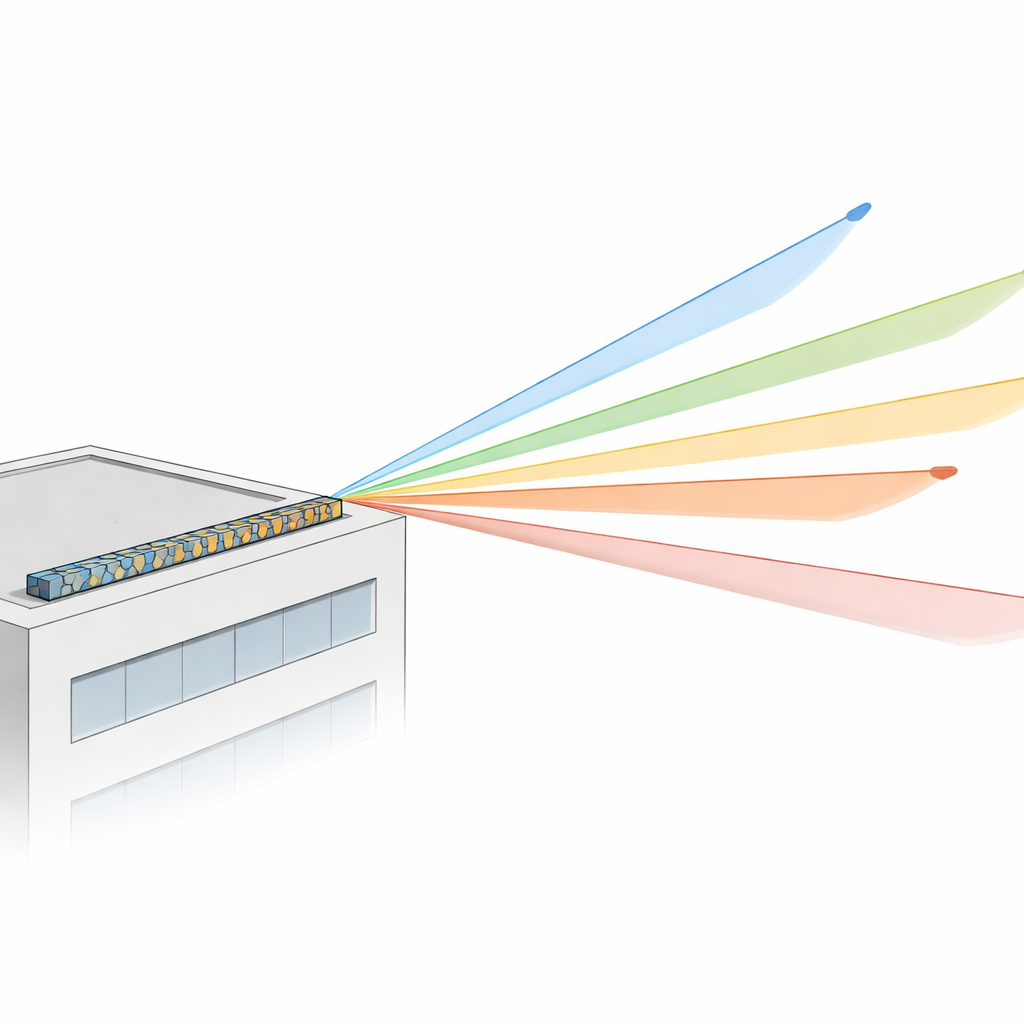
A thin surface that shapes radio waves
Instead of using many individual antenna elements with a maze of cables and phase shifters, the authors build what is essentially an engineered metal skin. This skin is made from a repeating pattern of tiny hexagonal metal patches printed on a standard circuit board. When a simple feed line launches a guided radio wave along this patterned surface, the patches are sized and spaced so that parts of the wave leak out in a controlled direction, like light diffracting from a hologram. By carefully choosing the pattern, the researchers can focus the radiated energy into a narrow, high‑gain beam while keeping the antenna low‑profile and easy to manufacture.
Scanning and splitting the beam
A key advantage of this hologram antenna is its ability to change where it points simply by changing the operating frequency or the pattern of the patches. In tests between 13 and 17 GHz, the main beam smoothly scans from about 30 to 64 degrees, reaching a peak gain of 20.6 dBi with high radiation efficiency (about 87 percent). By mixing two or more periodic patterns along the same surface, the antenna can also send energy into several directions at once. The team demonstrates dual beams at modest angles and widely separated beams around plus and minus 60 degrees. They then stack two patterned layers separated by a thin metal sheet to produce four simultaneous beams at angles spreading from −120 to +120 degrees, all from a compact structure.

Working as a compact multi‑antenna system
Modern base stations and devices often rely on multiple antennas working together (MIMO) to boost data rates and link reliability. When these antennas sit too close to each other, they tend to interfere, hurting performance. The authors arrange two of their hologram antennas side‑by‑side with an edge‑to‑edge spacing of only a quarter of a wavelength—extremely tight at these frequencies. To prevent them from "talking" to each other too strongly, they insert slim passive strips between the radiating surfaces. These strips are tuned so that the unwanted fields they carry cancel the coupling between the main antennas, cutting interference from roughly −10 dB to better than −20 dB across the band and yielding excellent diversity metrics that are desirable in real MIMO systems.
Bending the antenna around real‑world surfaces
Flat test boards are only part of the story; many real platforms are curved. The researchers therefore examine how their hologram antenna behaves when it is bent around cylinders in two different directions. When wrapped gently across its short dimension, the antenna largely keeps its beam shape and efficiency, with only moderate changes in gain as the bend tightens. When curved along its long dimension, where the radiating aperture is largest, the effects are stronger: the main beam widens, side lobes grow, and the frequency of best performance shifts. Even so, for realistic radii similar to fuselages or vehicle roofs, the antenna continues to provide strong, steerable beams, indicating it can be integrated into missiles, unmanned aircraft, cars, and trains.
What this means for future wireless systems
In practical terms, the work shows that a single, simple patterned surface can deliver many of the functions that today require bulky phased arrays: high gain, wide‑angle beam steering, multiple simultaneous beams, and closely spaced MIMO operation. Because it is thin, low‑cost, and can conform to curved hosts, the proposed genus hologram antenna is a promising building block for future 5G and 6G infrastructure and for compact high‑performance platforms. The authors also point toward future versions that add electronic tuning or fully two‑dimensional patterns, which could further sharpen the beams and make them reconfigurable on demand.
Citation: Eltresy, N.A., Malhat, H.A. & Deen, S.Z. Genus hologram antenna for MIMO applications. Sci Rep 16, 14647 (2026). https://doi.org/10.1038/s41598-026-50229-3
Keywords: hologram antenna, metasurface, MIMO, beam steering, 5G 6G wireless