Clear Sky Science · en
Influence of seismic strain stress on evolution law of microcracks in concrete TPB tests using AE technology
Why tiny cracks in concrete during quakes matter
When an earthquake shakes a city, the safety of bridges, tunnels, and buildings depends on how the concrete inside them breaks. This study looks closely at the tiny cracks that form and grow in concrete when it is bent at speeds similar to seismic shaking. By listening to the sound of cracks forming, the researchers show how faster shaking can make concrete appear stronger while at the same time turning its failure into a more sudden and brittle event, with important consequences for structural safety.
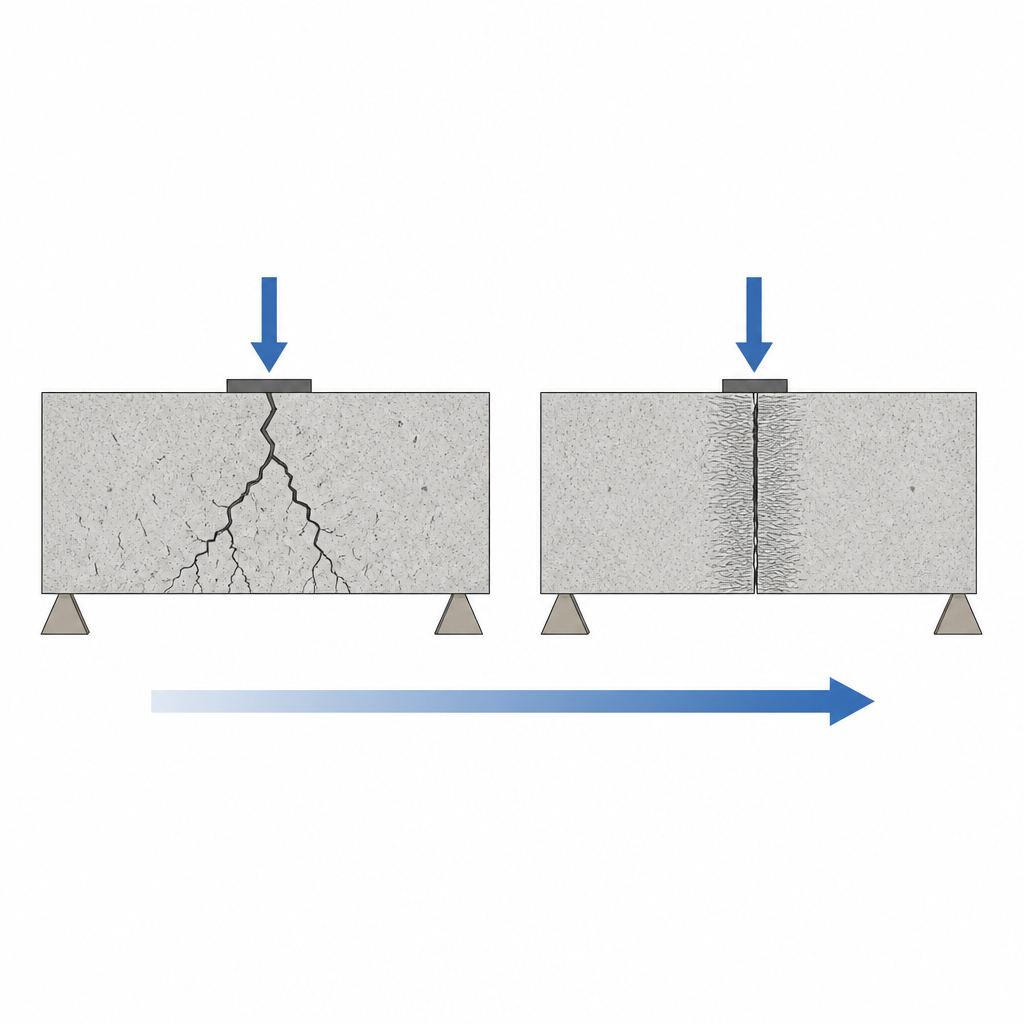
How the team tested earthquake style loading
The researchers made concrete beams with a starter notch and bent them using a three point bending setup, where each beam rested on two supports while a load pushed down in the middle. They carefully controlled how fast the load was applied, from very slow, almost static conditions to rates similar to those caused by earthquakes. At the same time, they used acoustic emission sensors, which act like tiny microphones, to pick up the elastic waves released whenever a microcrack formed or grew inside the concrete. This allowed them to record both the visible behavior of the beam and the invisible crack activity happening deep within it.
Concrete gets stronger but more brittle as loading speeds up
The bending tests showed that concrete does not behave the same way under slow and fast loading. As the rate of deformation increased from nearly static to earthquake level, the peak load the beams could carry rose by about one third, and the energy needed to drive a crack across the beam also increased by a similar amount. This apparent strengthening happens because the water trapped in the pores and tiny gaps of the material cannot flow away quickly at high loading rates, creating extra resistance that slows crack growth. However, while the beams could carry higher loads, the way they failed became more abrupt, with less visible warning and a steeper drop in load once the main crack took off.
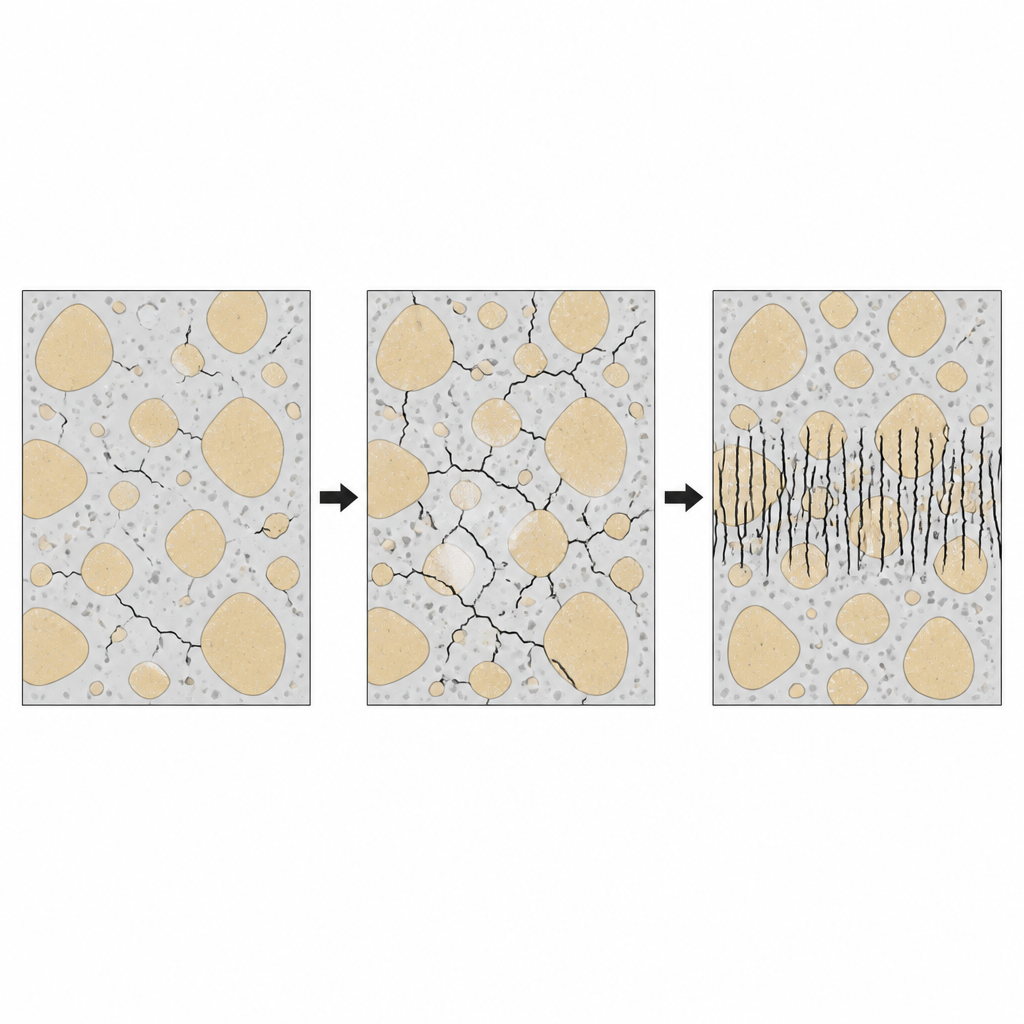
From gentle detours to straight through breaks
By examining the broken surfaces, the researchers found that the crack paths changed with loading rate. Under slow loading, cracks snaked around the larger stone particles, following the weaker boundary zones between stone and mortar. The fracture surfaces were rough, and many intact coarse aggregates were exposed, a sign that the material had failed in a more gradual, ductile way. Under faster loading, the main cracks ran straighter and cut directly through many aggregates. This straight, punch through style failure indicates that the material had no time to search for an easier route and instead broke the stronger parts of the internal skeleton, concentrating damage in a narrow zone.
Listening to cracks to map hidden damage
The acoustic emission measurements provided a detailed picture of how microcracks developed. With increasing loading rate, both the number of recorded crack events and the total acoustic energy grew, showing that more intense internal damage was taking place. At low rates, these events were spread out along the length of the beam, matching a wide damage zone and a twisting main crack. At higher rates, the signals clustered tightly near the pre existing notch, revealing that tiny cracks were merging into a single, focused fracture line. By analyzing the shapes of the recorded waveforms, the team also found that the dominant crack type shifted from opening cracks, which pull faces apart, to sliding cracks, which shear them past one another, as loading became faster.
What this means for earthquake resistant design
The study concludes that, under earthquake like loading, concrete can carry higher stresses but tends to fail more suddenly, with straighter, shear dominated cracks that offer little advance warning. This trade off between strength and ductility means that design rules based only on slow, static tests may underestimate the risk of brittle failure during real earthquakes. The findings suggest that engineers should account for the way crack patterns and internal damage change with loading rate, strengthen parts of structures where shear cracking is likely, and use monitoring systems that can detect shifts in crack behavior before they lead to sudden collapse.
Citation: Xiao, D., Wen, L., Cao, Y. et al. Influence of seismic strain stress on evolution law of microcracks in concrete TPB tests using AE technology. Sci Rep 16, 15483 (2026). https://doi.org/10.1038/s41598-026-49968-0
Keywords: concrete fracture, seismic loading, strain rate, microcracks, acoustic emission