Clear Sky Science · en
Design and implementation of a phasor measurement unit using a new measurement technique
Keeping the Lights On in a Changing Grid
As more wind farms, solar parks, and other renewable sources connect to our power grids, the flow of electricity becomes less predictable and more complex. To keep the lights on and avoid blackouts, grid operators need tools that can see what is happening across the network in real time, with astonishing precision. This paper describes the design and testing of a new kind of monitoring device, called a phasor measurement unit (PMU), that can track the state of the grid more quickly and accurately than many existing devices, even when the system is under stress.

A Fast "Camera" for the Power System
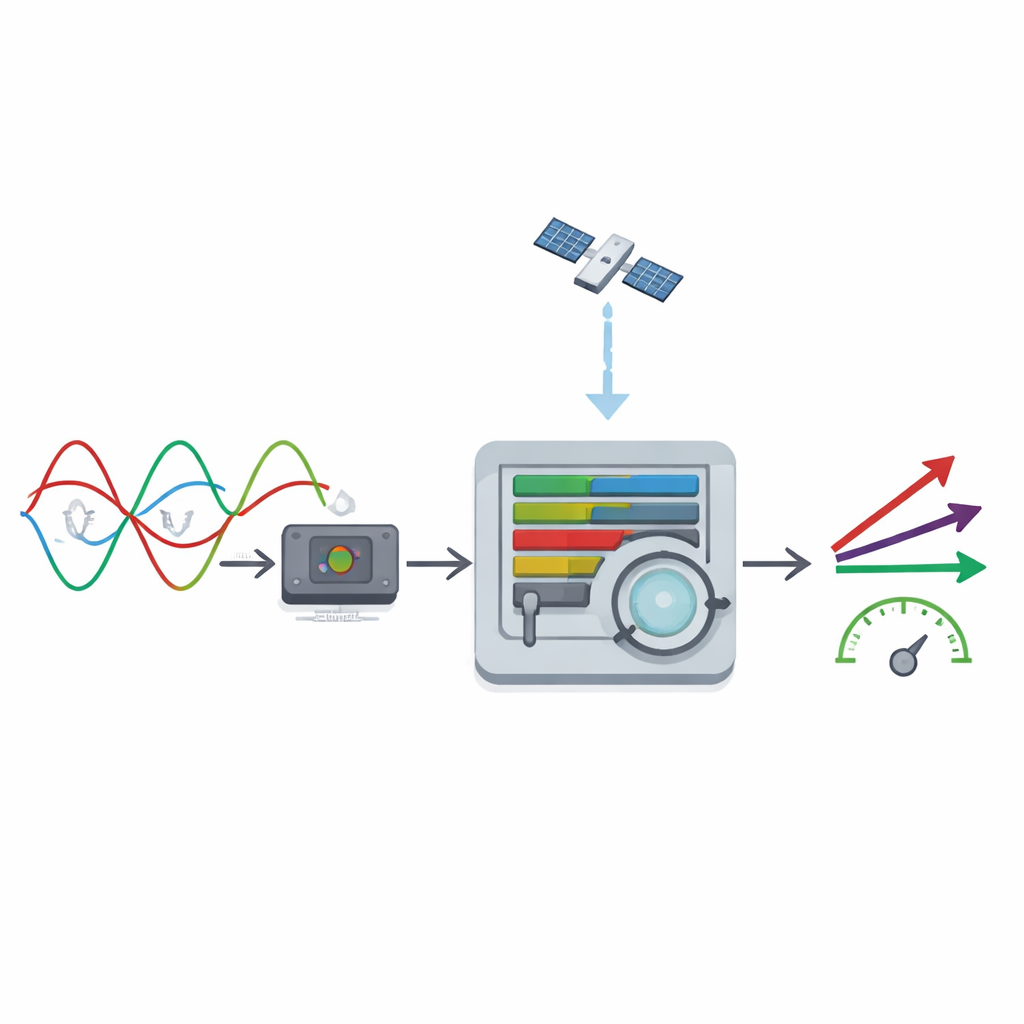
A PMU is like a high-speed camera for electricity. Instead of pictures, it captures synchronized snapshots of key electrical quantities such as voltage, current, and frequency at many locations across the grid. These snapshots, called synchrophasors, are all stamped with the same precise time reference from GPS satellites, so control centers can line them up and see a coherent picture of the whole network. Today, PMUs help with tasks such as detecting faults, shedding load before equipment is damaged, and monitoring how close the system is to instability. As our grids become “smarter” and more crowded with renewables, the need for more accurate and robust PMUs has grown sharply.
Why Existing Tools Fall Short
Most current PMUs estimate synchrophasors using a mathematical method known as the Discrete Fourier Transform. While this approach is efficient, it struggles when the signal is distorted, when the grid frequency drifts from its nominal value, or during sudden events such as faults or abrupt load changes. These conditions are becoming more common with renewable generation and power electronics. The result can be errors in the measured magnitude, angle, or frequency—exactly when grid operators most need trustworthy data. Researchers have proposed many improved algorithms over the years, but many studies stop at simulations or focus on just the math, without building and validating a full, three-phase device that handles both voltage and current in real time.
A New Way to Measure in Real Time
The authors tackle this gap by building a complete PMU around a more advanced measurement method called Sliding Fourier Transform Phase-Locked Loop (SFT-PLL). In simple terms, their approach continuously slides a measurement window along the incoming three-phase signals and uses a control loop to lock onto the true grid frequency and phase, even when they shift. The hardware prototype includes commercial voltage and current sensors that can handle typical grid levels, a high‑resolution 16‑bit analog‑to‑digital converter, and a Texas Instruments Delfino processing board to run the real-time algorithm. A GPS module provides a pulse-per-second signal so that all measurements are aligned to global time, allowing data from many PMUs to be combined into a single, synchronized view of the grid.
Putting the Prototype Through Its Paces
To test whether this new PMU is ready for real-world use, the team connected it to a three‑phase reference source capable of generating a wide variety of precise test signals. They checked how well the device measured voltage levels from 100 to 300 volts and currents from 1 to 5 amperes, all at the standard 50‑hertz grid frequency. Then they challenged it with harsh scenarios: unbalanced voltages where one phase is boosted and another is reduced, sudden shifts in phase angle, and injected harmonics that imitate distortion from electronic equipment and renewable inverters. For each case, they evaluated standard performance figures, including how far the measured phasor strays from the true value (Total Vector Error), how much the frequency reading is off, and how accurately the device reports how fast frequency is changing.
What the Results Mean for the Grid
The measurements show that the SFT‑PLL‑based PMU stays well within strict international limits set by IEC/IEEE standards, even under strongly unbalanced or distorted conditions. Errors in the voltage and current phasors remain below 1 percent, and frequency errors stay below 0.005 hertz, with very small mistakes in the rate of change of frequency as well. In practical terms, this means the device can deliver clean, reliable information fast enough to track grid disturbances as they unfold, giving operators a better chance to react before problems cascade. Because the design is modular and relatively low‑cost, it could be deployed widely in smart grids, research labs, and teaching facilities. For a layperson, the takeaway is clear: smarter, more precise “eyes” on the grid like this PMU can make power systems more resilient, helping ensure that an increasingly renewable‑powered future remains stable and reliable.
Citation: Mohamed, S.A., Mageed, H.M.A., Arafa, O.M. et al. Design and implementation of a phasor measurement unit using a new measurement technique. Sci Rep 16, 14281 (2026). https://doi.org/10.1038/s41598-026-49889-y
Keywords: phasor measurement unit, synchrophasor, smart grid, power system monitoring, renewable integration