Clear Sky Science · en
Frequency reconfigurable open-slot antenna for LTE smartphone applications
Why your phone needs smarter antennas
As our phones juggle streaming, video calls, navigation, and countless apps, they must talk to many different wireless bands at once. Yet the space inside a slim smartphone is fiercely limited. This article presents a new tiny antenna design that can switch its behavior on demand, allowing one compact part to cover all major 4G LTE bands used around the world without sacrificing battery life or signal quality.
Making more from less space
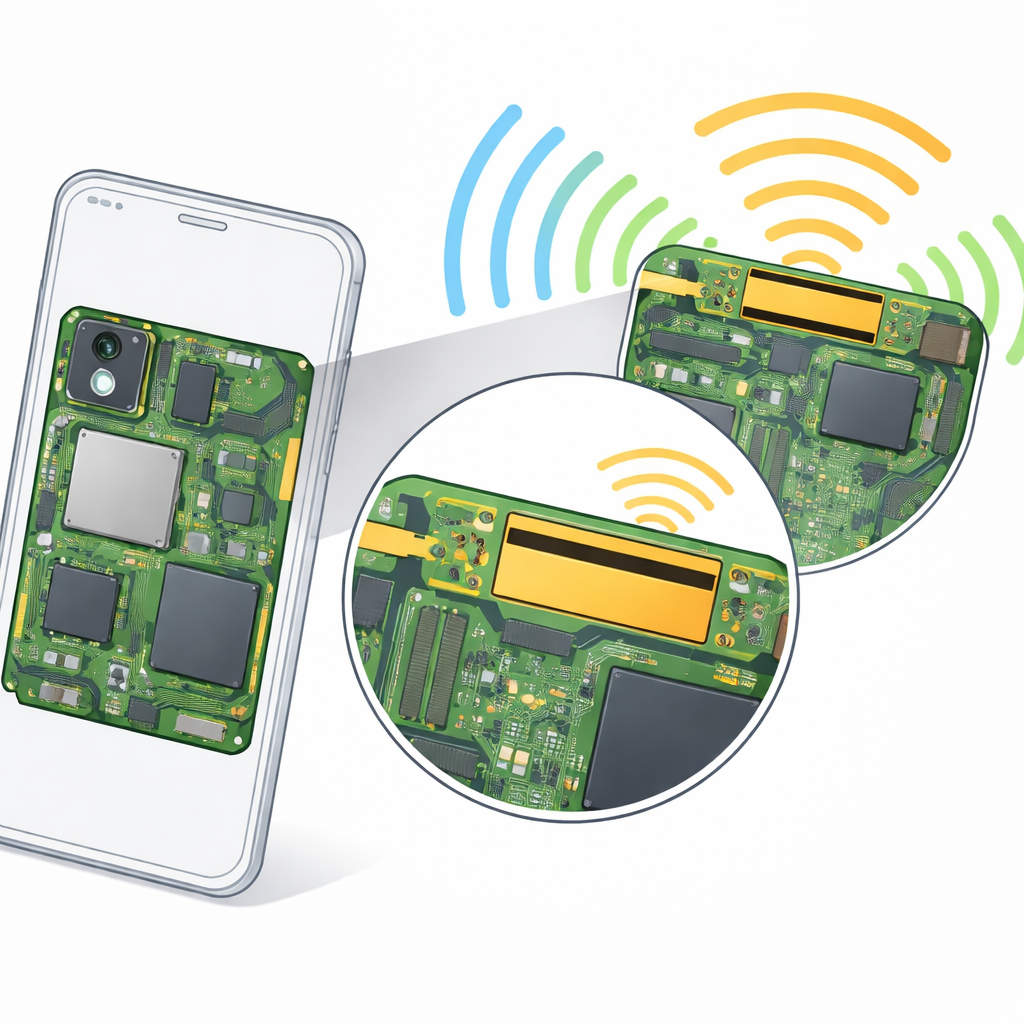
Modern smartphones must work across a wide span of frequencies so they can connect on different networks and in different countries. Traditionally, this has meant either squeezing in several antennas or using bulky, complicated designs, both of which compete with cameras, batteries, and big displays. The work described in this paper tackles that problem with a single “open slot” carved into the phone’s main circuit board. By carefully shaping this slot and feeding it with a thin metal strip, the author turns a piece of the existing hardware into a powerful antenna, saving space while still reaching the low and high bands required for LTE service.
A slot that can change its tune
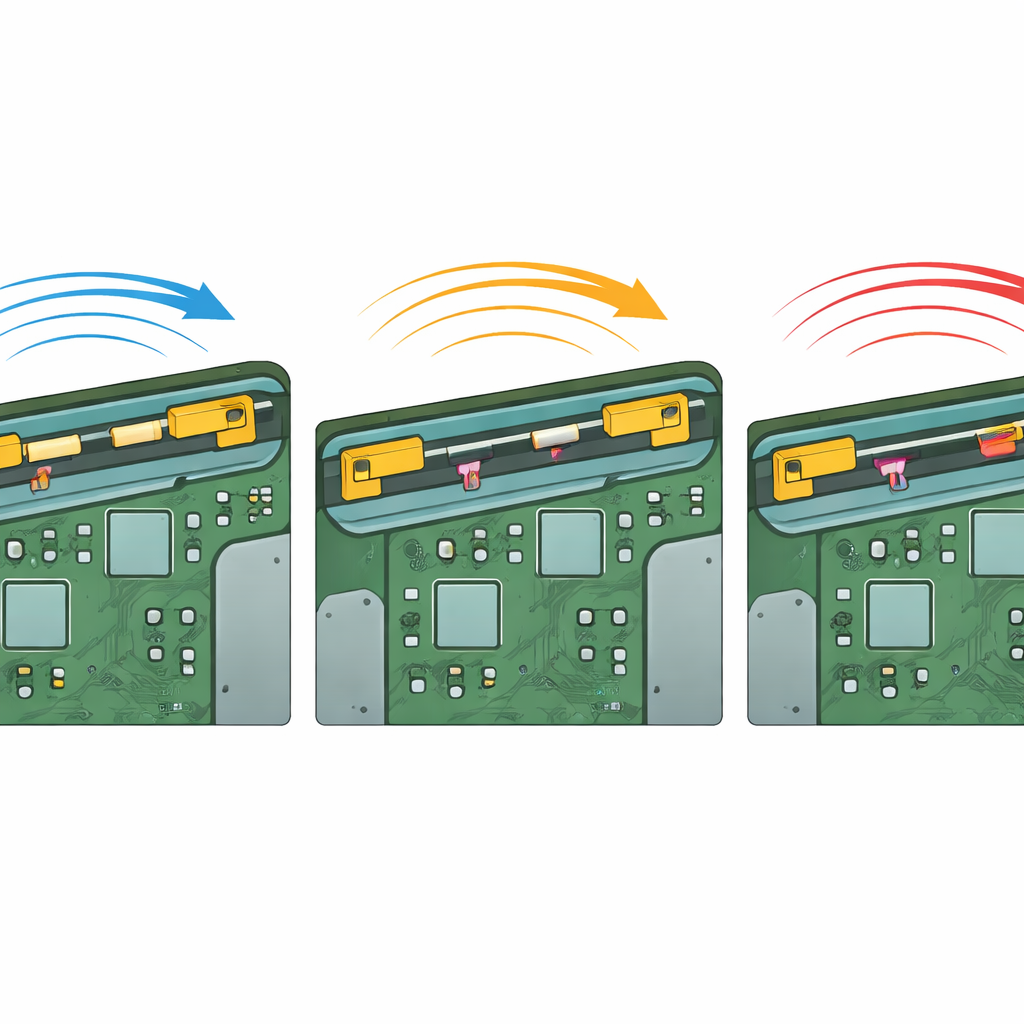
The heart of the design is that the antenna does not behave in just one fixed way. Instead, it can be reconfigured electronically. The slot runs along the top of a standard phone-sized board, while an L-shaped metal strip on the opposite side feeds energy into it. Small electronic parts—a tiny coil and a tiny capacitor—are connected to the slot through switches. Turning one path or the other on changes how current flows in the slot and effectively lengthens or shortens the electrical path. This shifts the antenna’s natural “notes,” or resonant frequencies, up or down, much like changing the tension or length of a guitar string. With only two such parts and three simple states—no extra part, added capacitance, or added inductance—the same slot can be tuned to cover eight key LTE-related bands from about 700 megahertz up to 2.7 gigahertz.
Proving the idea in the lab
To show that this is more than a simulation, the author built a working prototype on a common fiberglass circuit board. The antenna was wired to a test instrument that measures how much incoming signal is reflected instead of radiated, a key sign of how well an antenna is matched to its electronics. Across the three switch states, the prototype consistently kept reflections low over all the required bands, especially in the notoriously hard-to-cover lower frequencies used for long-range links. Additional checks showed that the switching parts introduce only tiny extra losses and that small variations in the coil and capacitor values or in board length—similar to what might happen between different phone models—do not break coverage.
How it behaves in the real world
Beyond basic tuning, the study examined how efficiently the antenna turns electrical power into radio waves and how its patterns look in space. Measurements inside an anechoic chamber, which mimics free space, revealed high total efficiency across both the low and high bands, with only slight differences between the three states. The radiation pattern is somewhat uneven because of the antenna’s asymmetrical shape, but remains stable and predictable, which is what matters most for designers. The author also modeled the presence of a user’s hand and head, standard practice for checking how the body detunes the antenna and how much energy it absorbs. Even in these tougher conditions, the antenna stayed within safety guidelines for specific absorption rate and still provided the needed bandwidth.
How this design compares with others
The paper compares the new antenna with many recent reconfigurable designs that use various shapes, layers, and types of switching devices. Many earlier approaches either occupy more area, need several tuning parts and control lines, or fail to fully cover the lowest LTE bands while keeping high efficiency. In contrast, this slot-based design uses the phone’s own ground plane effectively, keeps the layout simple, and relies on just two switches paired with a coil and a capacitor. This gives it both a broad tuning range and a compact footprint, making it especially attractive for phones that push the screen close to the edges and leave little room for dedicated antenna modules.
What it means for future phones
In plain terms, the article shows that a single, slim antenna etched into the main circuit board of a phone can be made to “retune itself” and handle all important LTE bands without sacrificing efficiency or safety. By swapping between a few electrical states, the antenna adapts to different parts of the spectrum while staying small enough for modern bezel-free designs. This approach could help future smartphones, tablets, and other handheld gadgets stay connected in more places using fewer components, freeing space for other features while keeping wireless performance strong.
Citation: Abdelgwad, A.H. Frequency reconfigurable open-slot antenna for LTE smartphone applications. Sci Rep 16, 14696 (2026). https://doi.org/10.1038/s41598-026-49763-x
Keywords: smartphone antenna, LTE bands, reconfigurable antenna, open slot design, wireless connectivity