Clear Sky Science · en
Dual-polarized ku-band microstrip antenna array with metamaterial loading and protective superstrate for GB-SAR applications
Watching the Earth Breathe
From slow-moving landslides to the subtle sway of bridges, our planet is in constant motion. Ground-based radar cameras can track these tiny shifts from a safe distance, helping engineers prevent disasters and keep infrastructure healthy. But the radar antennas behind these systems are often bulky, power-hungry, and not designed for harsh outdoor environments. This paper introduces a compact, highly efficient antenna design that aims to make these safety-critical radar systems lighter, smarter, and more robust.

Why Smaller Radar Eyes Matter
Conventional ground-based synthetic aperture radar (GB-SAR) systems typically rely on large horn antennas mounted on rails that slide back and forth to build up a detailed radar image. While effective, this setup is heavy, complex, and difficult to transport to remote sites like unstable slopes or high mountain passes. Most commercial systems also use a single polarization, meaning they sense only one “orientation” of the electric field. That limits their ability to tell apart different materials or to see clearly in messy conditions like rain, snow, or cluttered urban scenes. A more compact antenna that can handle two polarizations at once would make GB-SAR units easier to deploy and much more informative.
A Thin, Smart Radar Panel
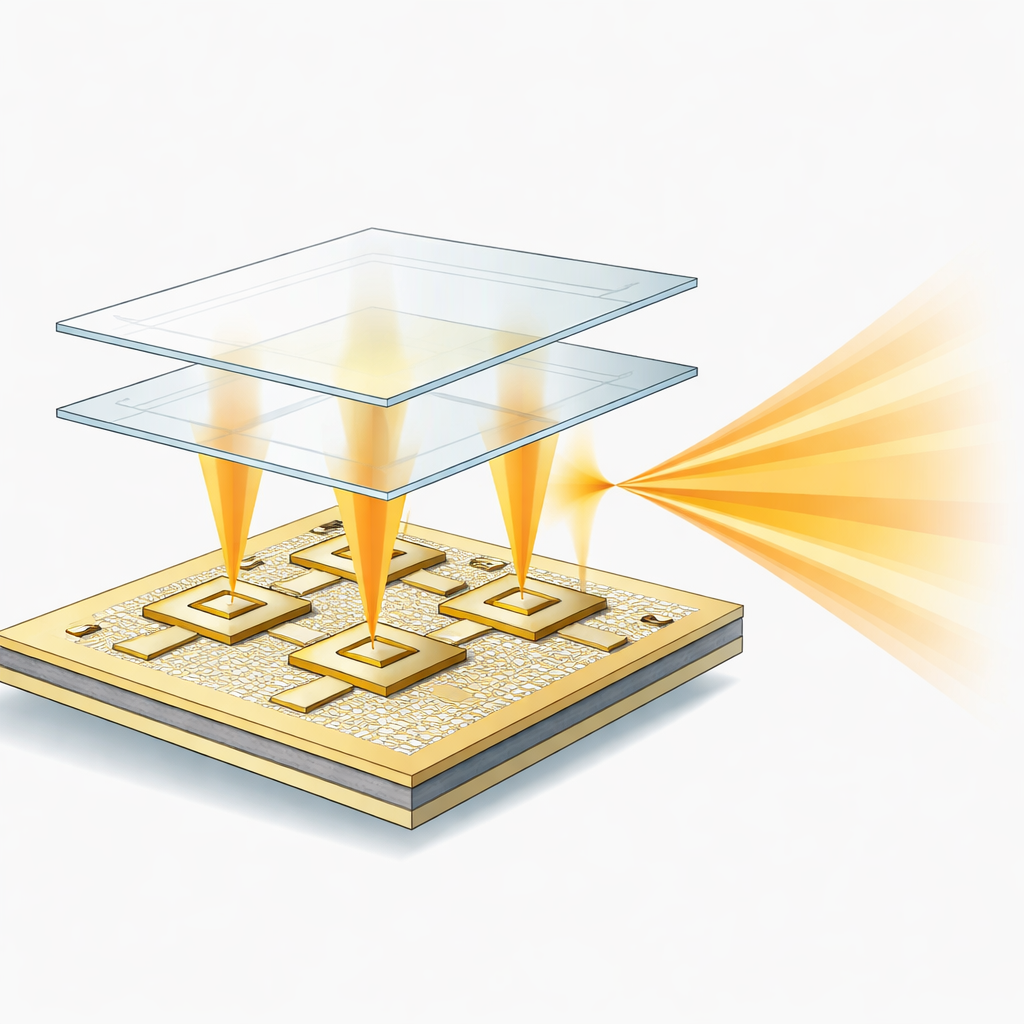
The authors propose a slim, 9-centimeter by 3-centimeter antenna panel built using microstrip technology—the same flat, printed-circuit approach used in many modern radios. At its heart are four identical square-ring patches arranged in a line. Each patch can send and receive radar waves in two perpendicular polarizations using two separate feed points, all on a single layer. Clever placement of tiny metal vias (vertical connections through the board) helps keep the two polarizations from interfering with each other, so both channels can work cleanly at the same time around a frequency of 17 GHz, in the Ku-band used by many radar systems.
Taming Stray Waves with Engineered Patterns
When multiple antenna elements are linked in an array, energy can leak sideways along the surface instead of radiating straight out, blurring the beam and wasting power. To combat this, the team adds miniature “metamaterial” cells between the patches—engineered copper patterns that behave in unusual ways when hit by microwaves. These cells, made from split rings and small strips on the same type of circuit board, are tuned to the antenna’s operating band. Simulations and measurements show that they suppress unwanted surface waves and reduce coupling between elements. The result is a cleaner, stronger beam with a gain increase of about 2–3 dB, while keeping radiation efficiency above roughly 94% and the interaction between ports extremely low.
Protective Lenses that Sharpen the Beam
Beyond performance, real-world GB-SAR units must survive heat, cold, moisture, vibration, and mechanical stress. To both protect the antenna and sharpen its view, the researchers cap the array with one, then two, thin dielectric “superstrate” layers spaced about half a wavelength above the patches. These extra sheets act a bit like a partially reflective optical cavity or lens: they reinforce the radiation in the forward direction and dampen unwanted side lobes. With two layers in place, the array reaches a peak gain of about 12 dBi, narrows its main beam to roughly 38 degrees, and suppresses sidelobes to around –17 dB, all while preserving very high efficiency and exceptionally low correlation between polarization channels.
What This Means in Practice
To a non-specialist, the bottom line is that the authors have designed a flat, compact radar “eye” that sees more clearly, from more angles, and in tougher environments than many existing options. By combining dual polarization, metamaterial loading, and protective superstrates in a simple, manufacturable structure, the antenna can distinguish materials and motion more reliably while remaining rugged enough for automotive and outdoor monitoring. This makes it a strong candidate for next-generation Ku-band GB-SAR and automotive radar systems that must be both portable and precise.
Citation: Desouky, A.F., Abd El-Hameed, A.S., Eldamak, A.R. et al. Dual-polarized ku-band microstrip antenna array with metamaterial loading and protective superstrate for GB-SAR applications. Sci Rep 16, 14685 (2026). https://doi.org/10.1038/s41598-026-49752-0
Keywords: ground-based radar, dual-polarized antenna, Ku-band, metamaterials, infrastructure monitoring