Clear Sky Science · en
A need-driven design research of modular functional armchairs for young adults
Why a Smarter Armchair Matters
For many young adults living alone, the armchair has quietly become the center of home life. It is where people work on laptops, binge-watch shows, scroll on their phones, and even eat simple meals. Yet most seating is still designed as if it were only for short rest. This study looks at how to rethink the armchair as a compact, changeable hub for comfort, work, and play in small apartments, using a careful process that starts from everyday needs rather than from guesswork.
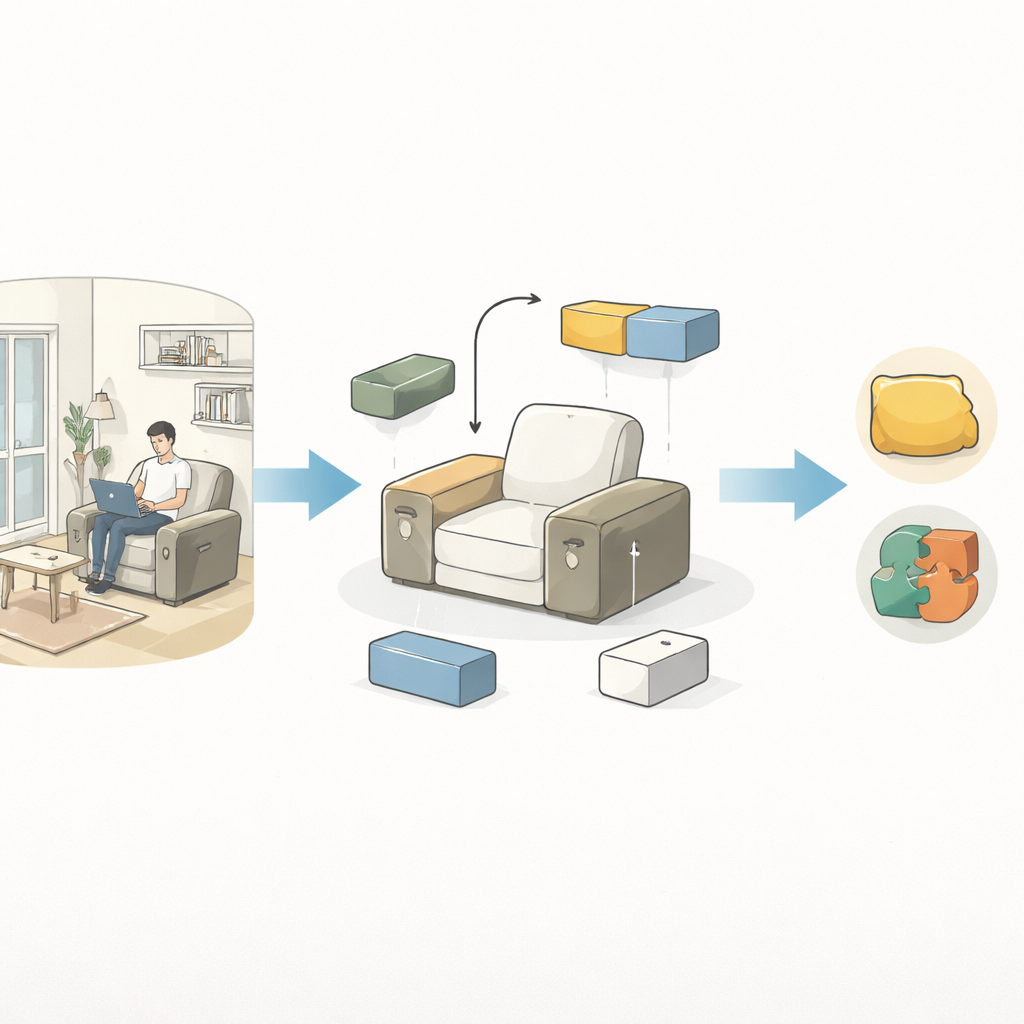
Life in Small Spaces
The authors focus on 25- to 34-year-olds who live alone in increasingly tight homes. These residents spend long stretches of time on sofas and armchairs, often doing several things at once: working remotely, watching videos, gaming, reading, and using their phones. Through online videos, interviews, and surveys, the researchers observed real living rooms and real habits, from slouched postures to improvised laptop stands and cluttered side tables. They found that people want seating that feels good for hours, but also helps them manage devices, lighting, storage, and temperature without filling the room with separate pieces of furniture.
Turning Wishes into Design Rules
Instead of simply asking what features might be “nice to have,” the team used a structured method to sort and rank needs. Young users highlighted basic comfort functions such as switching smoothly between sitting and lying, adjusting headrests, lumbar support, armrests, and enjoying back massage. On top of these, they strongly desired a small tabletop for laptops and snacks, better storage, breathable materials or airflow for long sitting, soft throw pillows, gentle heating, and built-in ways to power and charge phones. A statistical model helped divide these wishes into must-haves, performance boosters, and pleasant extras, and to filter out gimmicks that added little value, such as app or voice control for most users.
Breaking the Chair into Smart Building Blocks
To avoid bulky “do-everything” products, the researchers treated the armchair as a set of modules that could be combined or removed. They listed every chosen function, broke it into smaller tasks, and then mapped each task to the parts needed to make it work, such as motors, airbags, hinges, magnets, lights, and charging coils. Experts scored how closely these parts were linked in use and in space. A clustering process then grouped 23 sub-functions into 11 modules. For example, air-filled supports for head, back, and lower back merged into a single biomechanical support module; charging ports and wireless charging pads became a power module; storage, wireless charging, and detachable side units formed a space-saving utility module; and a reading light plus small tabletop combined into an office-friendly module. Less critical functions stayed as small add-on pieces.
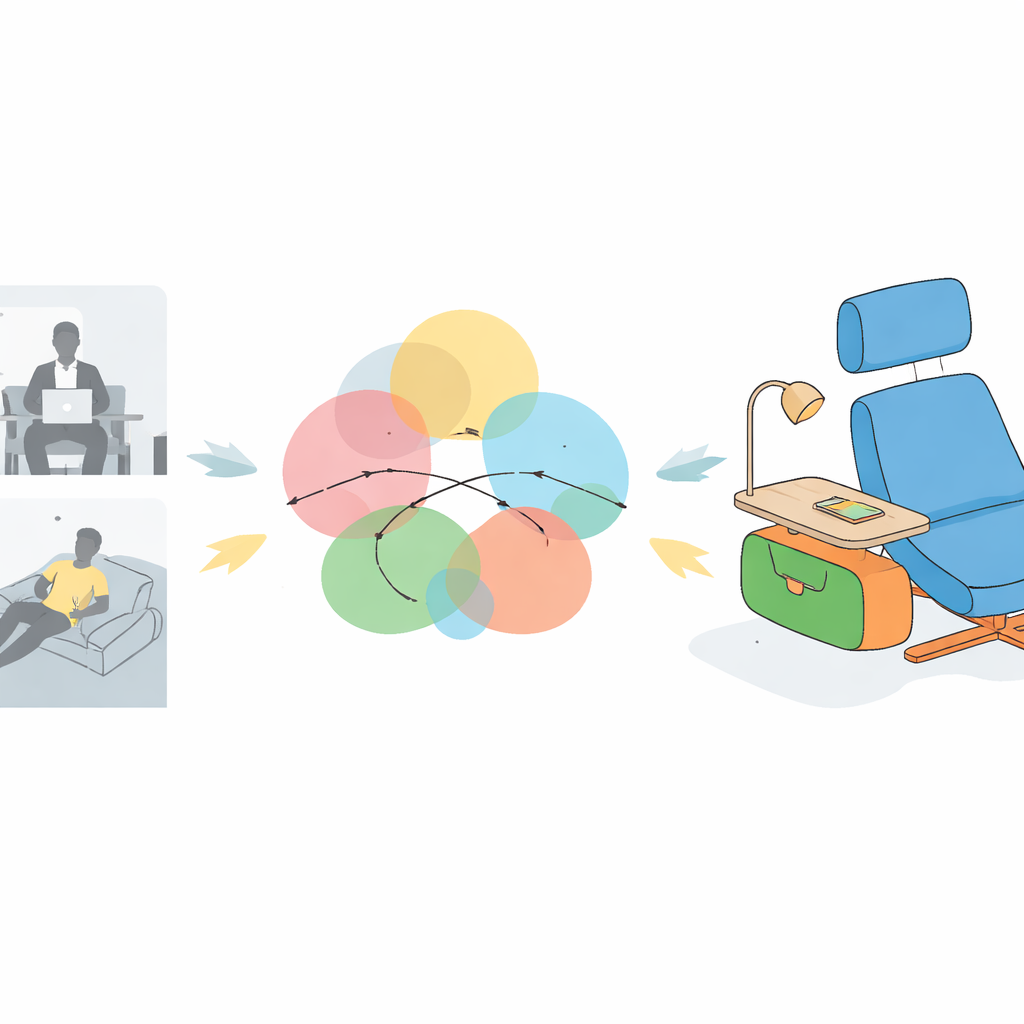
Testing Two New Armchair Ideas
Using this modular map, the team designed two different armchair concepts aimed at young single residents. Both shared the same core modules but arranged them differently in form and layout. To judge which version worked best, the researchers built an evaluation system with sixteen criteria across four themes: performance and quality, range of functions, comfort, and overall user experience. A panel of design experts and target users weighed the importance of each item, then rated the two new chairs against a strong existing product from the market. Comfort of support, sensible placement and logic of functions, and safety turned out to be the three most important qualities. In the scoring, both new designs outperformed the market benchmark, and the second concept ranked highest overall.
What This Means for Everyday Living
For non-specialists, the main message is that there is a practical way to turn messy wish lists about home life into clearer, better products. By starting with real behaviors in small apartments and then carefully sorting and grouping needs, the study shows how a single armchair can become a flexible platform: a cozy seat when you relax, a small workstation when you open your laptop, and a tidy charging and storage point for your devices. Rather than piling on random features, the modular approach keeps the focus on comfort, safety, and sensible use. The result is a roadmap that furniture makers can use to design seating that truly fits the routines and constraints of young people living alone.
Citation: Miao, Y., Li, J., Gao, X. et al. A need-driven design research of modular functional armchairs for young adults. Sci Rep 16, 13773 (2026). https://doi.org/10.1038/s41598-026-49680-z
Keywords: modular furniture, functional armchair, small-space living, user-centered design, young adults living alone