Clear Sky Science · en
Impact of urban blue spaces on urban surface temperatures - A seasonal perspective
Why city lakes matter on hot days
As heatwaves grow more frequent, many city dwellers instinctively flock to the water, hoping for relief from the heat. But how much can urban lakes and ponds actually cool their surroundings, and under what conditions do they work best? This study looks at dozens of water bodies across the German city of Hannover to find out when and how blue spaces help beat the heat—and when they might even add warmth instead.

Taking the city’s temperature from space
To explore these questions, the researchers turned to satellites rather than thermometers on the ground. Using thermal images from the Landsat mission, they mapped land surface temperatures for all four seasons over three consecutive years. They focused on 79 lakes and ponds ranging from tiny basins to a major city lake, and measured how temperatures changed in concentric rings extending up to one kilometer from each shoreline. This let them calculate two key properties: how much cooler (or warmer) the land around a water body was compared to the water itself, and how far that cooling or heating effect reached into the surrounding city.
When water cools—and when it warms
The study shows that urban lakes are most effective as natural coolers in spring and summer. During these seasons, larger water bodies stay relatively cool while nearby streets and roofs heat up quickly, creating temperature differences of about 2 degrees Celsius on average and sometimes much more. The cooling effect can stretch a few hundred meters into the surrounding neighborhoods. In winter, however, the pattern changes. Because water releases stored heat slowly, some lakes become slightly warmer than the land around them, leading to gentle heating rather than cooling, especially on calm, cold days and nights.
Size and surroundings make a big difference
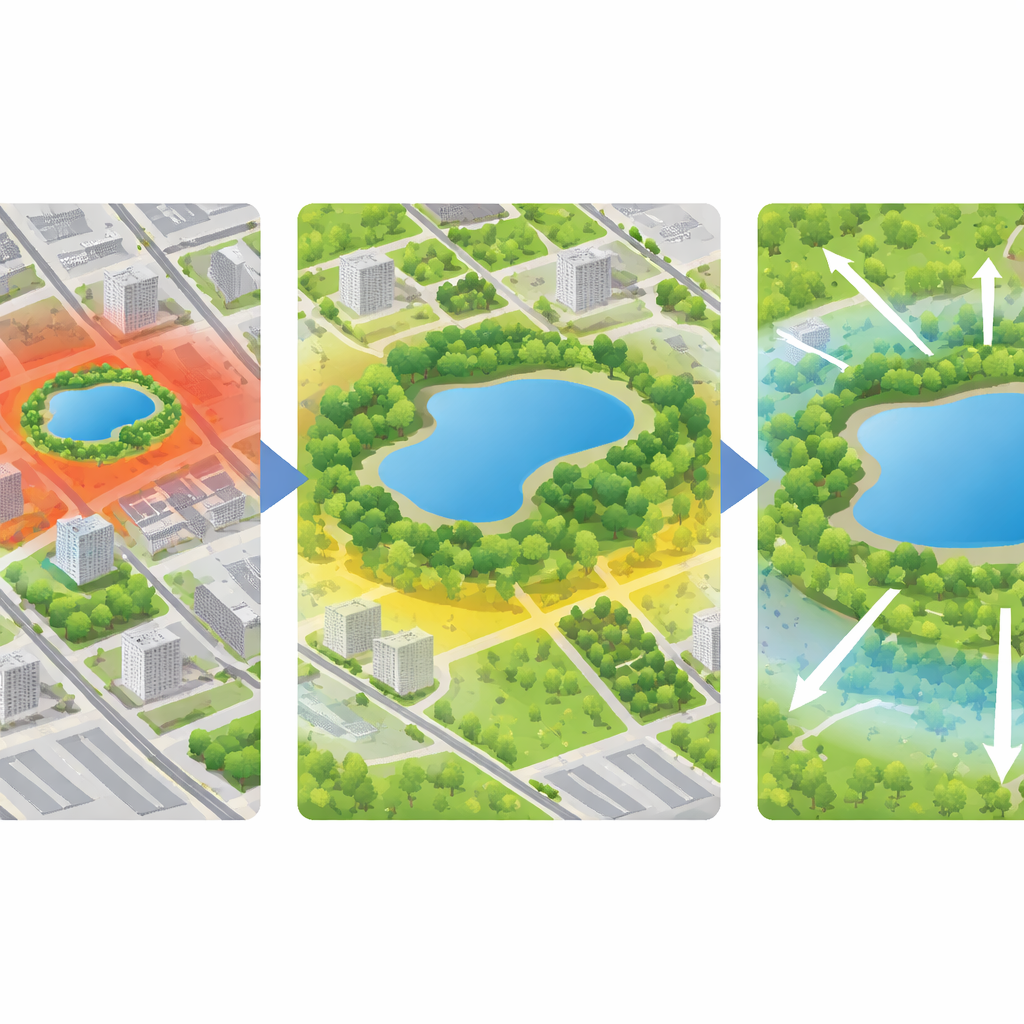
Not all water bodies behave the same. Bigger lakes consistently had the lowest surface temperatures and the strongest cooling influence. Very small ponds, by contrast, warmed and cooled quickly with the weather and could even become heat sources during hot spells. The authors identified a practical size tipping point: in Hannover, lakes of roughly three-quarters of a hectare and larger provided strong cooling benefits in summer, but making them much larger did not yield proportionally more cooling per unit of area. The landscape around each lake also mattered. Where shorelines were fringed with trees and other vegetation, water stayed cooler and the cooling effect spread farther. Where lakes were tightly hemmed in by concrete, asphalt, and dense buildings, the water itself was warmer and its cooling reach was much weaker.
How city design shapes the benefits of water
By combining satellite data with detailed maps of buildings, paving, and greenery, the researchers showed that high shares of impervious surfaces and building coverage near lakes are linked to higher water temperatures and reduced cooling. Lakes tucked into greener surroundings, or located farther from heavily built-up districts, tended to be cooler and to cast a wider "cooling shadow" over the city. Surprisingly, a commonly used indicator of how open the sky is above a place—the sky view factor—did not explain much of the variation in cooling. That suggests that, for lakes, what is on the ground around them (trees versus concrete) matters more than how open the sky is overhead.
What this means for cooler, healthier cities
For city planners, the message is clear: urban blue spaces can be powerful allies against heat, but only under the right conditions. Medium and large lakes provide the most reliable cooling during warm seasons, especially when their banks are lined with trees and other vegetation and when hard, impervious surfaces are kept to a minimum. Simply adding a small ornamental pond in the middle of a concrete plaza may offer little relief and can even trap heat. The authors argue that pairing water with generous green zones, and limiting nearby asphalt and dense buildings, is key to turning city lakes into effective natural air conditioners that help make urban life more bearable as the climate warms.
Citation: Fricke, L., Kabisch, N. Impact of urban blue spaces on urban surface temperatures - A seasonal perspective. Sci Rep 16, 14697 (2026). https://doi.org/10.1038/s41598-026-49643-4
Keywords: urban heat, city lakes, urban climate, blue-green infrastructure, remote sensing