Clear Sky Science · en
Neural network and regression approaches for predicting bubble point pressure in oil reservoirs
Why the pressure inside oil matters
When oil is buried deep underground, it is mixed with dissolved natural gas and held under enormous pressure. The point at which gas starts to bubble out of the oil – the bubble point pressure – quietly governs how much oil can be produced, how fast it flows, and how long a field remains profitable. Measuring this pressure directly in the laboratory is slow and expensive, so engineers rely on formulas and computer models. This study explores how to predict bubble point pressure more accurately, using real data from Egyptian oil fields and modern tools such as neural networks.
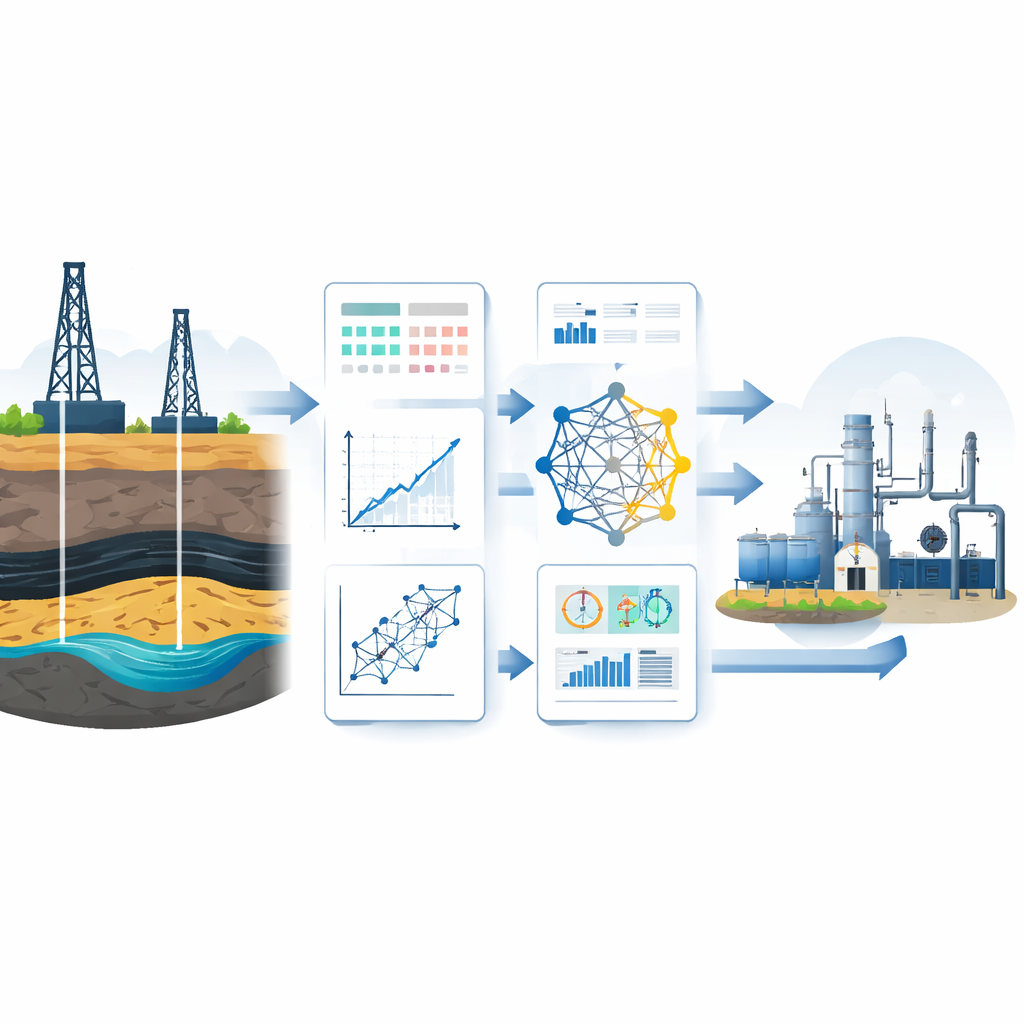
Looking closely at Egypt’s underground oils
The authors gathered an unusually large set of measurements: 1,161 detailed laboratory tests from many Egyptian reservoirs, plus an extra 232 cases reserved to build a separate computer model. They divided the oils into two broad families that behave differently: heavy oils, which are thicker and denser, and light oils, which flow more easily. For each sample they recorded properties such as temperature, how much gas is dissolved in the oil, how dense the oil and gas are, and aspects of the fluid’s chemical makeup. This rich picture of real reservoir fluids allowed them to examine which factors are most strongly linked to the point where gas begins to come out of solution.
Finding patterns with simple math
First, the team re-examined traditional “correlations” – compact equations used worldwide to estimate bubble point pressure from a few basic measurements. Many of these formulas were originally tuned to fields in other regions, such as the Middle East, the Gulf of Mexico, or Iran. When the researchers tested them against Egyptian data, performance varied widely: some equations worked reasonably well, while others produced large errors because they did not reflect local geology and fluid composition. To do better, the authors built new equations separately for heavy and light oils, using multiple regression, a statistical method that finds the best-fitting straight-line relationships among several variables at once. Crucially, they included more detailed composition information, not just temperature and density, to better capture the character of each oil.
Adding a smarter learning machine
Beyond simple equations, the researchers designed an artificial neural network, a type of computer model inspired by the way brain cells connect. This model used four easily measured inputs: how much gas is dissolved in the oil, how dense the gas is, how dense the oil is, and the reservoir temperature. Inside, two hidden layers of “neurons” transformed these inputs step by step, allowing the model to learn subtle, curved relationships that straight-line equations cannot capture. The team carefully tested different network sizes and internal settings, choosing the arrangement that achieved high accuracy without becoming unstable or overfitted. They then trained the network on most of the data and checked its predictions against separate cases it had never seen before.
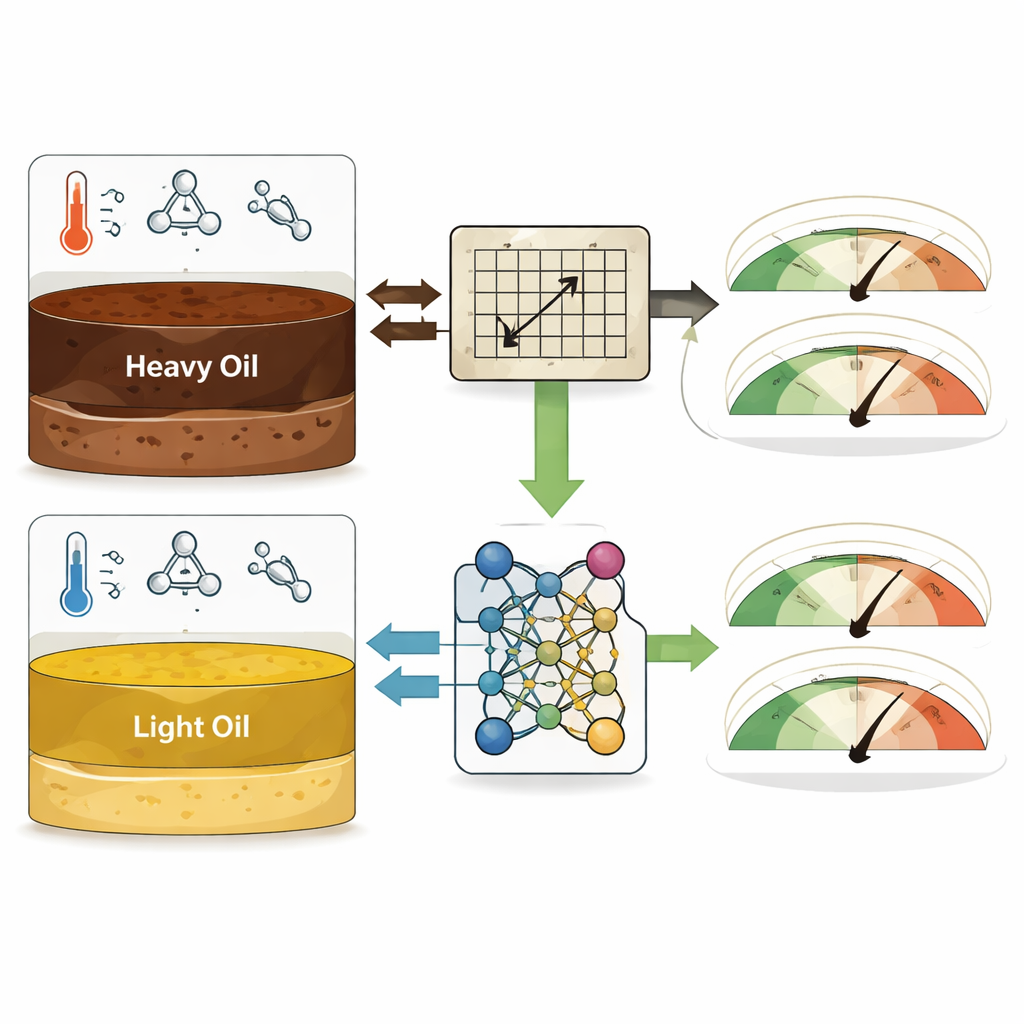
How well the new tools performed
The new heavy-oil and light-oil equations matched measured bubble point pressures far better than earlier formulas, reaching correlation levels above 96 percent and substantially reducing average errors. When tested on fresh data not used to build them, these equations continued to perform reliably, showing that they capture genuine physical trends rather than just memorizing the original samples. The neural network model performed even more strongly: its predictions tracked laboratory results with a correlation above 99 percent, indicating that it successfully learned the complex interplay among gas content, temperature, and fluid density that controls when bubbles form.
What this means for oil production decisions
For non-specialists, the key message is that better “pressure guessing tools” can translate directly into smarter choices about how to develop oil fields. When engineers know the bubble point pressure more accurately, they can design wells, pumps, and surface facilities that keep oil flowing efficiently while avoiding sudden gas release that can damage equipment or strand valuable hydrocarbons underground. This study shows that tailoring prediction methods to a specific region, and combining traditional statistics with modern neural networks, can sharply improve these forecasts. In practical terms, Egypt’s oil fields – and others with similar characteristics – can now be managed with greater confidence, potentially recovering more energy with less waste and lower cost.
Citation: Mansour, E.M., Gomaa, S. & El‑hoshoudy, A.N. Neural network and regression approaches for predicting bubble point pressure in oil reservoirs. Sci Rep 16, 13893 (2026). https://doi.org/10.1038/s41598-026-49027-8
Keywords: bubble point pressure, oil reservoirs, heavy and light oil, neural network modeling, reservoir engineering