Clear Sky Science · en
Development and simulation of an innovative autonomous knowledge-based smart waste collection system
Smarter Trash Pickup for Cleaner Cities
Household trash and recycling usually disappear from our curbs without much thought, but the process behind that simple service is costly, polluting, and often inefficient. Trucks drive fixed routes every day, even when many bins are only half full, wasting fuel and clogging streets. This study explores a new way to collect waste that uses data and autonomous vehicles to decide when and where to send trucks, cutting costs, traffic, and emissions while still keeping neighborhoods clean.
Why Traditional Pickup Falls Short
Most cities still rely on a simple playbook: a fleet of trucks follows the same route every day, stopping at every bin regardless of how full it is. Because trash generation varies with seasons, holidays, and local habits, this leads to trucks servicing many half-empty bins while burning fuel and adding to congestion. Previous "smart" systems tried to fix this by putting sensors in every bin to report fill levels in real time. In practice, outfitting hundreds or thousands of bins with electronics proved expensive and fragile, with challenges ranging from vandalism and weather damage to battery replacement and wireless connectivity.
Turning Past Collections into Useful Knowledge
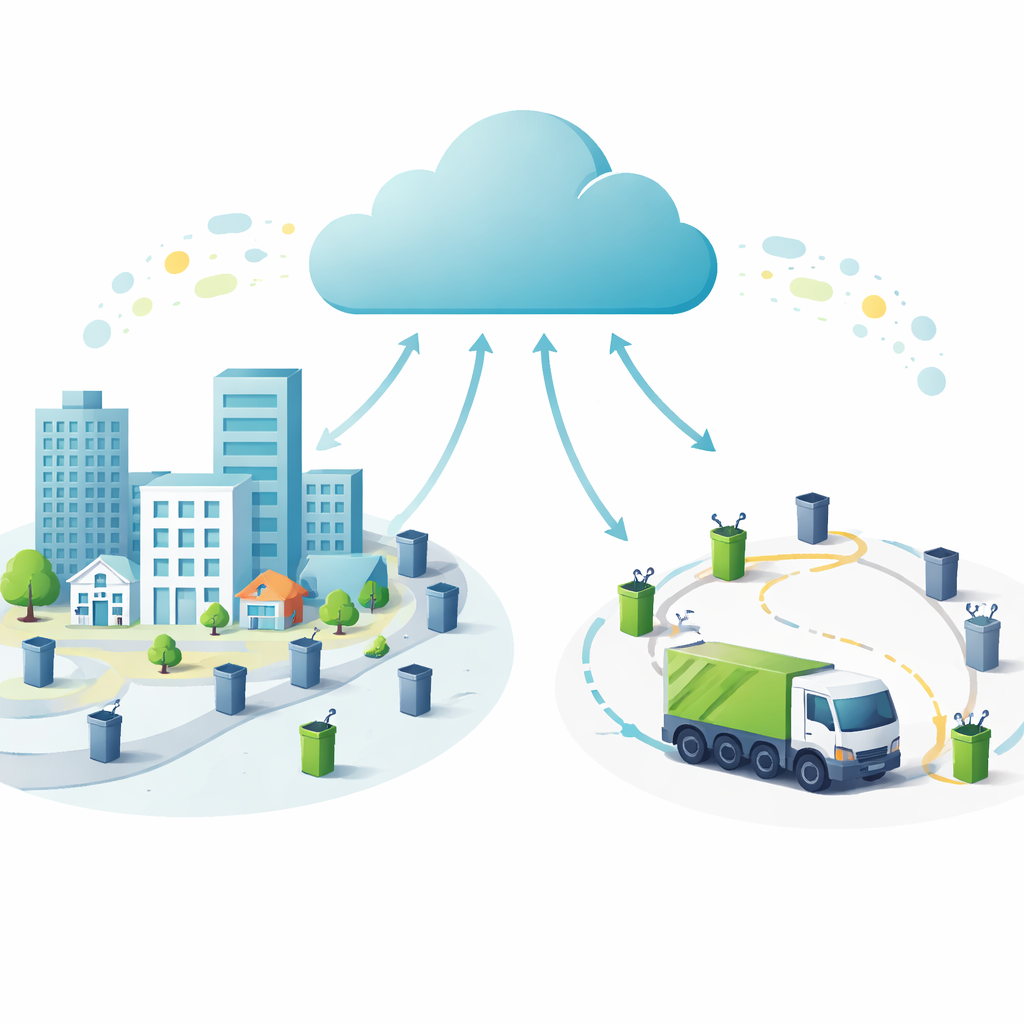
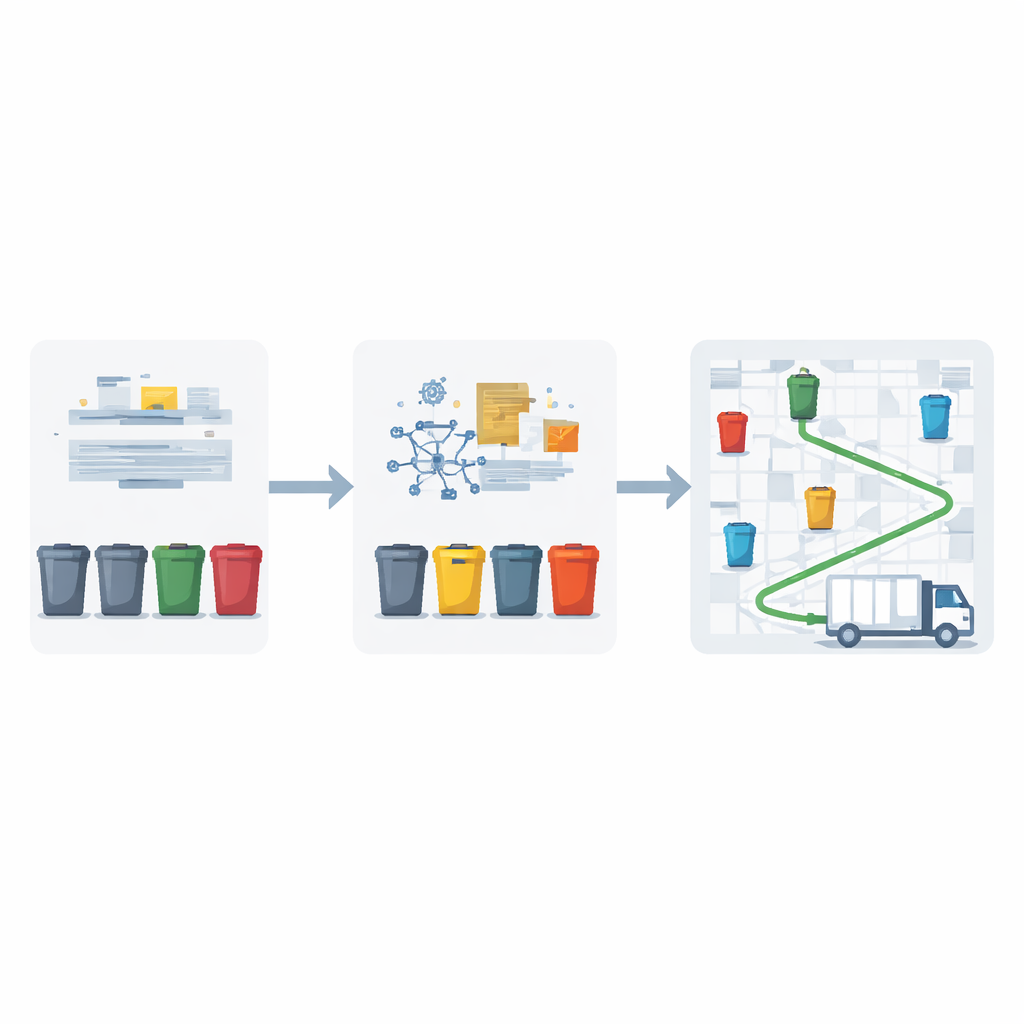
Instead of wiring up every bin, the authors propose a cloud-based "knowledge" system that learns from what trucks already measure. Modern collection vehicles can be equipped with weighing devices that record how much each bin contributes every time it is emptied, together with its location and the date. By compiling two years of such records for nearly 400 recycling bins in a residential area of Abu Dhabi, the researchers trained computer models to forecast how much waste would be in each bin on the next day. Several machine-learning approaches were tested, including linear models, neural networks, and advanced tree-based methods. The best model could predict daily waste per bin with only about 4% relative error, accurate enough to distinguish bins that truly needed service from those that could safely wait.
Picking the Right Bins and Routes Each Day
Armed with these forecasts, the system applies a simple rule: only bins expected to reach about 90% of their capacity are scheduled for collection. Bins predicted to be less full are skipped for the day and checked again in the next cycle. The selected bins are then passed to a routing engine that uses digital maps to find the shortest overall path for the truck. The researchers compared three setups over a simulated month: today’s conventional system that services every bin daily; a sensor-based system that relies on real-time bin measurements; and the proposed knowledge-based system that uses predictions instead of hardware in every bin.
Autonomous Trucks and Real-World Impacts
To understand how these strategies would play out on actual streets, the team used traffic simulation software to model both human-driven trucks and connected, autonomous vehicles. They fed in real traffic counts, speeds, and road layouts for the study neighborhood. In the smart scenarios, there were days when no collection was needed at all, and on service days trucks visited far fewer bins. Compared with the traditional approach, both smart systems cut travel distance by roughly 60%, slashed total travel time by about 85%, and reduced carbon emissions from the trucks by nearly half. When autonomous driving was added, traffic delays dropped even further—by around 70–90% depending on the scenario—because self-driving trucks could maintain smoother speeds and interact more efficiently with other vehicles.
Saving Money While Reducing Pollution
The researchers also examined long-term costs over 15 years, including vehicles, bins, fuel, maintenance, and electronics. The sensor-heavy system turned out to be the most expensive overall: the modest fuel savings from shorter routes did not make up for buying, installing, and maintaining hundreds of smart bins. In contrast, the knowledge-based system required only a few sensors on trucks and remote cloud computing. It delivered nearly the same operational benefits as the sensor-based approach while cutting total costs by about two-thirds compared with both the conventional and sensor-based systems. Even when the extra cost of autonomous-vehicle hardware was included, the knowledge-based setup remained the most economical option.
What This Means for Future Cities
From a layperson’s perspective, the message is straightforward: cities do not need to blanket every trash bin with gadgets to modernize waste collection. By learning from past collections and using that information to decide when and where to send trucks, it is possible to collect almost the same amount of waste with far fewer trips. The study shows that a cloud-based, prediction-driven system—especially when paired with autonomous trucks—can reduce traffic, emissions, and costs all at once. While real-world trials are still needed, this approach points toward cleaner, quieter, and more efficient neighborhoods without adding visible complexity on the curb.
Citation: Abdallah, M., Hosny, M. Development and simulation of an innovative autonomous knowledge-based smart waste collection system. Sci Rep 16, 13414 (2026). https://doi.org/10.1038/s41598-026-48792-w
Keywords: smart waste collection, autonomous vehicles, machine learning, urban sustainability, route optimization