Clear Sky Science · en
Stress modulates gastric interoception depending on eating traits and emotion regulation: evidence from the magic table
Why stress and fullness signals matter
Many people notice that their eating changes when they feel stressed, but it is not always clear why. This study looks inside the body to see how stress might alter the way we sense hunger and fullness, and how personal habits around eating and emotions shape that response. By understanding who is most likely to miss their body’s “I am full” signals under stress, researchers hope to support better approaches to preventing and treating unhealthy eating patterns.
A new way to watch the body while we eat
To explore this question, researchers created a device called the Magic Table. Volunteers arrived at the lab after fasting and ate yogurt from a bowl that secretly refilled from underneath, keeping the level in the bowl almost constant. Because they could not see how much they had eaten, they had to rely on inner feelings from the stomach. First, they stopped when they reached an initial sense of being satisfied, and then continued until they felt completely full. The exact amount of yogurt eaten at each point showed how sensitive they were to their body’s fullness signals. 
Testing stress in a controlled setting
Each person completed this eating task twice on different mornings. In one session, they first did a challenging mental arithmetic test designed to raise stress levels; in the other, they did an easier version that served as a calm control task. Questionnaires taken before and after confirmed that the stressful version clearly raised anxiety compared with the control. A subset of participants also completed an established “water load” test, in which they drank water through a straw until feeling satisfied and then full, as well as a free breakfast. Comparing these measures with the Magic Table results helped the team check whether their new method truly captured how the stomach’s signals guide eating.
Do stress and fullness always go together?
The Magic Table results matched well with the older water-based test and with how much breakfast people chose to eat, suggesting that it is a valid way to study stomach-based sensing during real food intake. On average, however, stress alone did not make people eat noticeably more or less yogurt before feeling satisfied or full. Group averages hid a lot of individual differences: some participants ate more under stress, some less, and some about the same. This pattern echoes everyday life, where some people snack heavily when tense while others lose their appetite.
Hidden risk in certain eating and emotion patterns
To explain these differences, the researchers looked at self-reported traits. These included how often people restrict food to control weight, how easily they lose control once they start eating, and how much they struggle to manage negative emotions. They found that stress particularly affected people who scored higher on restrained eating, uncontrolled eating, and difficulties with emotion regulation. Under stress, these individuals needed to eat more yogurt before feeling completely full, showing a reduced sensitivity to strong fullness signals, while their first mild feeling of satisfaction did not change much. In contrast, people with lower scores on these traits showed little change in fullness sensitivity between calm and stressful conditions. Interestingly, a common scale for “emotional eating” did not predict who became less sensitive to fullness, aligning with other work suggesting that such self-ratings may capture beliefs more than actual behavior. 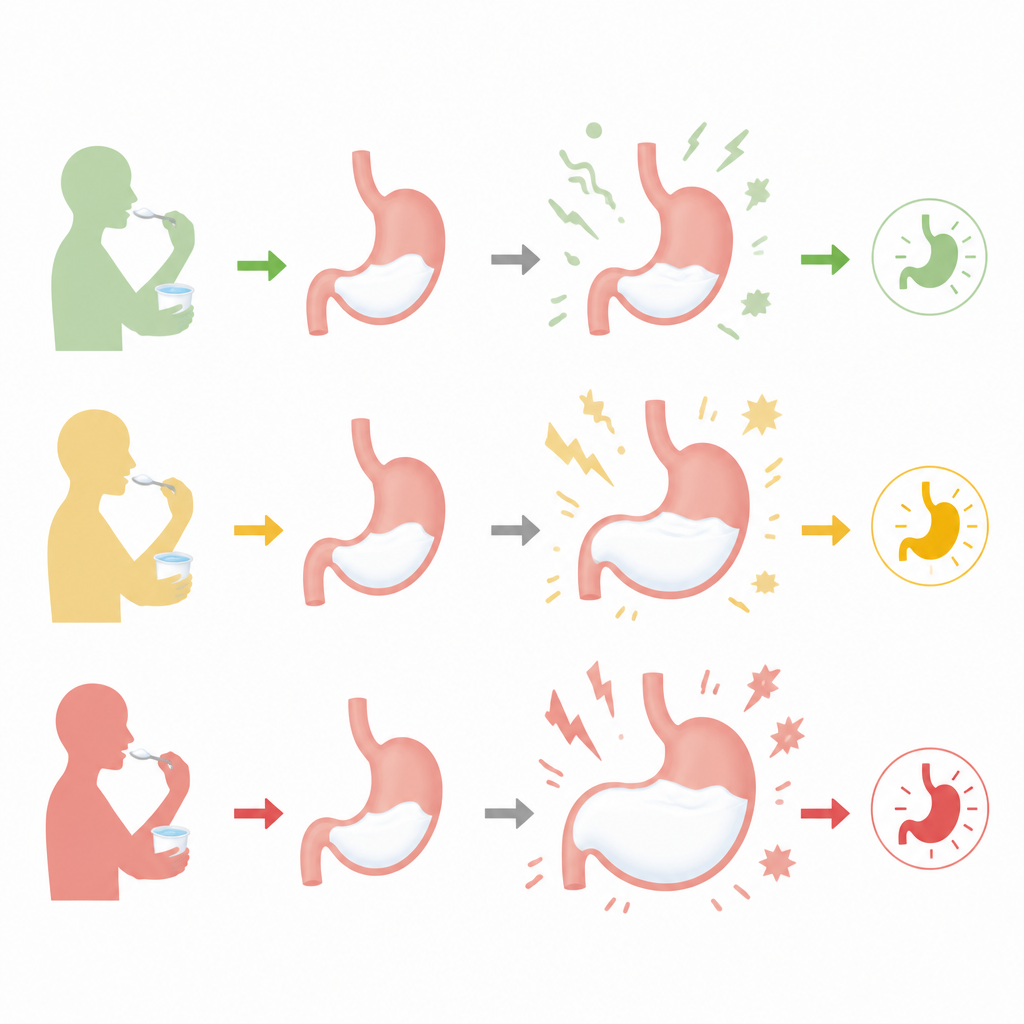
What this means for everyday eating
For a layperson, the main message is that stress does not affect everyone’s appetite in the same way. The body’s fullness signals from the stomach appear fairly stable overall, but in people who already tend to restrain or lose control over eating and who have trouble managing emotions, stress can blunt their awareness of feeling full. As a result, they may keep eating past the point their body would normally flag “enough.” Recognizing this pattern may help design prevention and treatment programs that combine emotion skills training with exercises that reconnect people to their internal hunger and fullness cues, aiming to support healthier, more intuitive eating even in stressful times.
Citation: Kipping, M., Schulz, A. & Pollatos, O. Stress modulates gastric interoception depending on eating traits and emotion regulation: evidence from the magic table. Sci Rep 16, 14969 (2026). https://doi.org/10.1038/s41598-026-48641-w
Keywords: stress and eating, fullness signals, gastric interoception, emotion regulation, eating traits