Clear Sky Science · en
Stability analysis and exploration of multiform soliton solutions for extended fractional NLS model using modified extended direct algebraic method
Why shaping waves matters
From internet traffic racing through glass fibers to plasma waves in fusion devices, many modern technologies rely on tiny wave packets called solitons—self‑stabilizing pulses that can travel long distances without losing their shape. As communication speeds and power levels rise, however, these pulses encounter complex effects that standard models can no longer capture. This paper explores a new way to describe and control such waves using "fractional" calculus, showing how a pair of tunable parameters can reshape and stabilize solitons in advanced optical and plasma systems.
A new dial for wave behavior
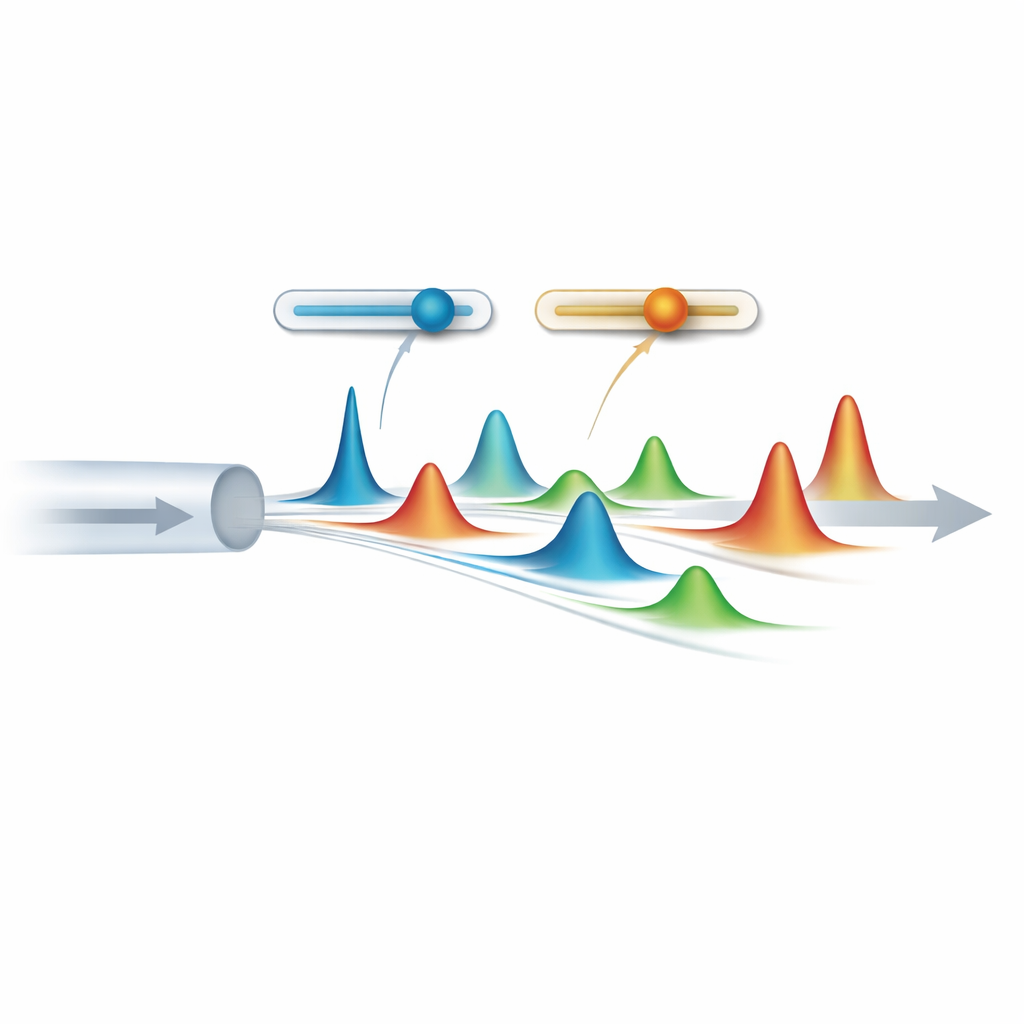
The authors start from the nonlinear Schrödinger equation, the workhorse model for wave packets in fibers, plasmas, and fluids. The classical version assumes that the medium responds locally and instantly, which is often too simple for real materials with memory, long‑range interactions, or unusual transport. To go beyond this, the study uses a generalized equation that replaces ordinary space and time derivatives with so‑called β‑fractional derivatives. These operators keep much of the familiar calculus structure but allow the strength of dispersion and temporal scaling to be tuned continuously by two exponents, denoted α (for space) and β (for time). In effect, α and β act like knobs that stretch or compress how waves spread and evolve.
Finding many kinds of solitons
Because the extended equation is highly nonlinear and involves high‑order fractional terms, solving it exactly is far from straightforward. The team employs a technique called the modified extended direct algebraic method, which systematically converts the original partial differential equation into an ordinary differential equation for a traveling wave profile. They then assume a structured mathematical form for this profile and determine its coefficients by solving an algebraic system with computer algebra software. This approach yields a rich family of exact wave solutions: bright solitons (localized peaks), dark solitons (localized dips), periodic waves built from Jacobi elliptic functions, and more exotic structures related to Weierstrass and exponential functions. Each solution corresponds to a different balance between dispersion and nonlinearity in the fractional setting.
How the fractional knobs reshape pulses
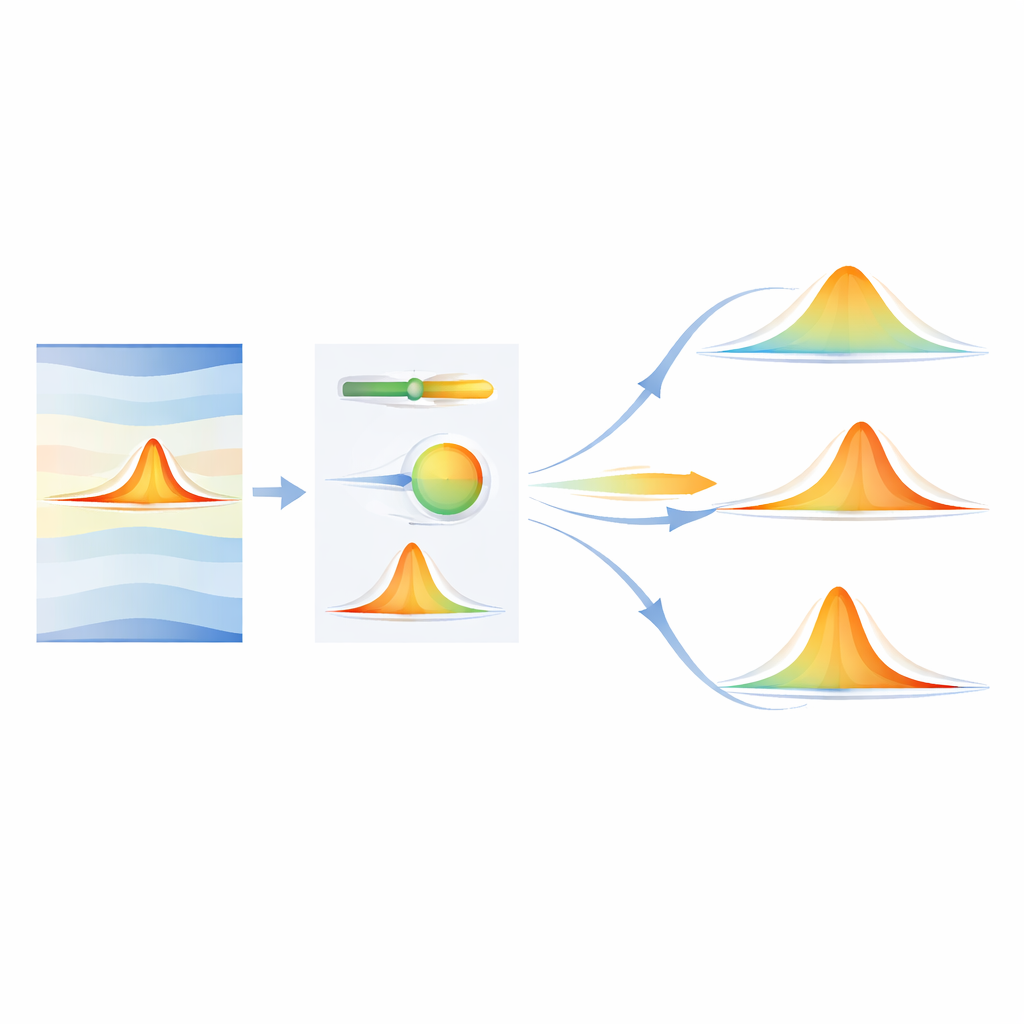
To understand the physical impact of the fractional parameters, the authors visualize representative solutions for different values of α and β. They find that adjusting these exponents mainly shifts and stretches the pulse in space and time without strongly changing its peak height. Decreasing the spatial order α makes solitons broader and less tightly confined, reflecting stronger effective dispersion. Reducing the temporal order β slows the apparent speed of the pulse and alters how quickly its phase evolves, but leaves the amplitude almost unchanged. Simple scaling relations derived from the solutions quantify these trends, linking α and β directly to soliton width, group velocity, and the spacing of periodic patterns.
Probing stability and taming instabilities
Beyond static shapes, the paper examines whether continuous wave backgrounds are stable when subjected to small disturbances, a phenomenon known as modulation instability. By perturbing a uniform solution and tracking how sideband fluctuations grow, the authors derive a dispersion relation that depends on the same fractional parameters. They then compute gain spectra that show, for each disturbance wavelength, how fast perturbations amplify. The results reveal that lowering the temporal order β shrinks both the peak gain and the bandwidth of unstable modes, effectively damping the tendency of the wave to break up. Changing the spatial order α shifts the instability toward longer wavelengths and smooths the spectrum. Together, α and β act as design parameters for widening or narrowing stability windows.
What this means for real‑world systems
In everyday terms, this study shows that introducing fractional derivatives into a standard wave equation turns it into a flexible toolkit for sculpting and stabilizing soliton‑like pulses. Rather than being fixed by the material alone, key features such as pulse width, speed, and resistance to breakup can be tuned mathematically through the orders α and β. This has implications for ultrafast fiber‑optic networks, high‑intensity plasma waves, metamaterials, and even fluid systems where wave packets play a central role. By providing explicit analytical solutions and clear stability criteria, the work bridges abstract fractional calculus and practical control of nonlinear waves, suggesting new routes for engineering robust, customizable information carriers in complex media.
Citation: Soliman, M., Ramadan, M.E., Alkhatib, S. et al. Stability analysis and exploration of multiform soliton solutions for extended fractional NLS model using modified extended direct algebraic method. Sci Rep 16, 14422 (2026). https://doi.org/10.1038/s41598-026-48474-7
Keywords: fractional solitons, nonlinear Schrödinger waves, optical fiber pulses, modulation instability, wave stability control