Clear Sky Science · en
A morphological analysis of the modern human frontal bone from Hahnöfersand, Germany
A puzzling skull fragment from a northern riverbank
In the early 1970s, builders working on a dike along the Elbe River near Hahnöfersand in northern Germany uncovered a single, well‑preserved forehead bone. At first glance this fragment seemed to blend features of both Neanderthals and modern humans, raising the tantalizing idea that it might belong to a hybrid individual. This study revisits that famous bone with powerful 3D methods, asking a simple question with big implications: does this fossil really sit between Neanderthals and us, or is it an ordinary—if robust—member of our own species?
How skull foreheads tell evolutionary stories
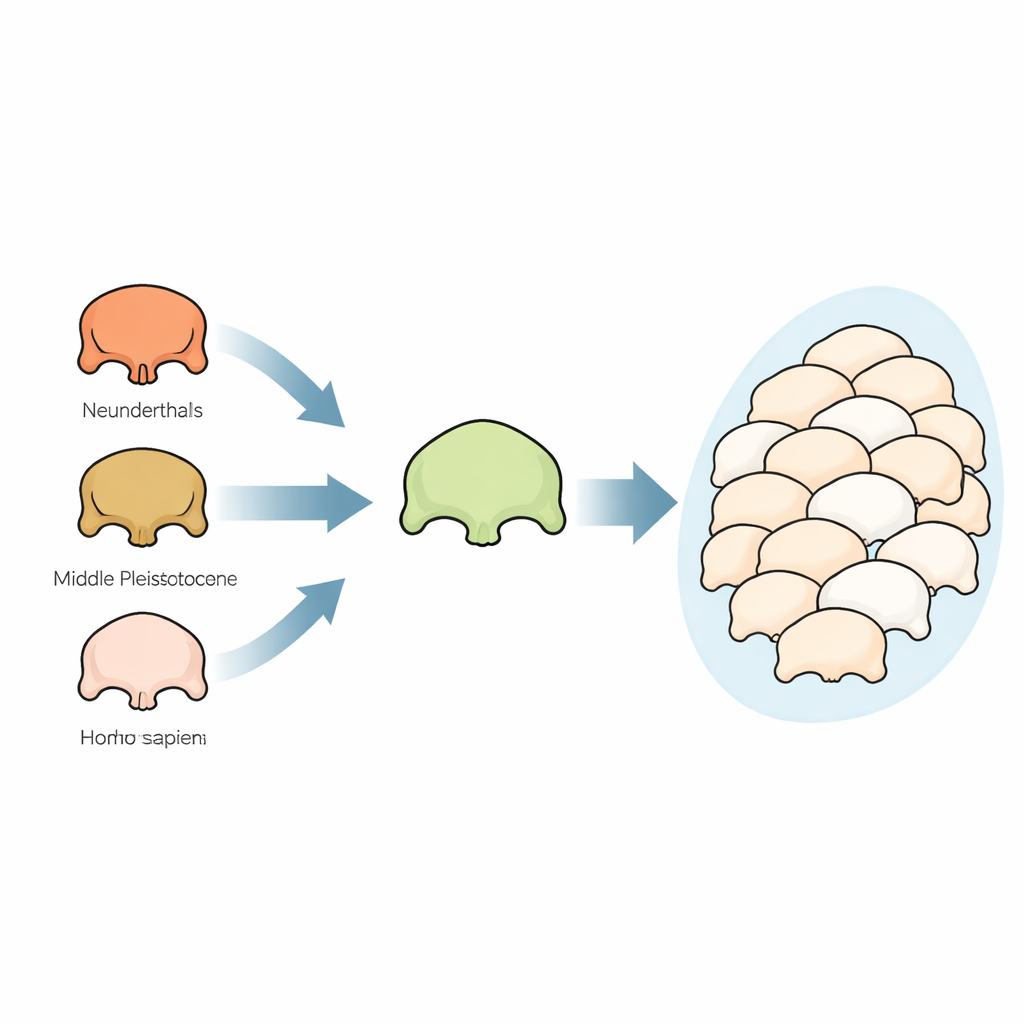
The frontal bone, which forms the forehead and upper eye sockets, varies in shape among different human groups and across time. Classic descriptions emphasize features such as how tall and curved the forehead is, how strongly the brow ridges project above the eyes, and how clearly different regions of the brow are separated from one another. Modern humans are usually said to have a high, rounded forehead and a more broken‑up, refined brow region, whereas Neanderthals and some earlier humans tend to show flatter foreheads with a single, strong brow bar. Because of this, the Hahnöfersand bone—which appeared somewhat flat yet also showed modern‑looking details—has long been debated as either a rare hybrid or an especially rugged modern human.
From “Ice Age hybrid” to Mesolithic local
Early work on the bone relied on visual inspection and simple measurements, and it was initially dated to about 36,000 years ago, a time when Neanderthals and modern humans may have overlapped in Europe. That age estimate, together with its mixed appearance, encouraged the hybrid interpretation. Later, however, a new radiocarbon date placed the fossil at roughly 7,500 years old—firmly within the Mesolithic, long after Neanderthals had disappeared. Despite this revision, the original hybrid idea lingered in the literature, partly because the updated date and reinterpretation were not widely accessible. The new study takes advantage of this lingering controversy to test how more objective, three‑dimensional techniques can clarify the identity of puzzling, fragmentary fossils.
Using full‑surface 3D mapping instead of guesswork
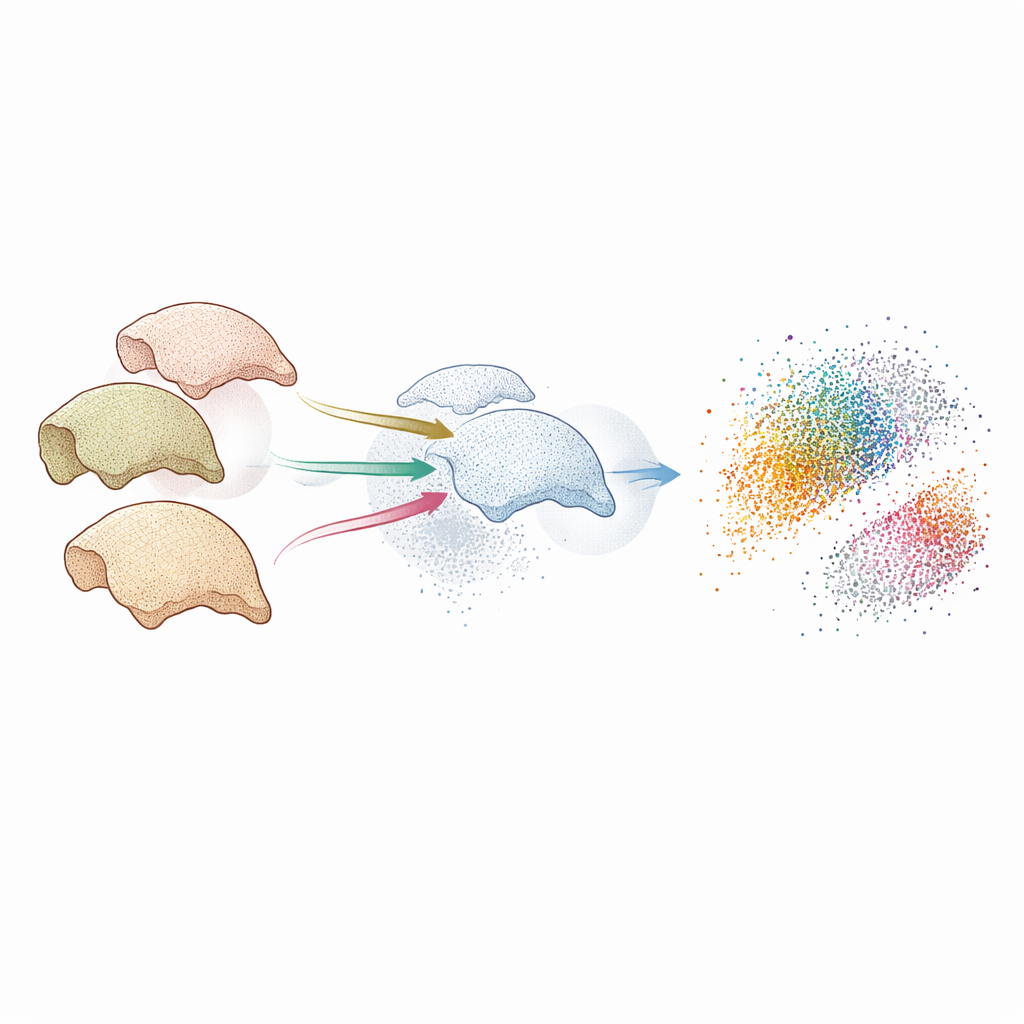
Rather than relying on a few hand‑picked points and eye‑based judgments, the researchers applied a nearly landmark‑free “surface registration” approach. They created detailed digital models of 44 frontal bones from Neanderthals, Middle Pleistocene Europeans, and a broad range of ancient and recent modern humans, including some with unusually robust brows. A high‑resolution 3D model of the Hahnöfersand bone was mirrored and virtually repaired to approximate its original full shape. Then, using computer algorithms, a reference surface was smoothly warped to fit each specimen, capturing the entire outer shape as thousands of points. The team carefully tested how much they could reduce this dense dataset—down to about 100 representative points per bone—without losing essential shape information, allowing powerful statistics to be applied efficiently.
Where the Hahnöfersand bone really fits
With these 3D data, the authors explored patterns of shape using principal component analysis and calculated distance measures that summarize overall similarity. The key result is that the Hahnöfersand frontal bone falls squarely within the range of Holocene (recent) Homo sapiens and away from both Neanderthals and earlier European humans. Its three closest matches are medieval German skulls, not Ice Age fossils. Even when the specimen’s apparently Neanderthal‑like traits are considered, it does not occupy an intermediate position expected of a true hybrid. Instead, its size, curvature, and brow form align with the broad natural variation seen in modern humans, particularly those with somewhat stronger brow ridges.
Why this matters for reading our fossil past
The study concludes that the Hahnöfersand bone is best understood as a robust Mesolithic modern human, not a Neanderthal–modern hybrid. The authors show how visual impressions can be misleading, especially when a fragment is incomplete, difficult to orient, or compared to a limited set of reference skulls. Their 3D surface‑based method reduces observer error and captures subtle aspects of overall shape, offering a powerful tool for classifying isolated bones from times and places where multiple human forms may have co‑existed. For non‑specialists, the take‑home message is that our own species has always been morphologically diverse, and that modern digital techniques can reveal this diversity more clearly, helping to prevent dramatic but incorrect claims about “missing links” and hybrids in the human story.
Citation: Röding, C., Profico, A., Merkel, M. et al. A morphological analysis of the modern human frontal bone from Hahnöfersand, Germany. Sci Rep 16, 12696 (2026). https://doi.org/10.1038/s41598-026-48468-5
Keywords: human evolution, Neanderthals, fossil skulls, 3D morphology, Mesolithic Europe