Clear Sky Science · en
GIS-based analysis of field margin photovoltaic potential at the landscape level in northwestern Germany
Turning Quiet Field Edges into Power Lines
Across much of the world, farmers are under pressure to grow food, protect nature, and help tackle climate change—all at the same time. This study explores an idea that tries to do all three at once: turning the narrow, often-overlooked strips along the edges of fields into long, slender solar power plants. By putting solar panels only at the margins of fields, instead of covering whole plots, the authors show how regions like northwestern Germany could generate large amounts of clean electricity while still growing crops and creating safe havens for wild plants and animals.
A New Use for the Edges of Fields
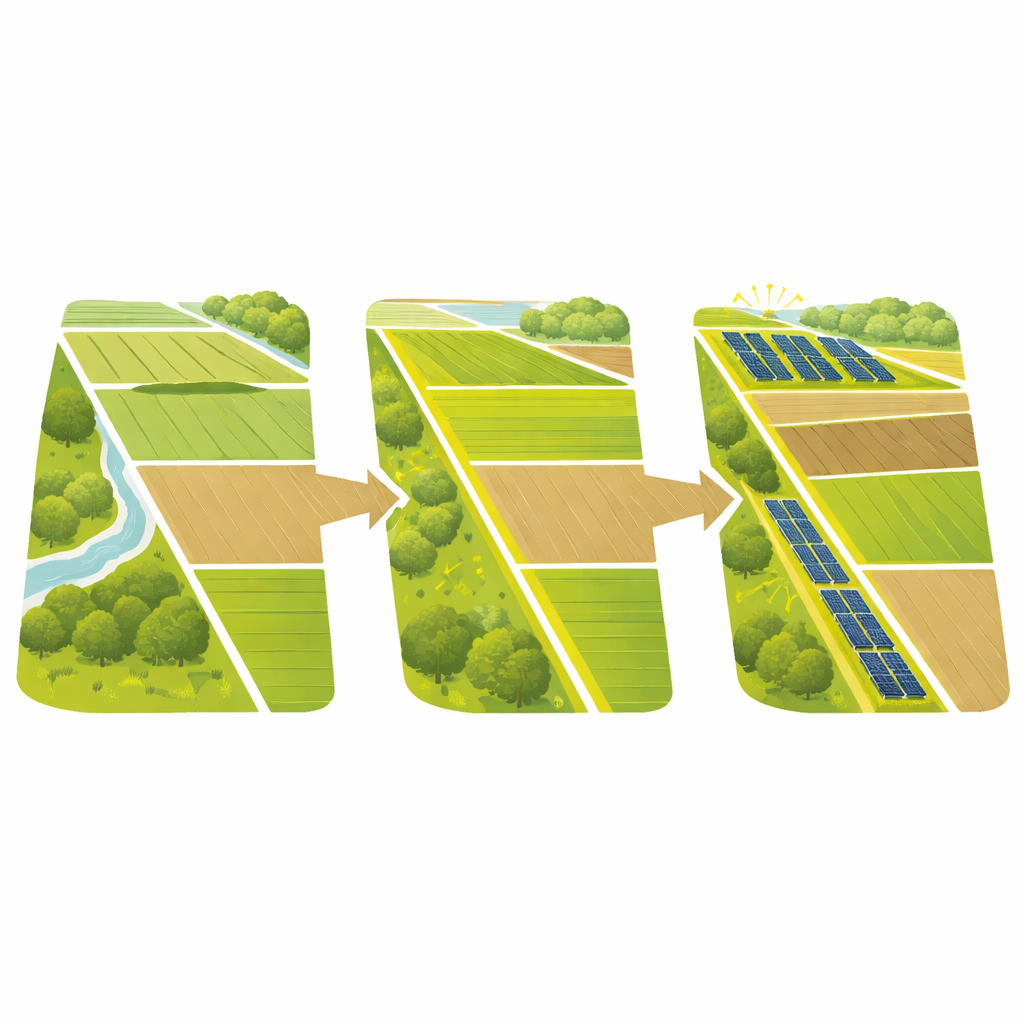
The core idea, called field margin photovoltaics, is simple: rather than filling entire fields with solar panels, only the least productive border strips are used. These strips are already awkward for large machines to farm efficiently. Lining them with panels barely interferes with harvests, yet opens space beneath for wildflower strips or hedges. That undergrowth can serve as habitat and movement corridors for insects, birds, and small mammals, improving how well nearby habitats are connected. At the same time, the panels can provide farmers with a steady second income, making rural livelihoods less vulnerable to volatile crop prices or weather shocks.
Mapping Where the Sun Meets the Soil
To move from concept to numbers, the researchers focused on the Weser–Ems region in northwestern Lower Saxony, Germany—a largely agricultural area stretching from the North Sea coast inland. They combined detailed official landscape maps with digital aerial photographs inside a geographic information system (GIS). First, they extracted all the lines that mark the boundaries of arable fields and grassland. These lines, treated as potential field margins up to five meters wide, were then given geometric properties such as their compass bearing. This made it possible to judge how well solar panels placed along them could face the sun.
Filtering Out the Shade to Find Prime Spots
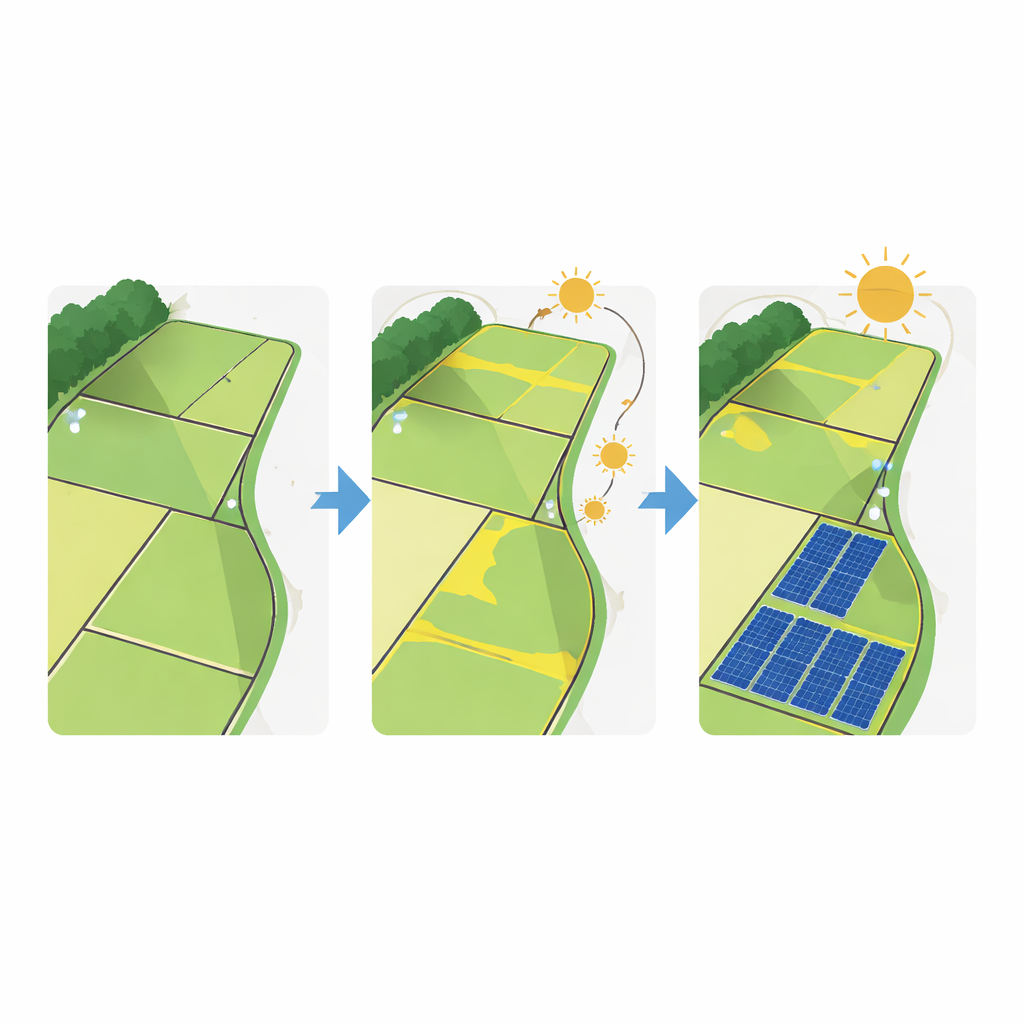
Not every field edge is a good candidate. Panels need enough direct sunlight, so the team developed a multi-step digital workflow to weed out unsuitable stretches. They identified margins that run in directions favorable for south-facing panels and then checked how nearby forests and tree rows would cast shadows over them on typical summer days. Using assumptions about tree height and the sun’s path, they created buffer zones that mimic the length of shadows; any margin falling inside those zones was treated as shaded and removed from the pool. The remaining segments were grouped into classes of high and medium solar potential, while still keeping track of neighboring land uses such as roads, water bodies, settlements, and protected areas.
How Much Energy Fits into the Margins
When the full model was applied to the roughly 15,000 square kilometers of Weser–Ems, it identified more than 1.3 million field-margin sections with usable solar potential. Altogether, these added up to about 97,870 kilometers of suitable edge length, with roughly 27,300 kilometers predicted to be partly shaded and less attractive. If these margins were lined with today’s commercially realistic density of solar modules—around one to four square meters of panel surface per meter of margin—the region could, in theory, produce about 119 terawatt-hours of electricity per year. To validate their map-based method, the authors compared a sample of modelled margins with recent aerial photos and found a 97% match for key attributes, suggesting the digital workflow is reliable and transferable to other regions.
What This Could Mean for Farms and Wildlife
Seen through everyday eyes, the findings suggest that the quiet strips at the edges of fields could become powerful tools for transforming rural landscapes. Instead of putting solar farms in direct competition with food production, field margin photovoltaics would tuck energy production into spaces that are currently underused, while also making room for wildflowers and hedges that support biodiversity. Turning these thin green lines into steady income sources and ecological corridors will still require new rules, supportive grid connections, and farmer buy-in. But the study shows that, from a spatial and technical perspective, there is ample room along Europe’s farm boundaries to harvest sunlight without sacrificing harvests.
Citation: Foth, H., Pesch, R. & Breckling, B. GIS-based analysis of field margin photovoltaic potential at the landscape level in northwestern Germany. Sci Rep 16, 13394 (2026). https://doi.org/10.1038/s41598-026-48425-2
Keywords: field margin photovoltaics, agrivoltaics, rural energy, biodiversity corridors, geospatial analysis