Clear Sky Science · en
Region-segmented gate driver for mitigating RC delay in large-area automotive OLED displays
Why bigger car screens face a hidden timing problem
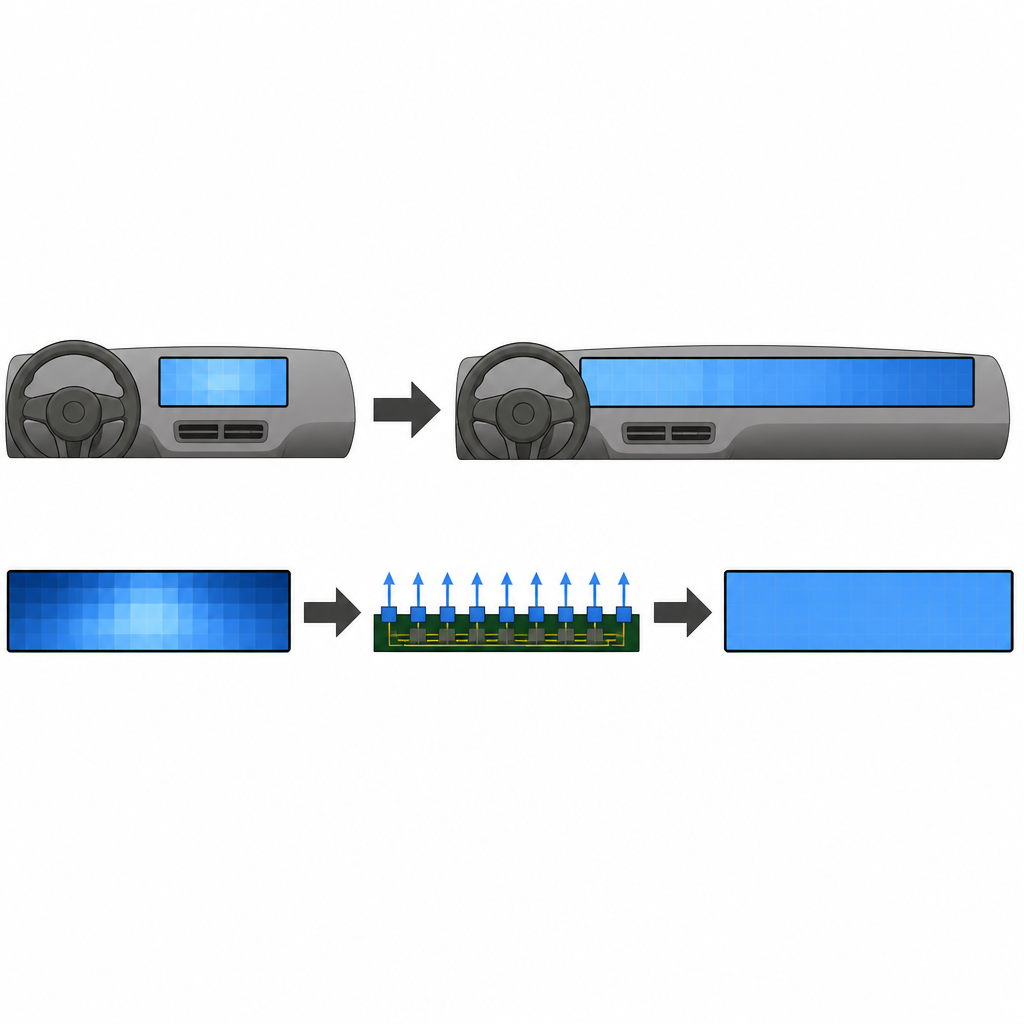
Modern cars are turning into rolling living rooms, filled with long, curved dashboard screens that show maps, alerts, movies, and more. But as these organic LED (OLED) displays grow wider and sharper, it becomes surprisingly hard to light every part of the screen at exactly the same time. Tiny timing errors that are invisible on a tablet can show up on a pillar-to-pillar car display as uneven brightness or washed-out text. This study looks at that timing problem and introduces a new way to drive the screen so that even very large panels stay clear and uniform.
How signals travel across a giant screen
In a typical OLED display, a line of tiny switches turns rows of pixels on and off in rapid sequence. On small panels, the control signal sent from a driver circuit at the edge reaches every pixel row quickly and evenly. On large automotive screens, though, those control lines become long, thin metal tracks that behave like a hose with friction: as the signal travels, electrical resistance and stored charge slow it down. The farther a pixel is from the edge driver, the later it receives the signal, which cuts into the time available to measure and correct for variations in the tiny transistors that feed each pixel. When that time shrinks too much, the display can no longer fully correct for device quirks and the image develops subtle bands or patches of different brightness.
A new way to place the driving circuits
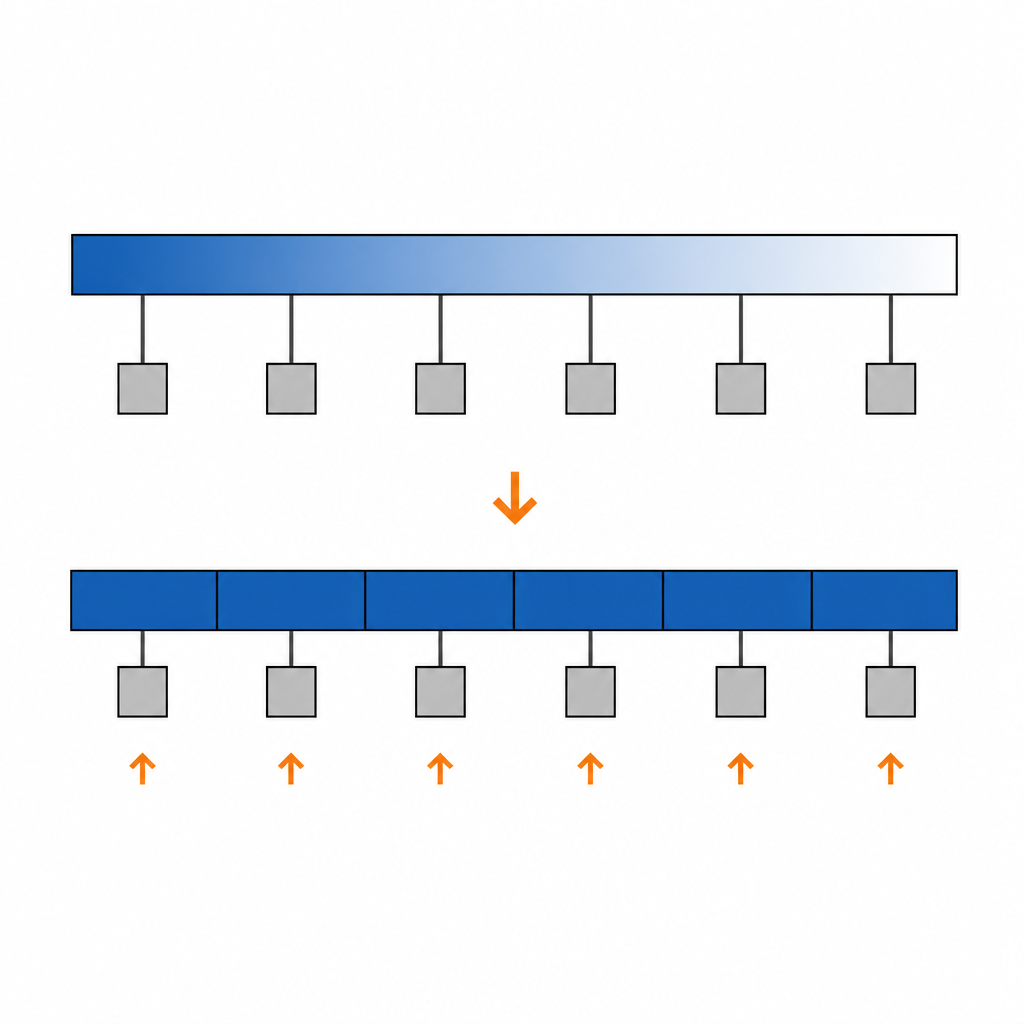
The researchers propose a different layout called a region segmented gate driver. Instead of putting the driver circuits only in the bezel at the edges, they embed many smaller driver units inside the active pixel area itself. The screen is divided into regions, and each region has its own local driver that feeds nearby rows. Because each driver serves a shorter stretch of wiring, the control signals do not have to travel as far, and the delay that builds up along the lines drops sharply. The team keeps the same basic timing scheme as conventional designs so that existing pixel circuits and production methods can still be used.
Keeping pixels safe from electrical noise
Placing powerful switching circuits inside the picture area introduces its own challenge: the large, fast voltage swings in the drivers can leak into nearby pixels and disturb their current. To prevent this, the design clusters the driver transistors tightly and surrounds sensitive paths with shielding lines that sit at steady voltages. These shields act like quiet walls between the noisy driver nodes and the delicate pixel nodes. Simulations and layout analysis show that this approach keeps unwanted coupling extremely small, even in the worst case where the driver sits close to a light emitting area.
What the simulations and prototype panel showed
Using circuit simulations for a 27 inch OLED panel with high horizontal resolution, the team compared the usual edge driver layout with the new segmented approach. With conventional drivers at the bezel, signals arriving at the center of the panel were delayed by microseconds compared with the edges, and some rows could not fully reach their intended voltage. This led to large errors in the pixel currents that set brightness, especially when the transistor characteristics varied. With dozens of embedded drivers spread along each line, the delay dropped by more than half and became nearly the same at the center and edges. The resulting current errors stayed within about ten percent even under sizable device variations, pointing to much more uniform brightness.
Real world tests on an automotive size display
To move beyond simulation, the authors built a 27 inch automotive OLED prototype using industry standard low temperature polycrystalline silicon technology. They integrated the segmented drivers inside the active area while preserving the light emitting aperture by using a top emission structure. Measurements of the control signals at both the center and the edge matched the simulation trends: rise and fall times were short and nearly identical across the panel. Brightness measurements at multiple points showed white luminance uniformity above 91 percent and very low black brightness, both better than typical automotive requirements. Visual test images with icons and solid color patterns revealed no visible seams where driver regions met and no artifacts from electrical coupling.
What this means for future car displays
For non specialists, the takeaway is that this work offers a practical wiring and layout strategy that lets very wide OLED car dashboards look as smooth and consistent as much smaller screens. By shortening the paths that timing signals must travel and carefully shielding the added driver circuits, the region segmented design reduces timing errors that would otherwise cause uneven brightness. The prototype results suggest that car makers can build larger, more flexible displays without relying on exotic manufacturing steps, while still meeting strict standards for picture quality and reliability.
Citation: Shim, D., Hong, S.G., Jeong, YM. et al. Region-segmented gate driver for mitigating RC delay in large-area automotive OLED displays. Sci Rep 16, 16228 (2026). https://doi.org/10.1038/s41598-026-48039-8
Keywords: automotive OLED display, large area displays, gate driver design, luminance uniformity, display timing