Clear Sky Science · en
Multi-scale modeling and sensitivity analysis for weak roadway areas: A case study of Xiaoyun coal mine
Why deep mine tunnels matter
Far below the surface, coal mine tunnels must safely carry people, equipment, and fresh air through rock squeezed by immense pressures. When parts of the surrounding rock are weaker or poorly supported, tunnels can deform, crack, or even collapse, threatening both lives and production. This study examines one such problem area in a Chinese coal mine and shows how combining computer modeling with measurements underground can reveal which support choices matter most—and how to keep deep tunnels stable for the long haul.
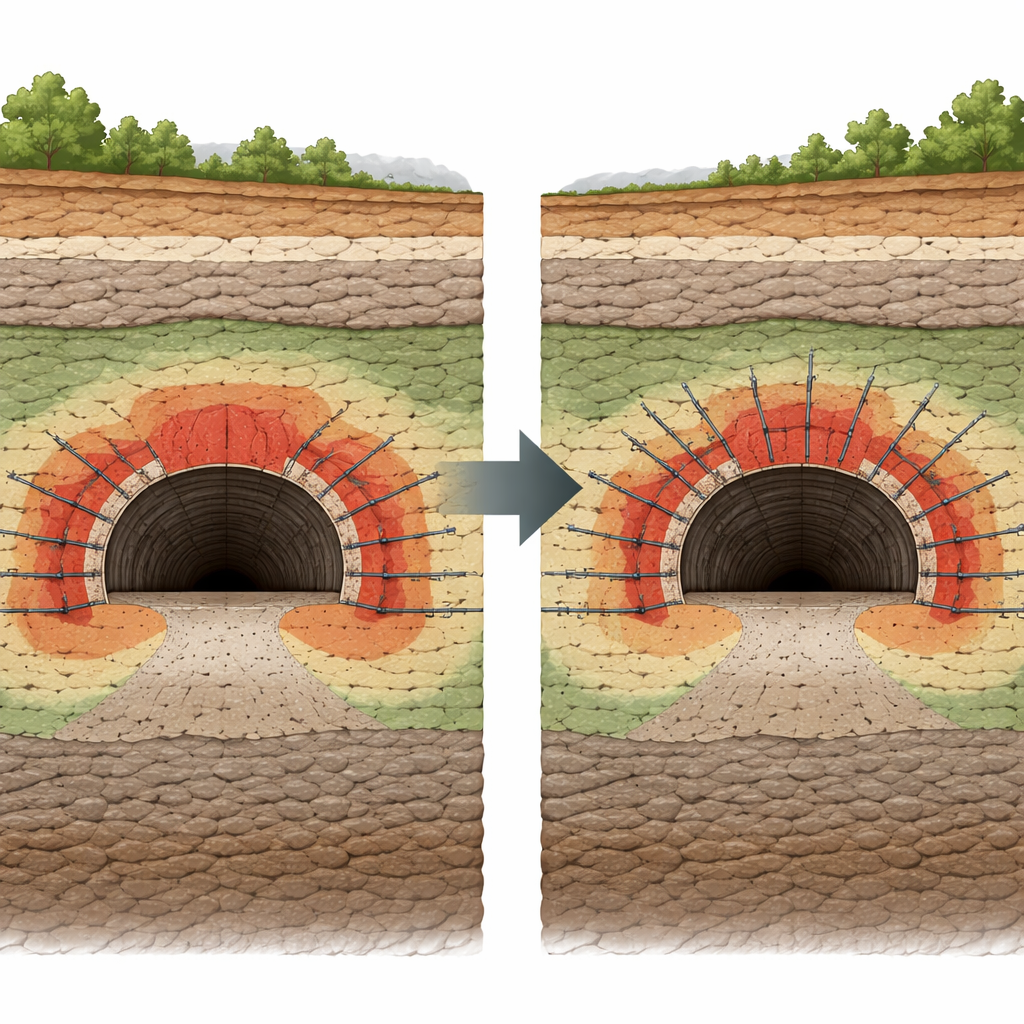
Hidden weak spots around a tunnel
The authors focus on “weak zones” around a roadway—a mining term for the underground passage—where damage begins first and deformation grows fastest. These weak zones arise where natural rock layers, stress from the overlying ground, and man‑made supports do not work well together. The team groups them into three practical types. Structural weak zones follow pre‑existing planes in the rock, such as bedding and joints, which can slide or open. Stress‑type weak zones form where the rock is highly squeezed, such as corners between walls and roof. Support‑mismatch zones occur where the support system is too sparse or too soft, allowing pockets of rock between bolts to bulge or separate.
From simple models to detailed simulations
To understand how these weak zones fail, the researchers first use simplified mechanical models for the roof and sidewalls of the tunnel. These show that, at the 800‑meter depth of the Xiaoyun Coal Mine roadway, the rock roof is at real risk of buckling under its own weight and extra mining‑induced stress, and that sidewalls can start slipping along weaker planes even when the intact rock itself is not crushed. Building on this, they construct a more sophisticated “multi‑scale” numerical model of the surrounding rock. Far from the tunnel, the rock is treated as a relatively undisturbed, elastic block, while near the tunnel the model zooms in with a finer mesh to capture crack initiation, plastic (permanent) deformation, and the growth of damaged zones around the opening.
Testing which support choices matter most
Using this virtual mine, the team systematically varies five common support parameters: how far apart bolts are placed, how long and thick they are, how many reinforcing cables are installed, and how far apart cable rows are. An “orthogonal” experimental design allows them to explore many combinations efficiently, while statistical tools—range analysis and variance analysis—reveal which parameters have the biggest effect on roof sag and wall convergence. The standout result is that bolt spacing dominates everything else. Tightening the spacing strongly limits how far the plastic, damaged zone grows into the rock, whereas simply making individual bolts longer or thicker brings relatively modest gains. The number of long cables is important but secondary, mainly for deeper roof stability.
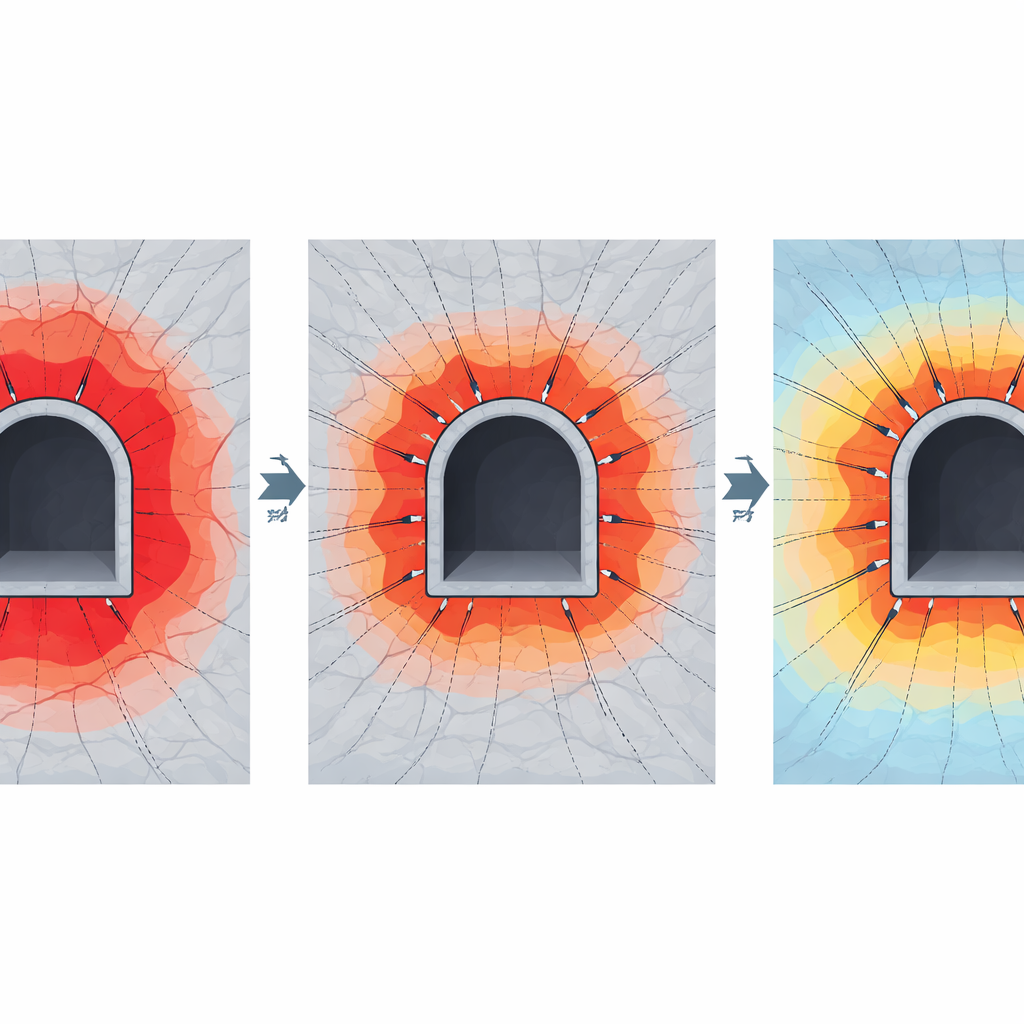
Designing a stronger yet practical support system
Guided by these findings, the authors design and model three support schemes for the actual roadway. The baseline scheme represents the mine’s original, moderately dense support pattern. A second scheme adjusts only bolt spacing, increasing bolt density. A third, “synergistic” scheme combines closely spaced, slightly upgraded bolts with more numerous, deeper cables across the entire tunnel cross‑section. Simulations show that while denser bolts alone help, the combined scheme performs best: it spreads stresses more evenly, lowers peak stresses by about 14%, and shrinks the depth of heavily damaged rock from roughly 2.5 meters to about 1.5 meters—a reduction of about 40%. In effect, the bolts knit the shallow rock into a firm shell, while the cables hang this shell from stronger, deeper rock.
Proof from real‑world measurements
To check that the model reflects reality, the researchers install instruments in the mine roadway to track roof movement and wall convergence over a month after excavation. The measured deformations follow three stages predicted by the simulations: a rapid early adjustment, a slower transition as the support system fully engages, and finally a stable stage where movement nearly stops. With the optimized support, final roof subsidence settles at around 32 millimeters and wall convergence at about 23 millimeters—small values for such depth. Field data and model predictions agree closely, suggesting that the new design effectively restrains weak zones and provides a stable, long‑term passage.
What this means for safer mining
In clear terms, the study shows that for deep, soft rock tunnels, how many bolts you use and how tightly you space them can matter more than how big each bolt is. By treating the rock and support as a single system and using multi‑scale modeling plus field monitoring, the authors demonstrate a practical recipe: dense shallow bolting to form a continuous protective shell, backed up by strong, deep cables. This combination not only improves safety in the studied Xiaoyun Coal Mine roadway but also offers a quantitative guide for designing more reliable, cost‑effective support systems in other deep mines with similar conditions.
Citation: Tian, Z., Ma, L., Liu, Y. et al. Multi-scale modeling and sensitivity analysis for weak roadway areas: A case study of Xiaoyun coal mine. Sci Rep 16, 11658 (2026). https://doi.org/10.1038/s41598-026-48033-0
Keywords: deep coal mine roadway, rock support bolts, weak zone stability, numerical modeling, ground control