Clear Sky Science · en
Diurnal variability of dust transport controlled by mountain terrain and thermal winds
Why daily dust patterns matter
People living in and around Tehran often wake up to hazy skies and poor air, especially in summer. This study asks a simple but important question: why do dust levels rise and fall so dramatically over the course of a single day? By tracking how heat, wind, and the surrounding mountains work together, the researchers show that dust pollution in this region is not random. It follows a daily rhythm driven by the shape of the land and the cycle of day and night heating—insights that can help improve health warnings and air-quality planning in many other mountain-rimmed cities.
The land of mountains, plains, and dust
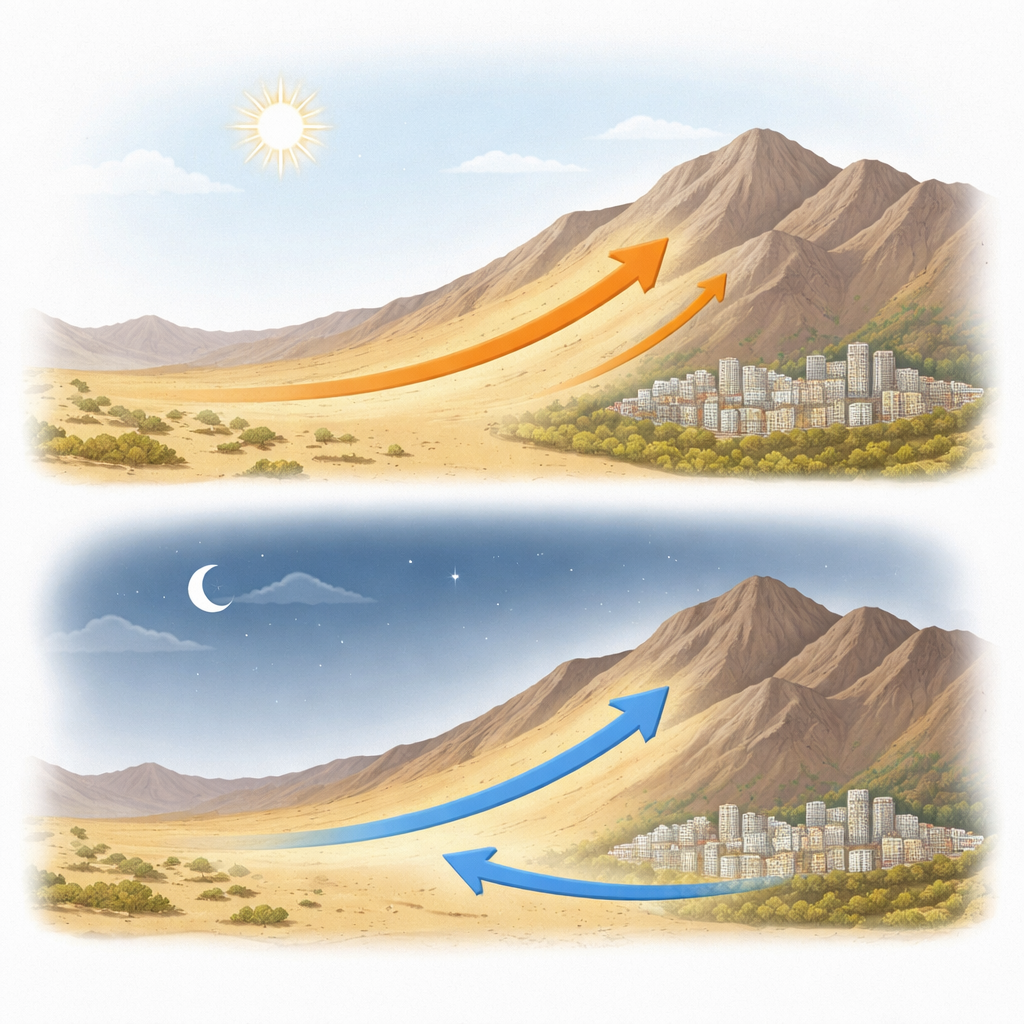
Tehran Province sits between two very different landscapes: the high Alborz Mountains to the north and vast, dry plains and deserts such as the Kavir and Varamin plains to the south and southeast. These dusty lowlands act as giant source areas where strong winds can pick up loose soil and send it toward the city. The steep rise from about 900 meters on the plains to nearly 4,000 meters in the mountains creates sharp changes in temperature and pressure between day and night. Those contrasts, in turn, drive local wind systems that alternately pull dusty air into the city and push it away.
Following the dust through the day
Using more than four decades of satellite-based reanalysis data, together with detailed weather records and hourly measurements of fine and coarse particles at six monitoring stations, the authors reconstructed how dust behaves hour by hour in summer. They found that dust emission from the southern plains surges in the morning as near-surface winds strengthen. These winds blow from the southeast, carrying freshly lifted dust toward Tehran and up the slopes of the Alborz Mountains. Dust near the surface first builds up over the southern parts of the province and then spreads northward, with peak levels in central and northern areas typically late in the morning to around midday.
How heat and height shape dirty air
The study shows that the daily rise and fall of a shallow layer of air near the ground—the part of the atmosphere most influenced by the surface—plays a key role. At night, this layer is low, so pollutants are trapped close to the ground. Over the southern plains, dust emissions remain active enough that concentrations stay high through the night and early morning. In the city itself, however, cool mountain breezes blowing downslope from the Alborz help limit dust buildup near the surface, even though the air layer is shallow. After sunrise, the ground heats up, this layer deepens, and vertical mixing dilutes near-surface dust—yet at the same time, stronger upslope winds import more dust from the plains, especially into central and northern Tehran. As a result, the usual link between a deeper mixing layer and cleaner air becomes weaker in those areas.
Night winds, day winds, and moving plumes
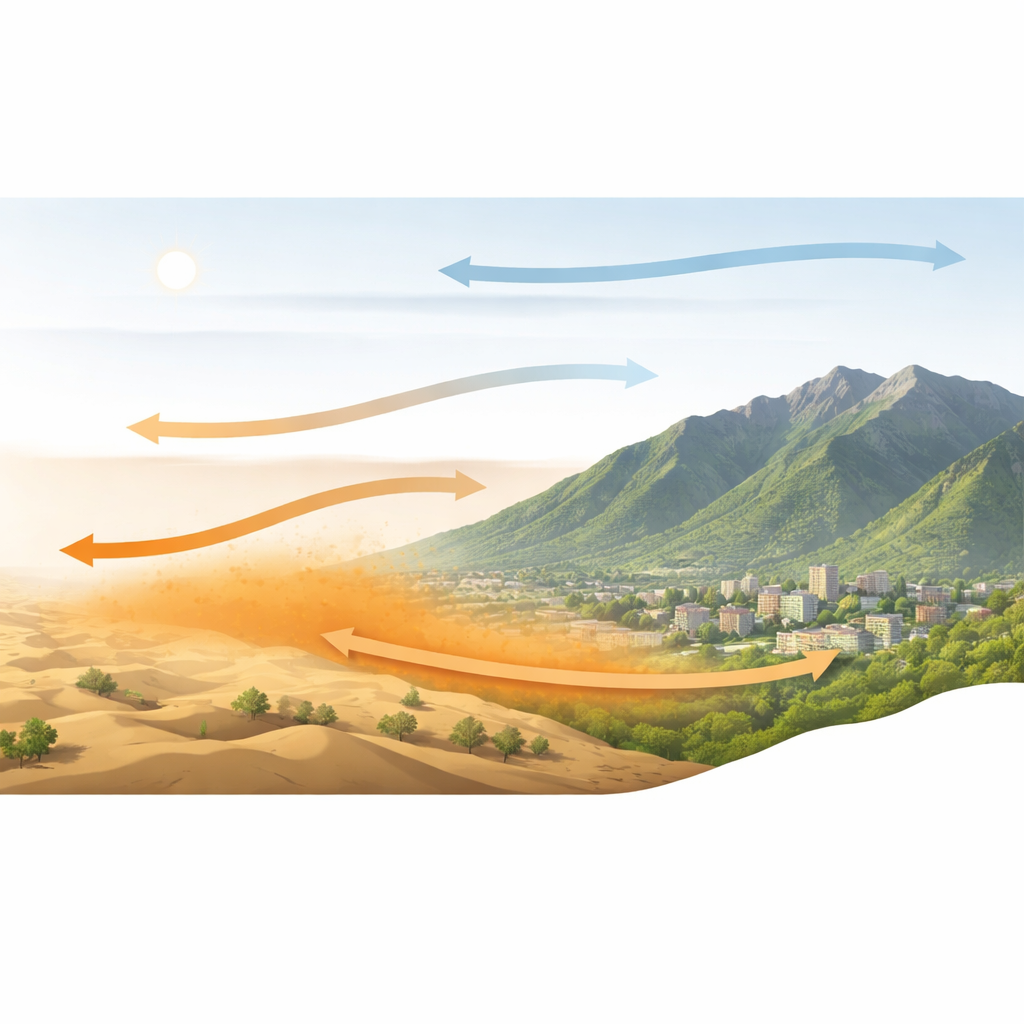
By examining winds not only at the ground but also higher in the atmosphere, the researchers uncovered a two-level circulation pattern. During the day, southerly upslope winds near the surface move dusty air from the plains toward the city and mountains, while return flows higher up help complete the loop. At night, gentle northerly breezes slide down the slopes near the surface, restricting dust from reaching northern Tehran, but stronger southerly winds aloft still move dust over the region. Dust plumes can therefore approach from different directions and heights at different times of day. Surface particle measurements across the city mirror this picture: southern stations show strong nighttime and early-morning peaks, whereas central and northern stations show clearer daytime peaks that march northward over several hours.
What this means for people and planning
In simple terms, this work reveals that summer dust in Tehran is steered by a daily tug-of-war between desert winds and mountain breezes. Morning and midday upslope winds bring in dust from the south and southeast, raising levels first in the southern neighborhoods and later in the city center and northern districts. In the afternoon, winds weaken and the deepened mixing layer helps clean the air somewhat, before nighttime patterns reset the cycle. Because similar mountain–basin layouts exist in many semi-arid regions, the findings help explain why some cities experience predictable daily waves of dust. Better knowledge of these rhythms can feed into hourly air-quality forecasts, targeted health advisories, and smarter planning to reduce people’s exposure during the dustiest times of day.
Citation: Ahmadi, R., Alizadeh, O. & Sabetghadam, S. Diurnal variability of dust transport controlled by mountain terrain and thermal winds. Sci Rep 16, 12024 (2026). https://doi.org/10.1038/s41598-026-47941-5
Keywords: dust storms, Tehran air quality, mountain winds, desert pollution, diurnal variability