Clear Sky Science · en
Local shear mechanical behavior of rock joint under constant normal load
Why tiny cracks in rock matter
Underground tunnels, dams, and reservoirs all rely on the strength of the rock that surrounds them. But real rock is crisscrossed with natural cracks, or joints, that can slip and break under stress, sometimes triggering sudden failures. This study looks closely at what happens along a single rough crack in rock when it is squeezed with a steady pressure and then pushed sideways. By zooming in on how force concentrates on tiny bumps and hollows along the crack, the work helps engineers better judge when and where rock may begin to fail. 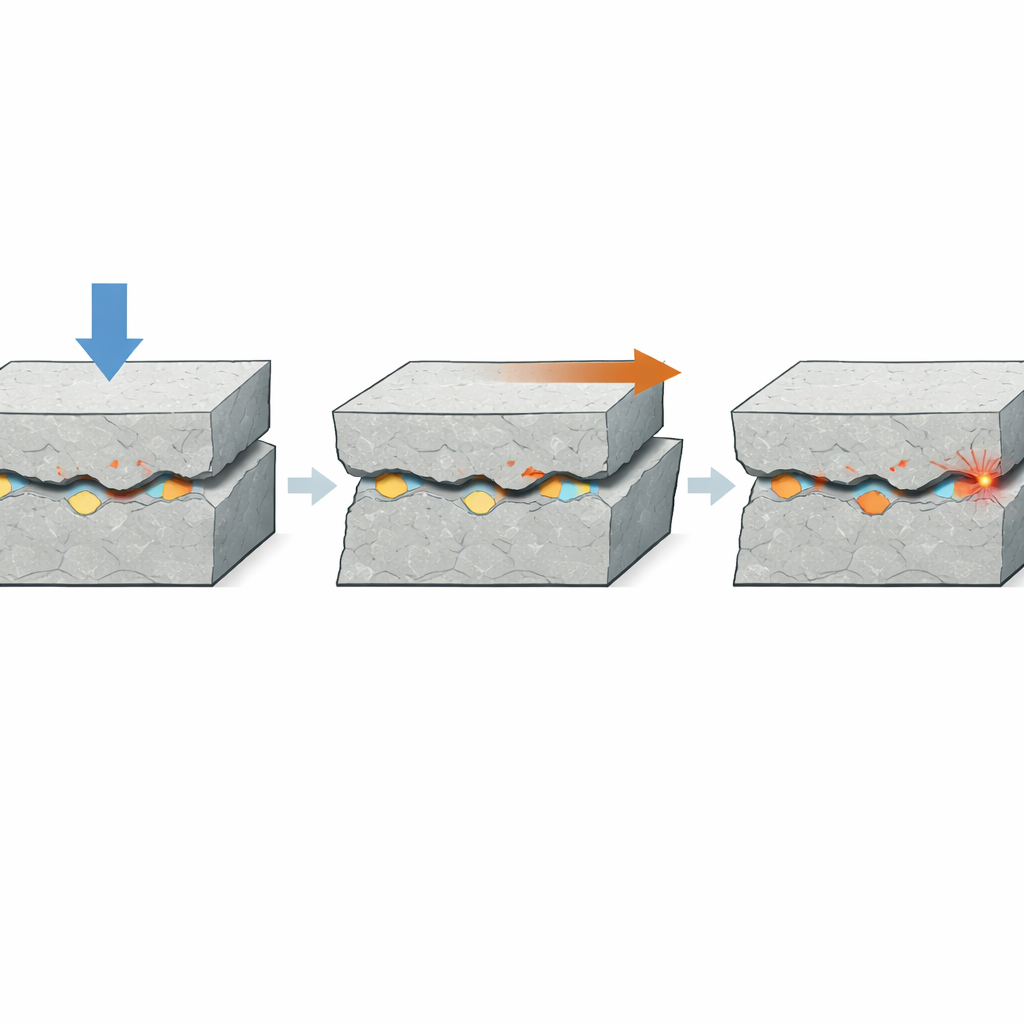
Hidden landscapes between rock faces
What looks like a simple crack is actually a miniature landscape of peaks, valleys, and gaps. When two rough rock faces are pressed together, only some of these peaks truly touch; the rest remain separated by small openings. As the upper face is pushed sideways, the contact pattern shifts. Parts of the surface tilt in the direction of motion and take on more load, while parts that tilt away can separate and carry almost no force. The authors describe these tilts using a simple angle on tiny rectangular patches of the surface, and they use this angle to decide which patches are actively resisting sliding and which are not.
Turning scans into a digital test
To explore this process in detail, the team first scanned a real rock joint surface at very fine spacing, building a three-dimensional digital model of its roughness. They then used a mathematical technique called the boundary element method to calculate how the two sides of the joint press on each other when a constant vertical load is applied. This method focuses only on the surfaces, not the whole rock volume, making it efficient while still capturing how contact pressure spreads over the rough landscape. With these contact pressures and the local surface angles, they used a classic friction rule to estimate the sideways (shear) forces on each tiny patch of the joint, step by step, as sliding progressed.
How sliding changes the stressed spots
The simulations reveal that most of the joint area carries very little shear force; only a relatively small set of patches bears the brunt of the load. As the joint is pushed farther, the overall zone where shear acts does not suddenly jump to new places—instead, it mainly grows and shrinks around its original region. Within this zone, however, the local shear forces can fluctuate strongly as contact points appear, disappear, or deform. Some locations show regular, predictable changes in shear force when the surrounding normal pressure is low and fairly uniform. Others, where nearby contact pressures are high and uneven and the surface height changes sharply, show irregular and sometimes abrupt shifts in shear force. 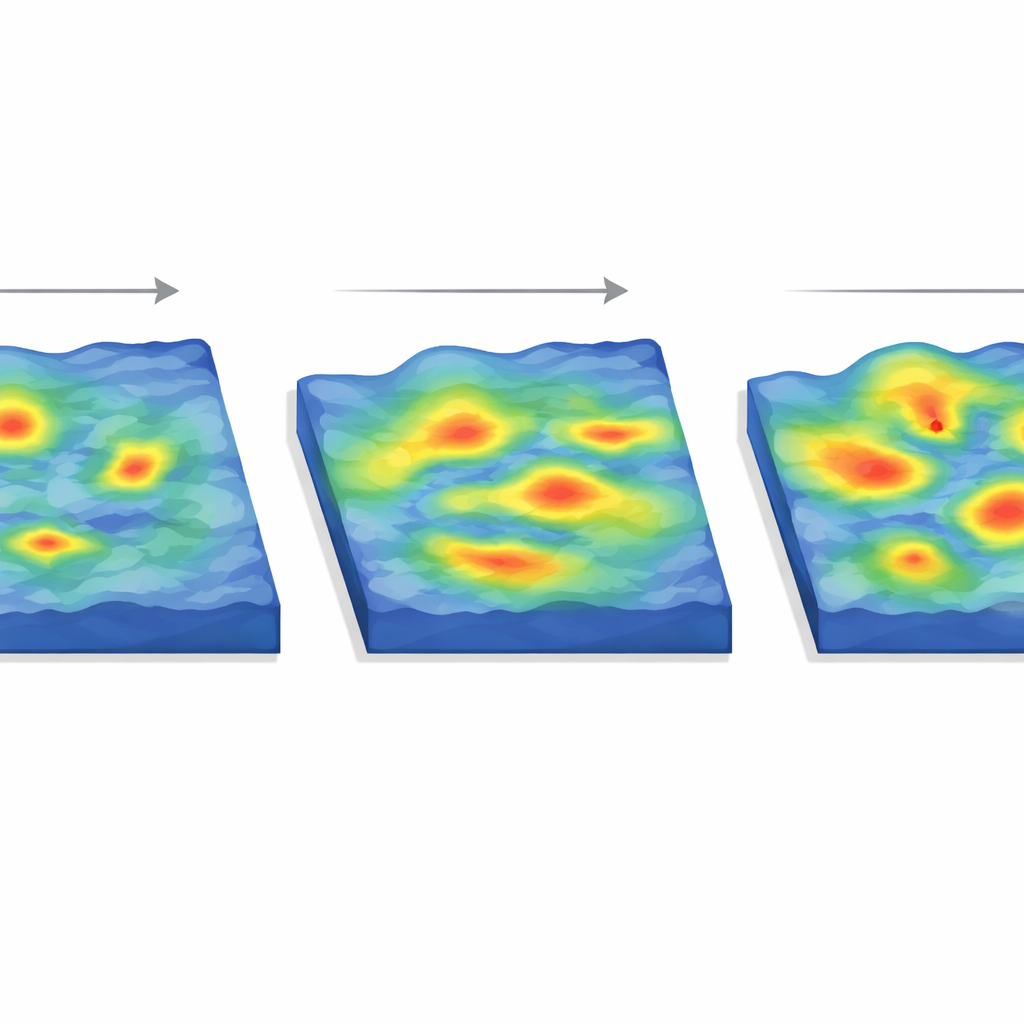
When more squeeze means more contact
Raising the vertical load increases both the number of contact spots and the average shear force they can carry. The contact area spreads, and more patches begin to participate in resisting sliding, though most still carry only modest levels of shear. At the same time, the rough peaks gradually flatten under pressure, so the surface as a whole becomes smoother. This smoothing tends to reduce the joint’s ability to resist shear over longer sliding distances, even as the immediate effect of higher load is to raise shear strength. The total shear force on the joint, averaged over all contact patches, rises and then slowly declines in a wavy pattern as sliding continues, reflecting this tug-of-war between growing contact area and fading roughness.
What this means for real rock stability
The study shows that failure in rock does not start everywhere at once; it begins at a few small, highly stressed spots along rough cracks and then spreads. By combining detailed surface scans with a surface-based calculation method, the authors can track how local shear forces evolve at each patch of the joint as load and sliding change. For engineers, this provides a more precise picture of where cracks are likely to initiate or grow under realistic loading, improving the assessment of tunnels, slopes, and underground reservoirs. In simple terms, the work explains how the shape of a hidden crack and the way it is squeezed together control when that crack begins to slip and potentially compromise the safety of the surrounding rock.
Citation: Wang, W., Ma, H., Dai, C. et al. Local shear mechanical behavior of rock joint under constant normal load. Sci Rep 16, 11669 (2026). https://doi.org/10.1038/s41598-026-47635-y
Keywords: rock joints, shear stress, fracture roughness, numerical simulation, geotechnical stability