Clear Sky Science · en
A miniaturized dual-port circularly polarized MIMO patch antenna for SAR-compliant wearable X-band communication systems
Smaller, Safer Wireless Gear on the Body
Smart watches, fitness bands, and medical wearables all rely on tiny radios that sit directly on our skin. As these gadgets handle more data at higher speeds, their antennas must shrink, work reliably while we move, and remain safe for long term contact with the body. This study shows how a matchstick sized antenna can meet all these needs at once for a little used high frequency band, opening the door to more capable yet comfortable wearable devices.
Why This Little Used Band Matters
The work focuses on the so called X band around 9 gigahertz, a slice of the spectrum mostly used today for radar on ships, aircraft, and satellites. At these frequencies, radio waves have short wavelengths, so antennas can be very small, yet signal loss in air is still moderate compared with millimeter wave bands. Unlike the crowded Wi Fi and cellular bands below 6 gigahertz, the 9.0 to 9.3 gigahertz range has far fewer consumer devices, which reduces interference. This makes it attractive for short range, body worn links that need compact hardware and clear channels.
The Challenge of Packing Many Demands Into One Antenna
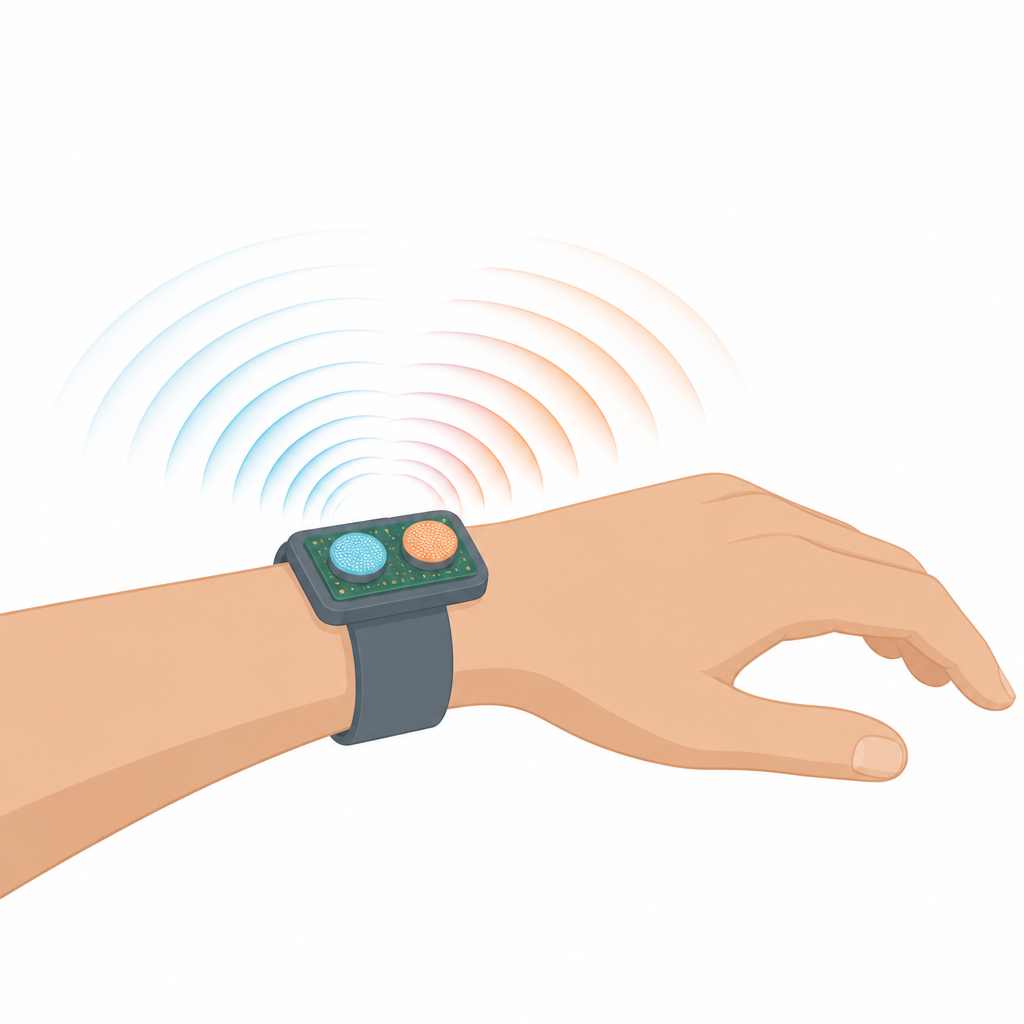
Designing an antenna for a wrist or patch style device at these frequencies is not simply a matter of scaling things down. The available surface on the body is tiny, yet earlier circularly polarized X band antennas often measured several centimeters on a side. Being close to the skin shifts the tuning and can sap signal strength unless the antenna is carefully shielded. Engineers also want multiple antenna ports so a device can use multiple input multiple output, or MIMO, techniques to fight signal fading. At the same time, the antenna must radiate in a way that stays within strict safety limits on how much energy is absorbed by nearby tissue, measured by the specific absorption rate, or SAR. Previous designs usually met only some of these goals.
A Matchstick Sized Twin Antenna
The team built a dual port antenna just 40 by 15 millimeters and 1.6 millimeters thick, roughly the size of a slim stick of gum. It uses two small circular metal patches side by side on a common backing board with a solid metal layer underneath that both steadies the radiation pattern and shields the body. Each patch is fed from below by a short coaxial probe placed slightly off center. This simple geometric offset, together with the curved edge of the circle, naturally sets up two radio wave components that are equal in strength but a quarter cycle out of phase, producing circular polarization without extra slots, corner cuts, or complex feed networks.
How It Talks Clearly Without Interference
The two patches are spaced only a few millimeters apart, tight enough for a small wearable but far enough that their near fields do not strongly overlap. Simulations and measurements show that when one port is active, the current on the other patch stays much weaker, and the energy each patch sends into space points in slightly different directions and spirals. This yields low correlation between the two signals, which is vital for MIMO systems. Across the 9.0 to 9.3 gigahertz band, both ports match well to standard radio hardware, their interaction stays below the level that would spoil diversity gains, and the circular polarization remains stable, so signal strength does not collapse when the wearer turns a wrist or moves through a complex indoor environment.
Keeping the Wearer Safe
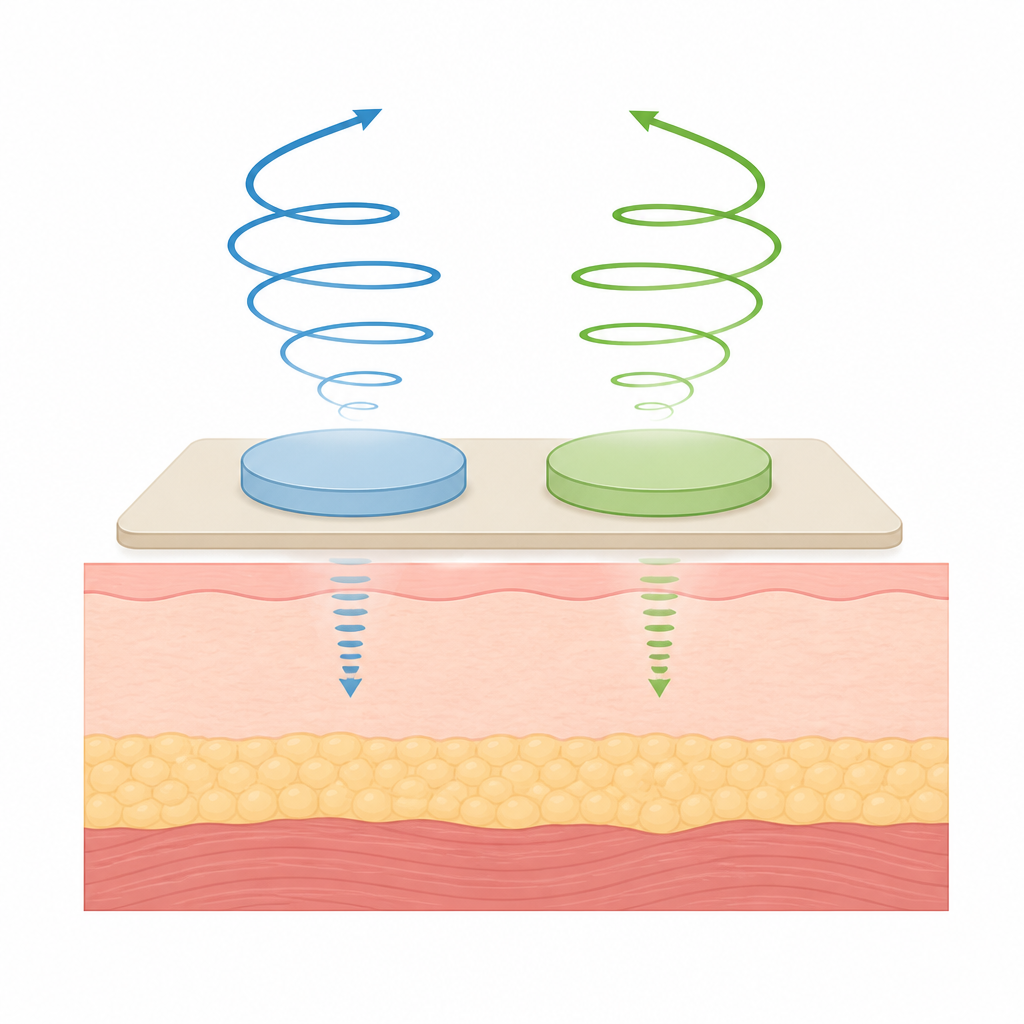
To check safety, the researchers placed the antenna model on a realistic three layer digital hand made of skin, fat, and muscle and calculated how much power the tissues absorb. Even at the operating frequency, the peak SAR values are well below international exposure limits when averaged over one and ten grams of tissue. The strong front to back ratio of the radiation pattern shows most power heading away from the body, while the metal backing and compact geometry limit hot spots in the skin. This suggests the antenna can support continuous or long duration use in real wearables without exceeding regulatory thresholds.
What This Means for Future Wearables
In practical terms, the study offers a blueprint for building very compact antennas that still provide the reliable, orientation tolerant links and multi channel capacity modern wireless systems require, all while respecting safety standards. By proving that miniaturization, circular polarization, MIMO performance, and low SAR can coexist in a single, simple structure at X band, the work points toward future smart bands, health monitors, and even small radar sensors that are both powerful and comfortable to wear.
Citation: Gloria, J.P., Anbarasu, M.M., Liakath, J.A. et al. A miniaturized dual-port circularly polarized MIMO patch antenna for SAR-compliant wearable X-band communication systems. Sci Rep 16, 16150 (2026). https://doi.org/10.1038/s41598-026-47610-7
Keywords: wearable antenna, X band, circular polarization, MIMO, SAR safety