Clear Sky Science · en
Numerical evaluation of a bio-inspired hybrid nanofluid-based cooling technique for high-efficiency CPVT system
Why cooling tomorrow’s solar panels matters
As the world leans more heavily on solar power, a quiet problem is becoming harder to ignore: solar panels work less efficiently as they heat up, and they are easily dulled by dust. This study explores a new way to keep highly concentrated solar panels both cool and clean, so they can deliver more electricity and usable heat while cutting climate-warming emissions over many years.
A smarter way to catch more sunlight
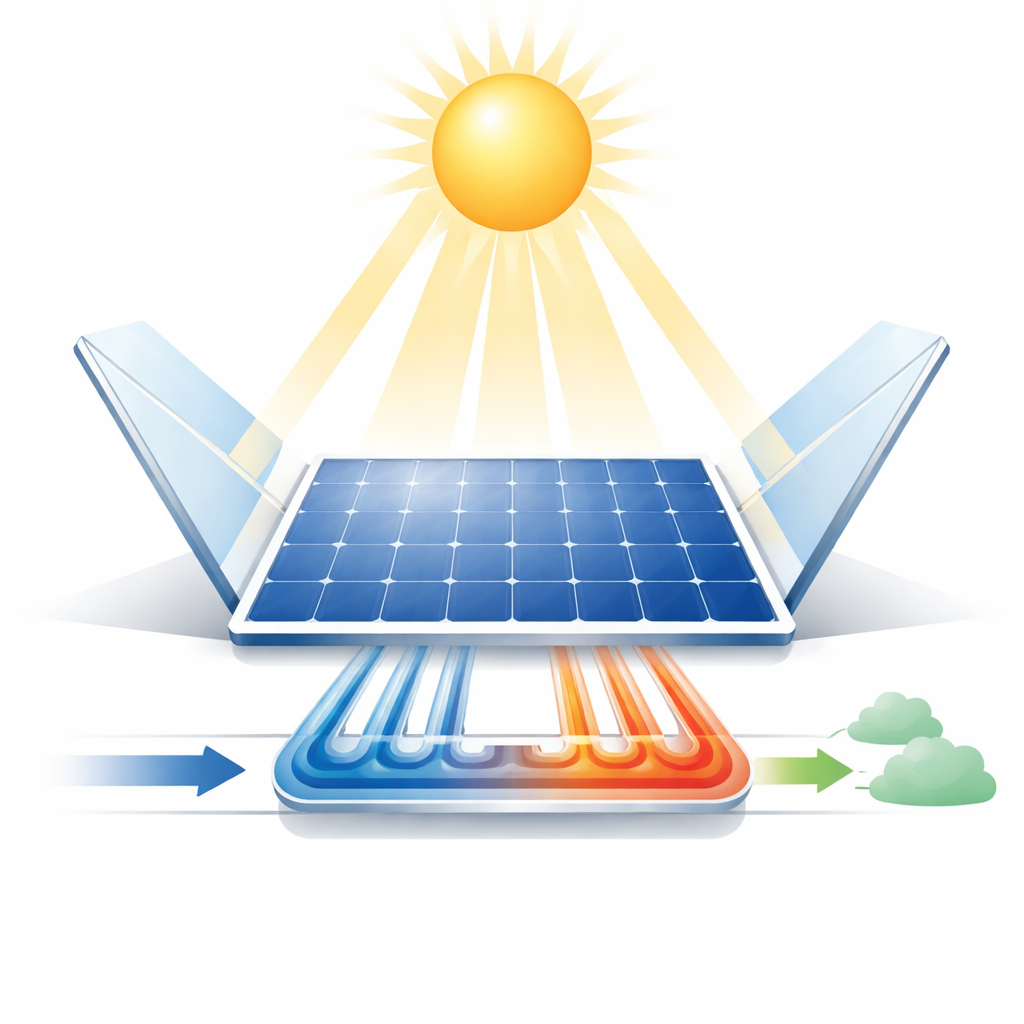
The researchers focus on a type of system called concentrated photovoltaic–thermal, or CPVT. Instead of using only flat panels, they add shiny V-shaped reflectors on either side of the module to bounce extra sunlight onto it, boosting how much energy hits the surface by roughly one and a half times. That extra light can lead to more electricity and hot water or air, but it also makes the solar cells run hotter, which normally drags their efficiency down. The key question the team tackles is how to enjoy the benefits of concentrated sunlight without paying the price in lost performance and shorter panel life.
Borrowing tricks from nature and nanotechnology
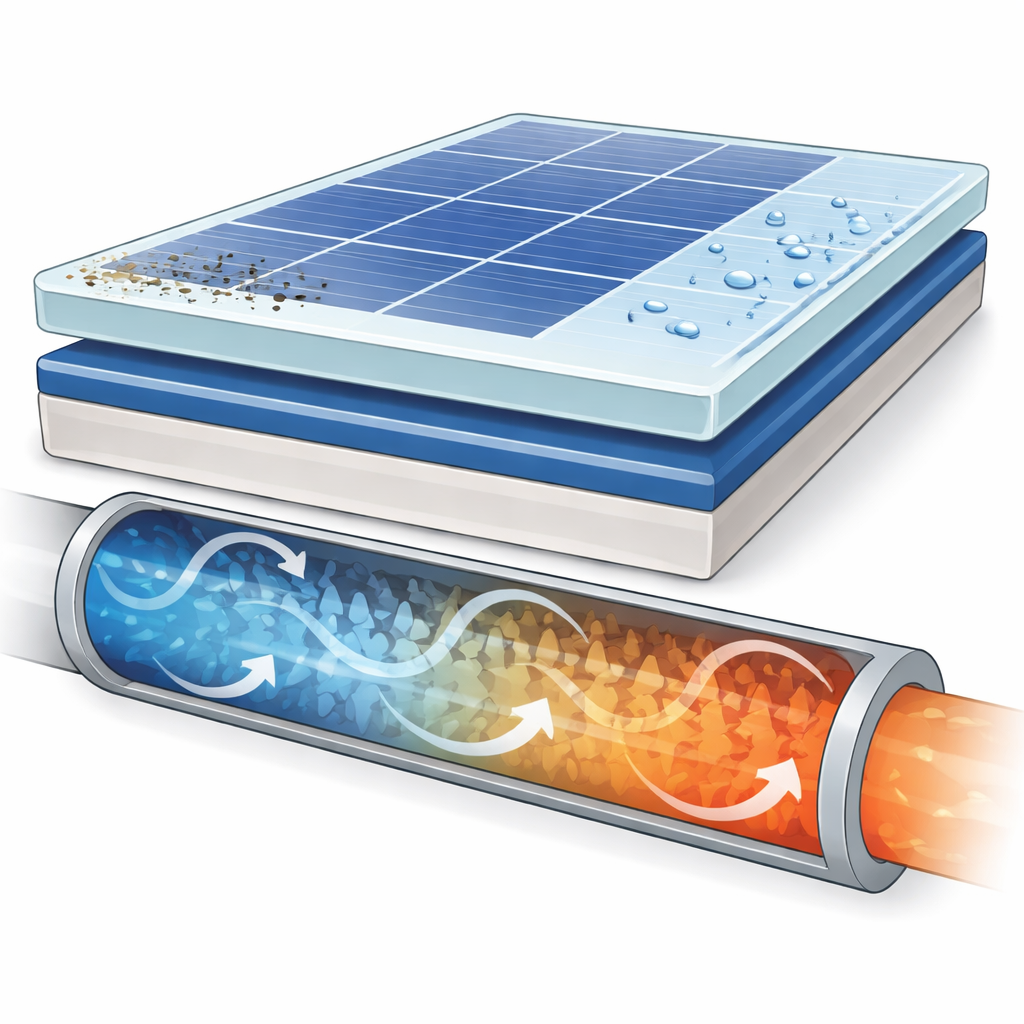
To solve the overheating problem, the authors design an intricate cooling channel attached to the back of the solar panel. Water flows through this channel and carries away heat, but they supercharge it by dispersing tiny silver and magnesium oxide particles into the water, creating a “hybrid nanofluid” that conducts heat much better than plain water. Inside each cooling tube they place a metal insert inspired by hedgehog spines: rows of small spikes jut into the flow, stirring the liquid and breaking up smooth layers that otherwise insulate the hot wall. Computer simulations show that this bio-inspired insert lowers the panel’s average temperature by more than 8% and makes the temperature more uniform across the surface, both of which help the solar cells work closer to their ideal point.
Fighting dust with self-cleaning glass
Heat is only half the story. Outdoor panels steadily gather dust, which blocks light and can slash electrical output. In their virtual experiments, the authors find that heavy dust buildup can cut electrical efficiency by over a third and shrink overall energy recovery by nearly 40%. To counter this, they add a thin layer of silicon dioxide nanoparticles to the front glass. This coating makes the surface more water-repellent and less welcoming to dust, so wind and rain can remove particles more easily. With this self-cleaning layer in place, the system recovers much of the lost performance: total efficiency rises by almost 14%, and the amount of carbon dioxide emissions avoided over the system’s life jumps by about 28% compared with a dusty, uncoated panel.
Putting the pieces together in one system
The real strength of the work lies in combining all these ideas into a single, carefully simulated setup. Using detailed three-dimensional computer models, backed by earlier experimental data, the team studies dozens of scenarios: with and without reflectors, with smooth tubes versus hedgehog-like inserts, with low and high nanofluid flow rates, and under clean, dusty, and coated glass conditions. They find that cooling with the hybrid nanofluid alone can make the total power output more than five times that of a conventional, uncooled panel. Adding the reflector further boosts how much clean energy is generated per square meter, and the advanced cooling design keeps temperatures in check so that the electrical efficiency penalty from the extra heat is held to only a few percent.
What this means for everyday energy
In plain terms, the study shows that future solar installations can be made both tougher and more productive by treating heat, light collection, and dirt as a linked set of problems. The V-shaped mirrors help the system capture more sunlight; the nanoparticle-enhanced coolant and hedgehog-like mixer inside the tubes pull heat out efficiently; and the self-cleaning glass keeps the front surface clear. Together, these features raise the combined electrical and thermal efficiency, improve temperature uniformity for longer panel life, and significantly increase the amount of greenhouse gas emissions the system prevents over 25 years. While the work is based on numerical modeling rather than a field prototype, it maps out a practical route toward high-efficiency solar units that make better use of space, especially in hot and dusty regions where clean energy is most urgently needed.
Citation: Sheikholeslami, M., Larimi, M.M. & Mohammed, H.J. Numerical evaluation of a bio-inspired hybrid nanofluid-based cooling technique for high-efficiency CPVT system. Sci Rep 16, 13758 (2026). https://doi.org/10.1038/s41598-026-47361-5
Keywords: solar cooling, hybrid nanofluid, dust on solar panels, concentrated photovoltaics, self-cleaning coatings