Clear Sky Science · en
Multi-timescale energy-aware grid-forming control with self-tuning virtual inductance for battery lifetime enhancement
Why smarter solar and battery control matters
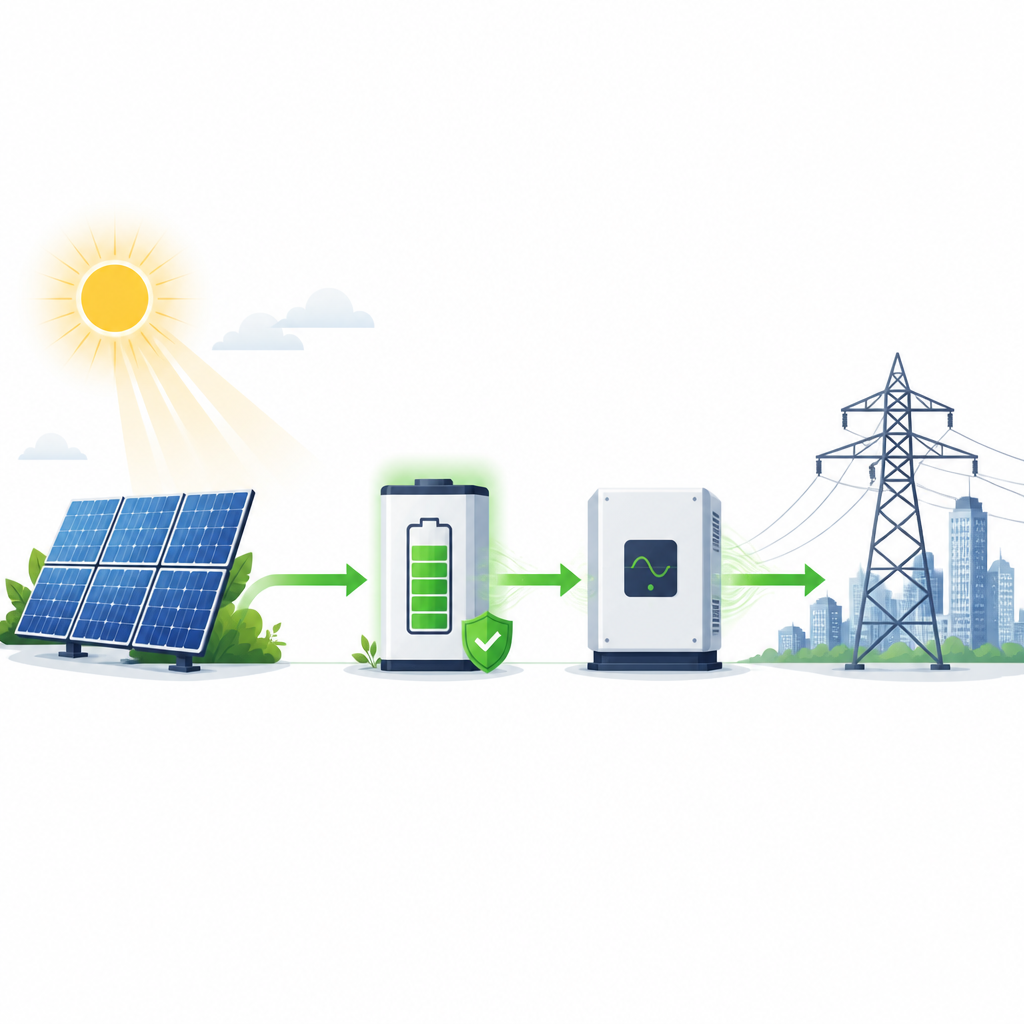
As more homes and communities rely on solar panels and batteries, keeping the lights on during grid disturbances becomes harder. Traditional power plants naturally steady the grid, but electronics based systems do not. This paper explores a new way to control solar plus battery units so they can keep the grid stable while also treating the battery more gently, helping it last longer and lowering long term costs.
The challenge of a weaker, cleaner grid
Solar farms and battery systems connect to the grid through electronic inverters instead of heavy spinning generators. While this is efficient and flexible, it removes much of the natural cushioning that used to smooth out sudden changes in demand or faults on the lines. In weak parts of the grid, where there is little backup strength, voltage and frequency can wobble when clouds pass over, loads switch on, or lines trip. At the same time, the battery must constantly charge and discharge to support these changes, and repeated small cycles wear it out over years of operation.
Building a layered control brain
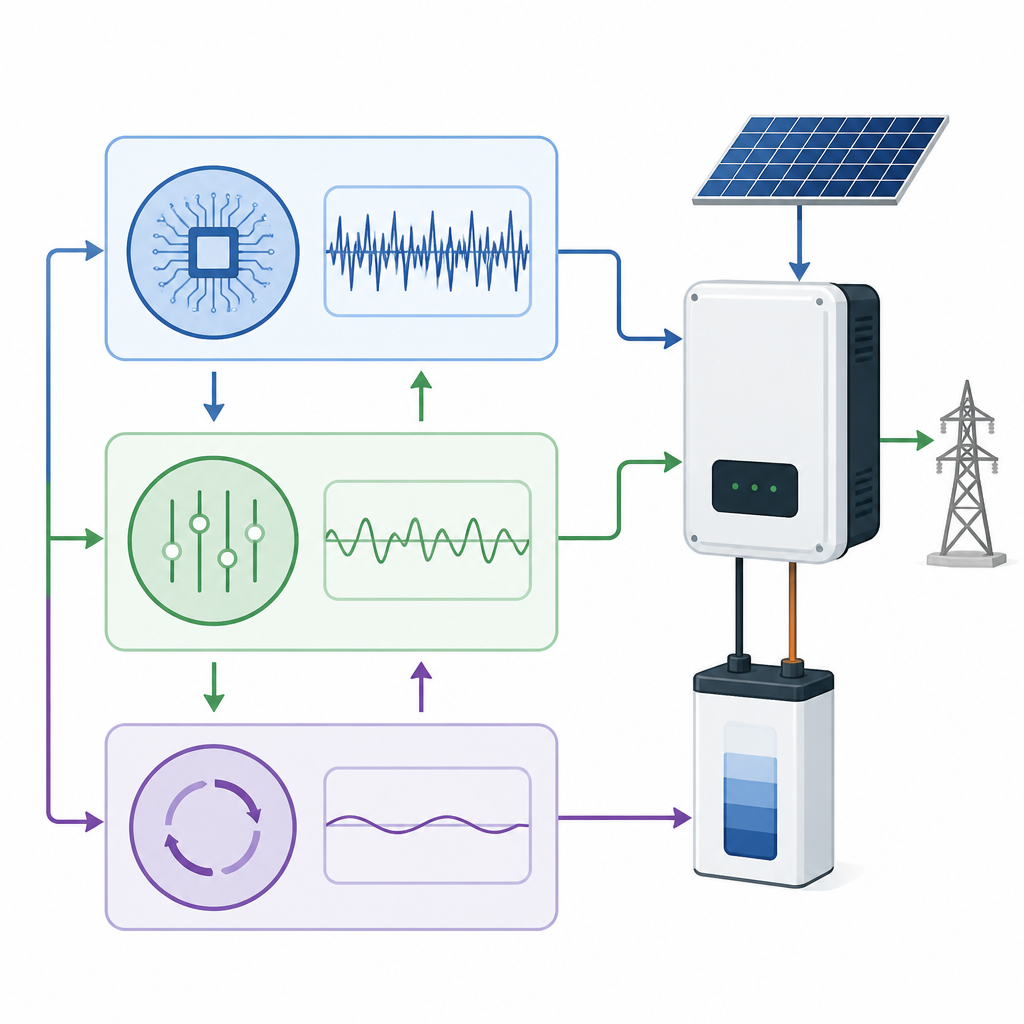
The authors propose a control strategy that works across several time scales inside a solar plus battery unit. At the fastest level, the controller keeps the inverter current tightly in line and applies an artificial damping effect that tames electrical resonances without extra hardware. On a middle level, the inverter behaves like a virtual version of a traditional generator, adjusting its apparent inertia and damping so that it can either react quickly or more cautiously depending on conditions. The slowest level looks at how energy in the shared direct current link between the battery and inverter drifts over time and gently reshapes how the system responds so that the battery is not stressed by constant rapid cycling.
Letting the hardware adapt to its surroundings
A key idea is that the inverter does not stick to fixed settings. Instead, it continuously estimates how much energy is stored in the link capacitor and how strong the nearby grid is. From these two clues, it tunes a virtual inductance and inertia inside its software. In weaker grids or when stored energy is low, the controller increases its virtual inductance and damping, which calms oscillations but still keeps the system stable. When the grid is strong and plenty of energy is available, it relaxes these values to avoid a sluggish response. A separate coordinator manages smooth switching between grid following, grid forming, and islanded modes so that transitions do not cause sudden jolts in power or battery current.
Tested behavior in realistic simulations
Using detailed computer models that include switching effects, grid strength changes, and a realistic battery, the researchers compare their adaptive method with a standard controller. Under sudden drops in solar power, the conventional approach lets the shared link voltage sag by around ten percent and take many hundreds of milliseconds to recover. The new method keeps the voltage within a very narrow band and settles much faster. Power flows to the grid become smoother, and current waveforms show fewer high frequency ripples, which means less electrical stress on both the inverter and the grid connection.
Protecting the battery over years
To understand long term impact, the study also links fast electrical behavior to a simple model of battery aging. It counts how often and how deeply the battery is effectively cycled as it compensates for link energy swings and grid disturbances. Because the new controller sharply reduces these swings, the number of equivalent full cycles falls. Over a simulated 12 year period with the same hardware and environment, the proposed method keeps a few percent more of the battery’s original capacity than the fixed setting controller. While this is not claimed as an exact lifetime prediction, it shows that controlling power electronics with battery health in mind can measurably reduce wear.
What this means for future solar and storage
In plain terms, the work shows that a solar plus battery unit can act more like a helpful, self aware citizen of the grid. By sensing its own energy state and the strength of the surrounding network, it can change how hard it pushes or resists, keeping the grid steady while avoiding needless strain on the battery. This layered, energy aware approach could make it easier to run power systems with very high shares of renewables, especially in remote or fragile networks, while squeezing more useful years out of costly storage packs.
Citation: Zheng, L., Liu, X. Multi-timescale energy-aware grid-forming control with self-tuning virtual inductance for battery lifetime enhancement. Sci Rep 16, 15926 (2026). https://doi.org/10.1038/s41598-026-47270-7
Keywords: grid forming inverter, battery lifetime, solar PV storage, weak grid stability, virtual inertia control