Clear Sky Science · en
The late positive potential is associated with serial dependence effects in facial identity
Why yesterday’s face still shapes what you see today
When you glance at a stranger on the street, your brain does more than capture a snapshot. It quietly compares that face with ones you have just seen, striking a balance between noticing change and preserving a stable, continuous world. This paper explores how the brain’s electrical activity reflects that balancing act when we judge who a face belongs to, revealing that a late wave in the brain’s response is tied to how we subtly pull our current perception toward, or push it away from, faces we saw moments before.
Seeing patterns in a stream of faces
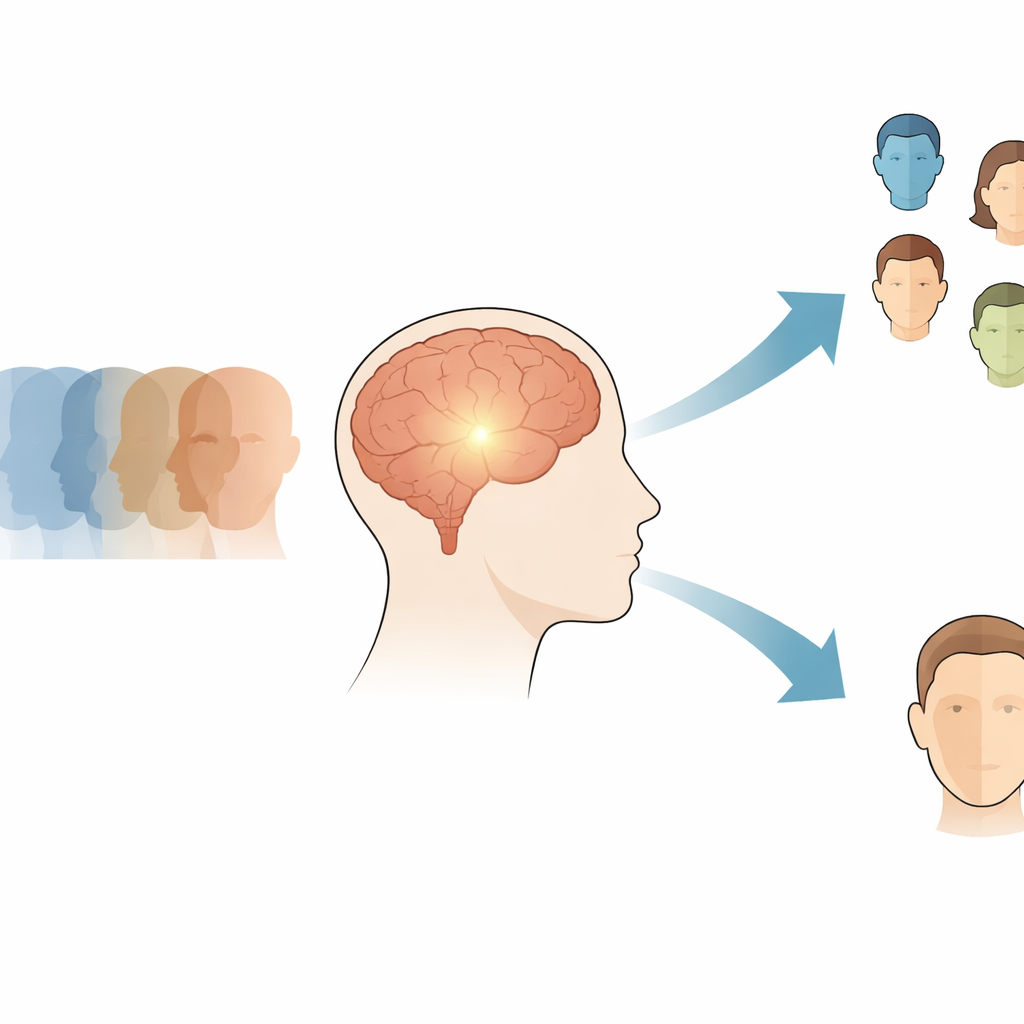
Our eyes are constantly bombarded with images that are similar from one moment to the next. The visual system can use this continuity in two main ways. Sometimes it adapts to what just happened and exaggerates differences, making new input seem more distinct from what came before. This produces a “repulsive” bias: the current face is judged as less like the previous one. At other times, the brain integrates information across moments, nudging the current perception toward recent input. That “attractive” bias smooths over small changes so that faces, objects, and scenes feel stable rather than flickering. Both tendencies—distinguishing change and preserving stability—have been documented for simple features such as line orientation and color. The question here was whether these opposing pulls also co-occur for something as complex and meaningful as facial identity, and which stages of brain processing are involved.
Testing memory for faces under fuzzy viewing
To probe these subtle biases, the researchers asked volunteers to perform a face-matching task while their brain activity was recorded with electroencephalography (EEG). Each trial showed two faces in succession. These faces were not completely clear: they were overlaid with the same street scene at either lower or higher transparency, making them harder or easier to see. The first face was an “inducer” that did not need to be remembered; the second was the target. After a brief distraction, participants adjusted a clean face image around a morph wheel until it matched the target as closely as possible. By examining how the chosen face shifted relative to the true target, and how much the first and second faces differed along the morph wheel, the team could measure both repulsive (away from the previous face) and attractive (toward the previous face) serial dependence across different degrees of similarity.
When the brain pushes faces apart or blends them together
The behavioral data revealed a striking pattern. When the two faces on a trial were very similar, people’s judgments were biased away from the first face: they tended to push the match away, showing a repulsive effect that favors telling look-alike faces apart. When the faces were very different, the bias flipped. Now responses drifted toward the earlier face, an attractive effect that effectively pulls distinct faces closer together in memory. For intermediate similarity, there was no reliable bias either way. Surprisingly, making faces more or less visible did not change this pattern, nor did it alter overall accuracy in the matching task. That suggests the key factor was how alike the faces were, not how clearly they were seen.
A late brain wave linked to “pulling” faces together
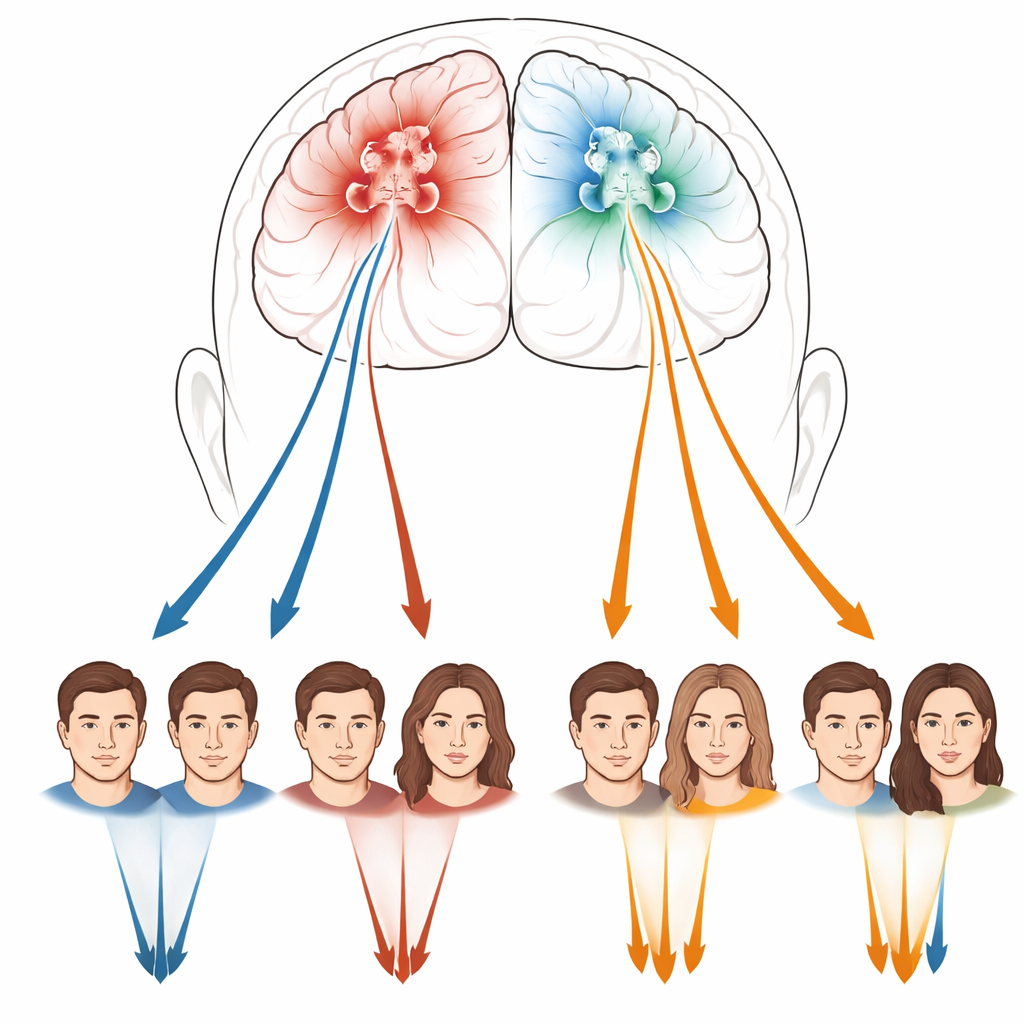
The EEG recordings allowed the authors to ask which stages of brain processing tracked these perceptual pulls. They focused on well-known electrical signatures of face processing that unfold over fractions of a second after a face appears. Early waves (N170 and N250), thought to reflect initial structural analysis of faces and activation of stored face representations, hardly changed with face similarity and did not relate to the behavioral biases. In contrast, a later, broad positive wave over the center and back of the scalp—called the late positive potential (LPP)—did vary with how similar the two faces were. This activity was reduced when the current face closely resembled the previous one and increased when the faces were quite different. Crucially, the size of this LPP difference predicted the strength of the attractive bias for dissimilar faces but did not explain the repulsive bias for similar faces. Topographical analyses suggested that the neural patterns linked to repulsive and attractive effects within this time window had different spatial distributions, hinting at partially distinct underlying brain networks.
What this means for how we recognize people
Put simply, the study shows that our sense of who we are looking at is not purely based on the face in front of us; it also depends on recently seen faces, and the brain treats similarity and difference in asymmetric ways. When faces are alike, our perception tends to exaggerate their differences, helping us tell individuals apart. When faces are quite different, later brain processes associated with attention and comparison can instead lead us to blend them slightly together in memory, stabilizing our experience at the cost of fine detail. Because only the late brain response was tied to this attractive pull, these findings point to higher-level comparison and working-memory processes, rather than early visual encoding, as key drivers of how we integrate facial information over time. That in turn suggests that the brain’s mechanisms for separating similar identities and for smoothing over changes rely on different neural machinery, rather than being opposite sides of a single process.
Citation: Lidström, A., Bramão, I. The late positive potential is associated with serial dependence effects in facial identity. Sci Rep 16, 11222 (2026). https://doi.org/10.1038/s41598-026-47266-3
Keywords: face perception, visual memory, EEG, serial dependence, attention