Clear Sky Science · en
Signal extraction in SWAXS data for the compact X-ray light sources: a machine learning approach
Bringing Powerful X-ray Movies into the Lab
Modern X-ray lasers let scientists film molecules in motion, but today these facilities are rare, huge, and heavily oversubscribed. This paper explores how a new generation of compact X-ray machines, small enough to fit in a university lab, could still reveal ultrafast molecular changes even though they fire far fewer X-ray photons. The authors show that by pairing these modest light sources with a smart machine learning technique, researchers can still pull out clear “molecular movies” from data that looks overwhelmingly noisy at first glance. 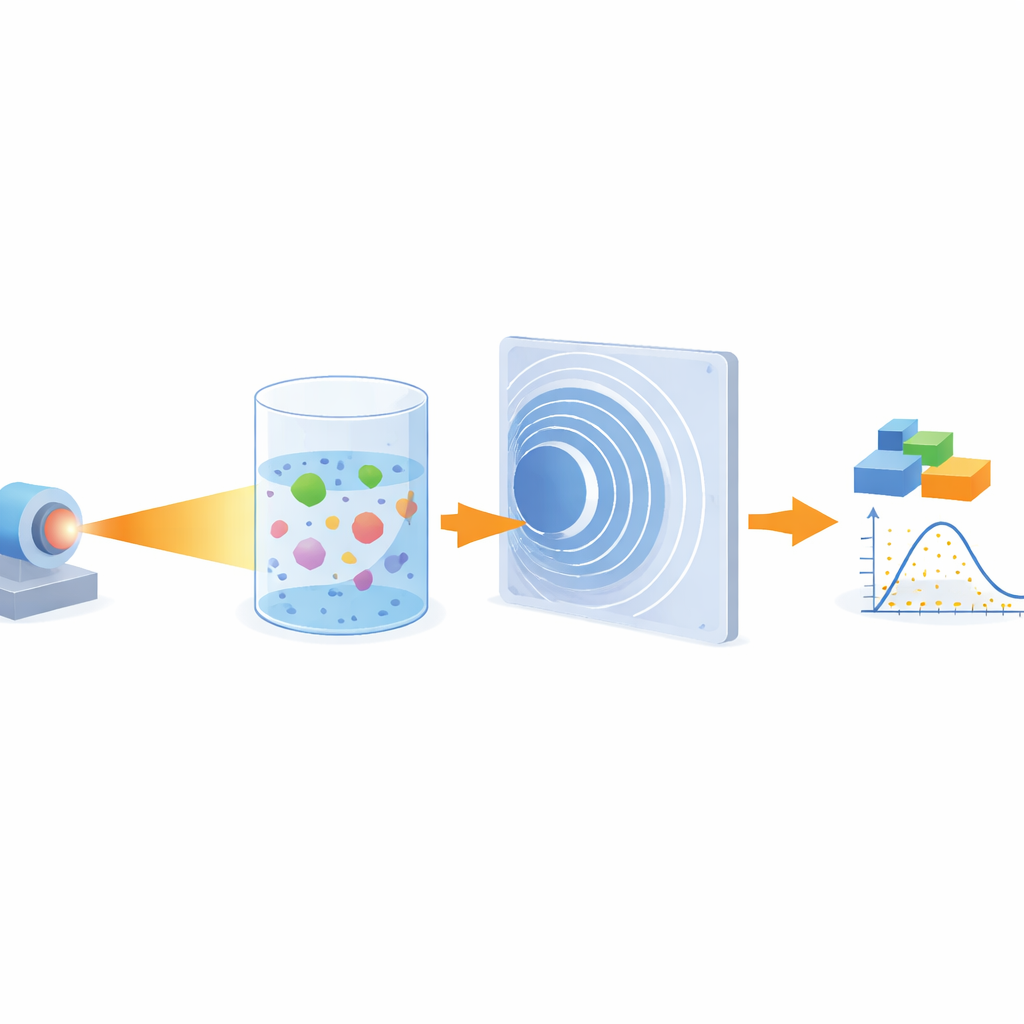
Smaller X-ray Machines, Big Scientific Ambitions
Large X-ray free-electron lasers (XFELs) have transformed structural biology by delivering extremely bright, ultrashort pulses that can capture biomolecules in action before radiation damage sets in. However, they rely on kilometer-scale accelerators and complex technology, so only a handful exist worldwide. Arizona State University is building a different kind of setup: the Compact X-ray Light Source (CXLS) and the Compact X-ray Free Electron Laser (CXFEL). These machines use inverse Compton scattering instead of the standard XFEL mechanism, shrinking the source to a laboratory footprint while still delivering ultrafast pulses. The trade-off is that compact sources produce four to five orders of magnitude fewer photons per pulse, so the crucial scattering signals from molecules in solution are easily buried in noise.
Why Noisy X-ray Ripples Are So Hard to Read
To watch proteins move in real time, scientists use small- and wide-angle X-ray scattering (SWAXS). X-rays scatter off molecules in solution, and the resulting ring-like patterns encode information about their size, shape, and structural changes over time. At large facilities, strong beams generate patterns with enough signal that standard mathematical tools, such as singular value decomposition (SVD), can extract the key changes. At compact sources, the photon-starved data look more like grainy static. Under these conditions, SVD tends to confuse true structural changes with random fluctuations, ranking noisy components ahead of the real signal and making it difficult for non-experts to decide which features of the data to trust.
A Machine Learning Lens for Time-Resolved Scattering
The authors introduce a different way of looking at these data, based on a method called Nonlinear Laplacian Spectral Analysis (NLSA). Instead of treating each scattering pattern in isolation, NLSA folds short time histories of the signal into higher-dimensional “snapshots” and then uses a manifold learning approach (diffusion maps) to discover the curved surface that best represents the system’s underlying behavior. In this reduced space, the method applies a decomposition similar to SVD but on the learned manifold rather than on the raw pixels. This combination acts like a smart filter: it emphasizes slowly varying, physically meaningful dynamics and pushes random noise into separate modes that are easy to discard. A graphical user interface helps users choose parameters and visualize which modes carry real structure versus noise. 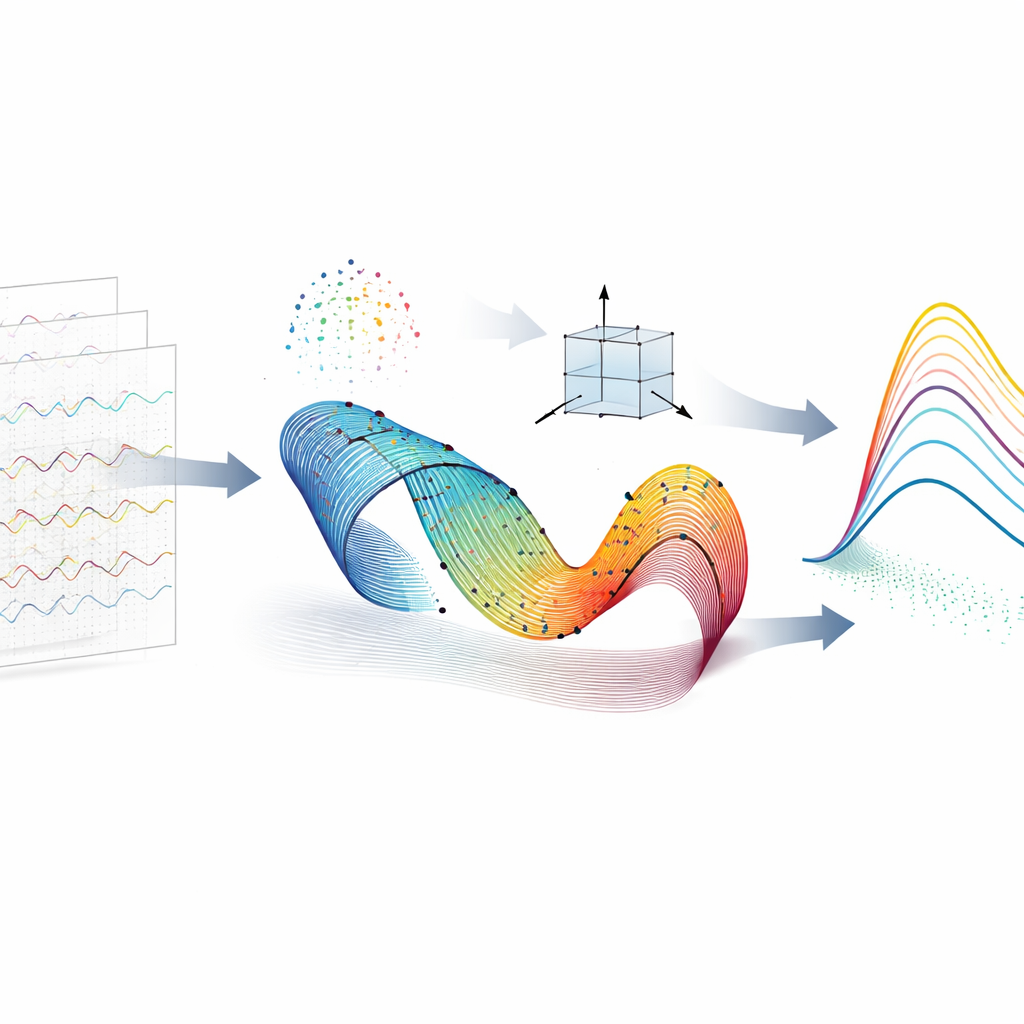
Testing the Method on Molecular Shape-Shifters
To benchmark the approach under realistic compact-source conditions, the team simulated time-resolved SWAXS experiments using current and planned CXLS parameters. First they modeled calmodulin, a protein that undergoes large, calcium-driven shape changes over microseconds to milliseconds. Later they turned to photoactive yellow protein, where the structural rearrangements are smaller and much faster, posing a tougher test. In both cases, they generated synthetic scattering data by combining detailed protein models, realistic solvent and background contributions, Poisson photon noise, and timing jitter. They then compared how well NLSA and standard SVD could recover the known, “ground truth” reaction rates and denoise the difference scattering profiles over a wide range of photon counts and exposure times.
Clearer Molecular Movies from Fewer Photons
The simulations show that NLSA consistently isolates the key kinetic signal in the leading modes, even when each pulse contains as few as one hundred thousand photons—well below what SVD needs to perform reliably. For calmodulin, NLSA recovers a clean sigmoidal time course with high precision, while SVD mis-orders the modes and mixes signal with noise. For photoactive yellow protein, which presents subtler structural changes, NLSA still produces smooth temporal modes that can be fit to extract relaxation times, whereas SVD only reveals a weak hint of the expected behavior in much higher-order, noisy components. Across parameter sweeps, NLSA reduces temporal noise in the extracted modes by orders of magnitude compared with SVD, and it reaches accurate reaction rates using shorter exposure times or lower flux. The authors note a trade-off: in extremely noisy regimes, NLSA’s use of long time windows can slightly shift absolute timescales, but it preserves the essential shape and relative timing of the dynamics.
What This Means for Future Tabletop X-ray Labs
From a lay perspective, the message is that smarter data analysis can, to some extent, substitute for brute-force brightness. By treating noisy scattering patterns as points on a hidden geometric surface that encodes the molecule’s motion, NLSA acts like a signal amplifier, revealing clear trends where conventional tools see only static. This means compact X-ray sources such as CXLS and CXFEL could support meaningful, time-resolved studies of proteins and other complex systems without needing the sheer photon power of national facilities. As these algorithms are packaged into user-friendly software, more labs may be able to run “molecular movie” experiments in-house, accelerating discovery while making advanced X-ray science more broadly accessible.
Citation: Opperman, A.K., Huang, S., Botha, S. et al. Signal extraction in SWAXS data for the compact X-ray light sources: a machine learning approach. Sci Rep 16, 11712 (2026). https://doi.org/10.1038/s41598-026-47265-4
Keywords: compact X-ray light sources, time-resolved X-ray scattering, machine learning for physics, protein structural dynamics, signal denoising