Clear Sky Science · en
Fractal dimension and morphological heterogeneity of pore in carbonate rocks: implications for production differences between adjacent wells
Why two nearby gas wells can behave so differently
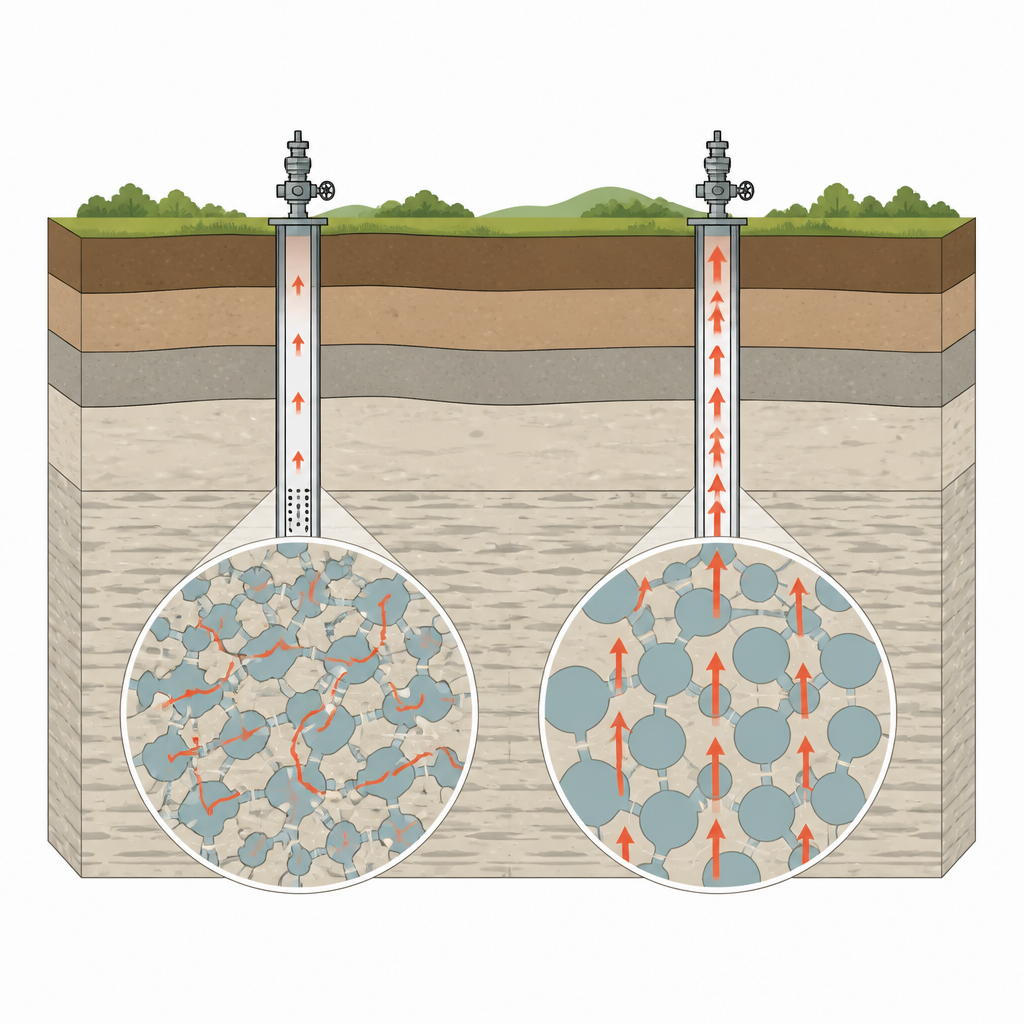
Imagine drilling two gas wells only a short distance apart and finding that one gushes gas while the other is almost dry. This study explores why that can happen, even when both wells tap into the same rock layer. By zooming in on the tiny holes inside carbonate rocks from southwest China, the researchers show how small differences in the shapes and connections of these pores can have big effects on how easily gas can flow to the surface.
The rock layer that feeds the gas
The team focused on the Canglangpu Formation, an ancient layer of carbonate rock buried deep beneath the Sichuan Basin. Carbonate rocks like these hold about half of the world’s oil and gas, yet they are notoriously tricky to develop because their internal structure is highly uneven. Even within the same formation, fluids may travel easily in one spot but struggle just a few hundred meters away. In this field, wells P7 and P9 sit close together and share similar large scale geology, yet P9 delivers a strong daily gas flow while P7 produces almost nothing. This puzzling contrast motivated a closer look at the rock on a microscopic scale.
Looking at tiny pores with powerful microscopes
To investigate, the researchers collected small pieces of rock from both wells and polished them for viewing under a scanning electron microscope. These instruments create detailed pictures of the rock surface where individual pores, far smaller than the width of a human hair, can be seen. The team did not just look at these images by eye. They used machine learning tools in the ImageJ software to train the computer to distinguish pore space from solid rock. Once the images were converted into simple black and white maps, the software measured each pore’s area, perimeter, roundness, and how stretched out it was, turning complex microstructures into a large set of numbers that could be compared between the two wells.
Different pore shapes and patterns inside each well
Using these measurements, the pores were grouped into five simple shape classes: nearly round, slightly distorted, transitional, elongated, and highly irregular. In both wells, slightly distorted pores made up a large share of the total, but their mix with the other types differed. Well P7 showed strong micro scale variation from one field of view to another, with some areas dominated by elongated pores and others by highly irregular ones. This pointed to a very patchy and complex internal fabric. Well P9 also had a mix of shapes, yet its pore patterns were more consistent across the many images analyzed. In essence, the pore system in P7 looked more chaotic, while that in P9 looked more orderly and repeatable.
Measuring complexity with a simple number
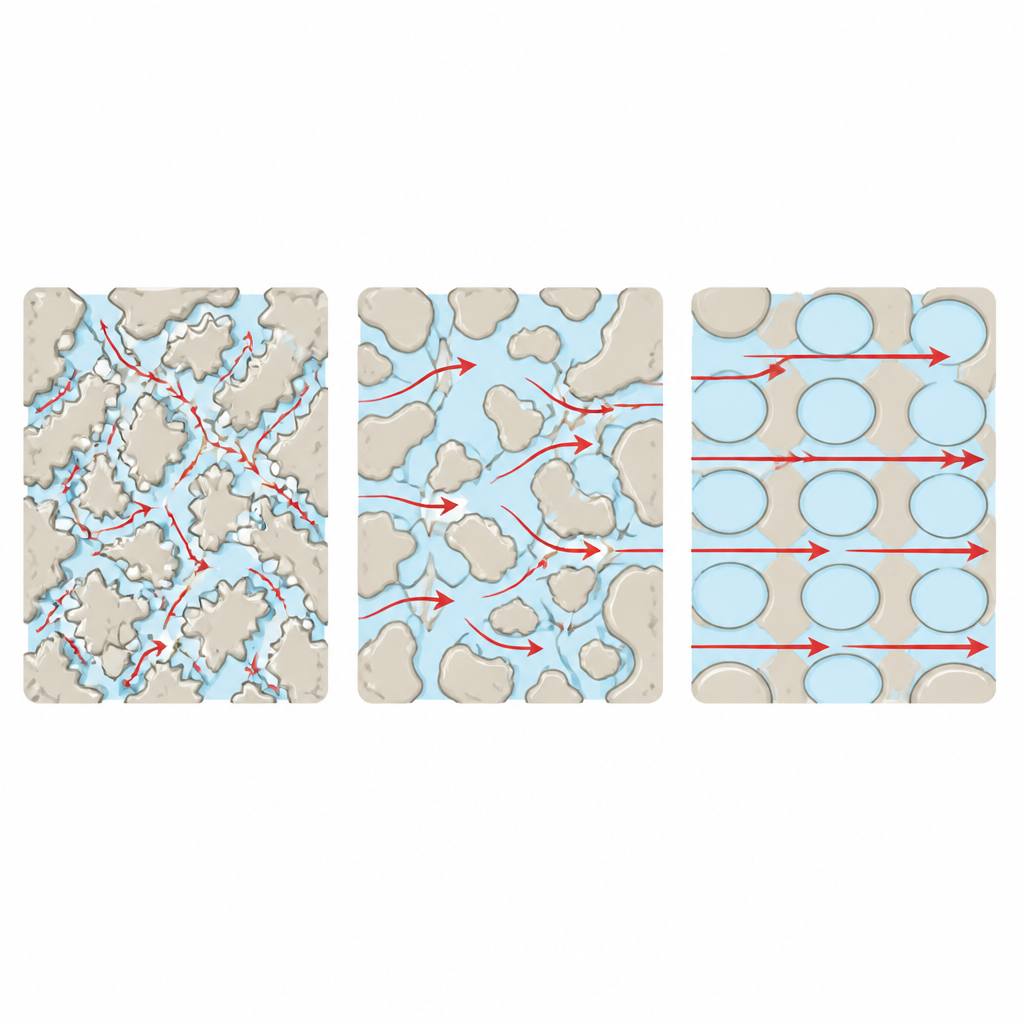
To go beyond visual impressions, the study used a concept called fractal dimension to summarize how intricate the pore boundaries are. This number grows as pore edges become rougher and more irregular. By relating each pore’s area to its perimeter across the images, the team calculated fractal dimension values for both wells. P7 had a higher typical value and a wider spread, meaning its pore network is both more complex and more variable. P9 showed slightly lower values in a narrower band, consistent with a more even and less tangled pore system. Laboratory tests on core samples confirmed that rocks from P9 also have higher porosity and permeability, which together signal better pathways for gas to move.
What these tiny structures mean for gas production
Putting these lines of evidence together, the researchers argue that the highly irregular and patchy pore network in P7 creates long, twisting paths that slow down gas movement, even if there is space to store gas. In contrast, the more uniform pore system in P9 offers shorter and better connected routes, making it easier for gas to reach natural fractures and then the well. Other large scale factors, such as the thickness of the gas bearing layer or the number of fractures, still matter, but this work shows that microscopic pore patterns alone can strongly influence which well becomes a strong producer and which one does not. For future exploration, the study suggests that carefully measuring pore shapes and their complexity can help identify rock intervals with more favorable flow paths, improving predictions of well performance in challenging carbonate reservoirs.
Citation: Zhang, Y., Long, H., Li, Y. et al. Fractal dimension and morphological heterogeneity of pore in carbonate rocks: implications for production differences between adjacent wells. Sci Rep 16, 15457 (2026). https://doi.org/10.1038/s41598-026-47223-0
Keywords: carbonate reservoir, pore structure, fractal dimension, Sichuan Basin, gas production