Clear Sky Science · en
Toward adaptive control power sharing and bus voltage regulation for DC microgrids
Why smarter small power networks matter
As homes, offices, and vehicles rely more on solar panels, batteries, data centers and electric cars, electricity is increasingly handled by small local power networks called microgrids. Many of these new systems use direct current (DC), the same kind found in batteries and electronics. Keeping power flowing smoothly and fairly among multiple sources in a DC microgrid is surprisingly difficult. This study shows a new way to let several electronic power converters share the load automatically while keeping the system voltage steady, without needing a complex communication network.

The challenge of sharing work fairly
In a DC microgrid, several power converters sit side by side and feed a common DC line that supplies different devices. Ideally, each converter should carry a fair share of the work, and the voltage on the shared line (the “bus”) should stay very close to its target value. A popular technique called droop control tries to do this by slightly lowering each converter’s output voltage as its current increases, encouraging the load to spread among units. However, differences in wiring resistance and hardware mean that traditional droop control cannot keep both current sharing and bus voltage within tight limits, especially when loads are high or changing quickly. The result is circulating currents between converters, wasted energy, and possible overloading of individual units.
A new way to let converters adapt
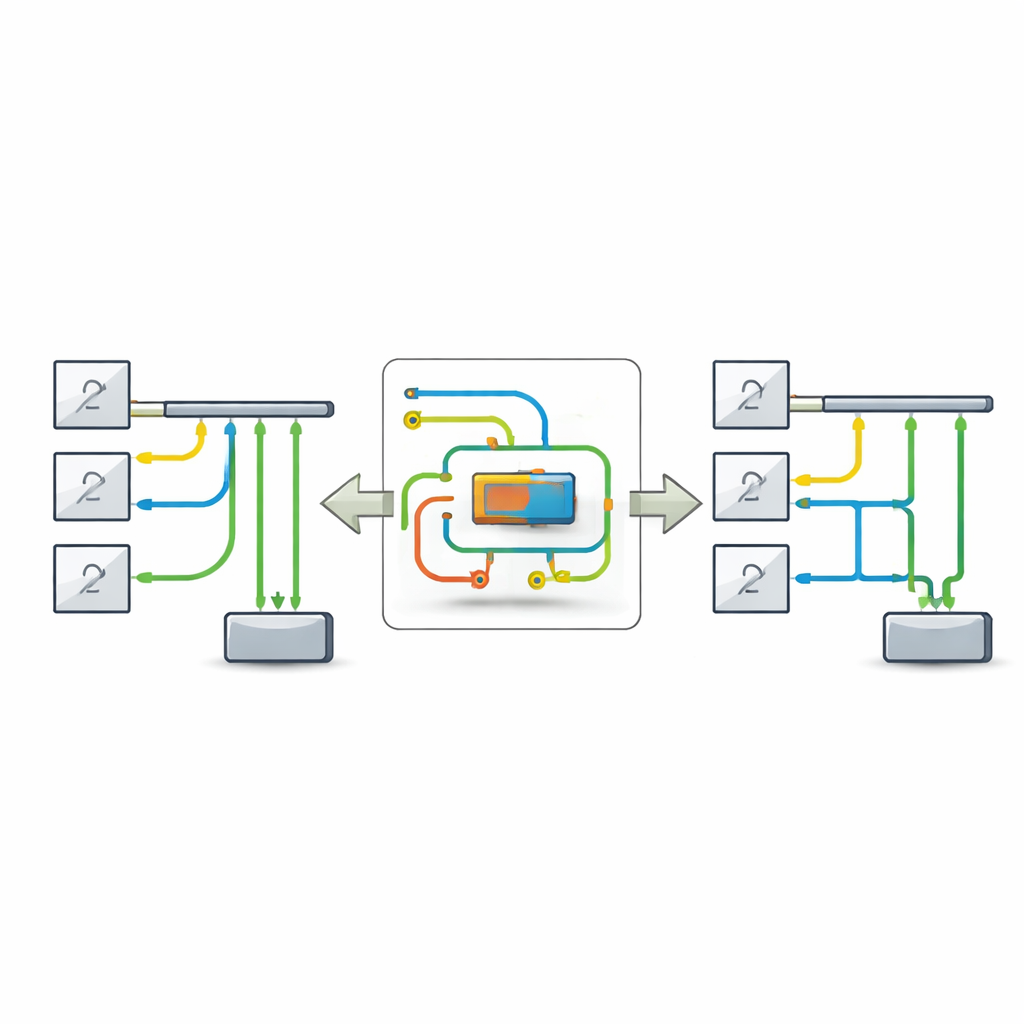
The authors propose an adaptive droop control strategy that allows each converter to continually tune its behavior based on what is actually happening in the microgrid. Instead of using fixed settings, the method adjusts an artificial “virtual resistance” inside each converter in real time. A primary control loop monitors how much current each unit is providing and compares it with the desired sharing pattern. If one converter is doing too much or too little, its internal droop setting is nudged so that its output voltage shifts slightly, redistributing current until the mismatch is minimized.
Keeping the voltage steady at the same time
Simply reshaping how the current is shared can disturb the overall bus voltage, which should remain close to a set value (48 volts in this work, a common level in telecom and low‑voltage DC systems). To address this, the researchers add a secondary control loop. This loop watches the actual bus voltage and gently shifts all the converters’ reference voltages together to cancel out any long‑term drift. In effect, the primary loop makes sure the workload is fair, while the secondary loop makes sure the “pressure” in the system, the DC voltage, stays right where it should be. Crucially, each converter only needs to measure its own voltage and current; no data lines between units are required.
Testing the idea in models and simulations
The team applied their method to a small DC microgrid built from three buck converters, a common type of electronic power stage. They first analyzed the control system mathematically using standard tools that look at stability in both time and frequency domains. Then they tested the design in detail using MATLAB/Simulink simulations and real‑time digital simulation hardware. They examined many practical situations: different input voltages, different line resistances between converters and the bus, and three load levels from light to heavy. In each case they compared the traditional fixed droop approach with the new adaptive strategy.
What the results show for real‑world systems
Across all tested conditions, conventional droop control led to noticeable problems: current sharing errors of up to about a quarter of the total load and bus voltage deviations of several percent. With adaptive droop and the added voltage loop, current sharing errors fell to around one percent or less, and bus voltage stayed within a fraction of a percent of its target. These improvements were achieved without any communication network between converters, preserving the simplicity and robustness that make DC microgrids attractive in the first place.
Why this matters for future energy networks
For non‑experts, the key message is that the authors have found a smarter, self‑tuning control method that helps small DC power networks behave more like a well‑coordinated team than a set of competing devices. By automatically balancing how much work each converter does while holding the system voltage steady, their adaptive droop control makes DC microgrids more efficient, reliable, and easier to expand. This could help future buildings, neighborhoods, and electric‑vehicle charging hubs use local solar panels, batteries, and other DC technologies more safely and economically.
Citation: Mosbah, M.A., Abokhalil, A. & Sayed, K. Toward adaptive control power sharing and bus voltage regulation for DC microgrids. Sci Rep 16, 13395 (2026). https://doi.org/10.1038/s41598-026-47219-w
Keywords: DC microgrid, droop control, power sharing, voltage regulation, distributed energy