Clear Sky Science · en
A compact quad-port dielectric resonator MIMO antenna with intrinsic isolation for sub-6 GHz 5G network
Why this tiny antenna matters
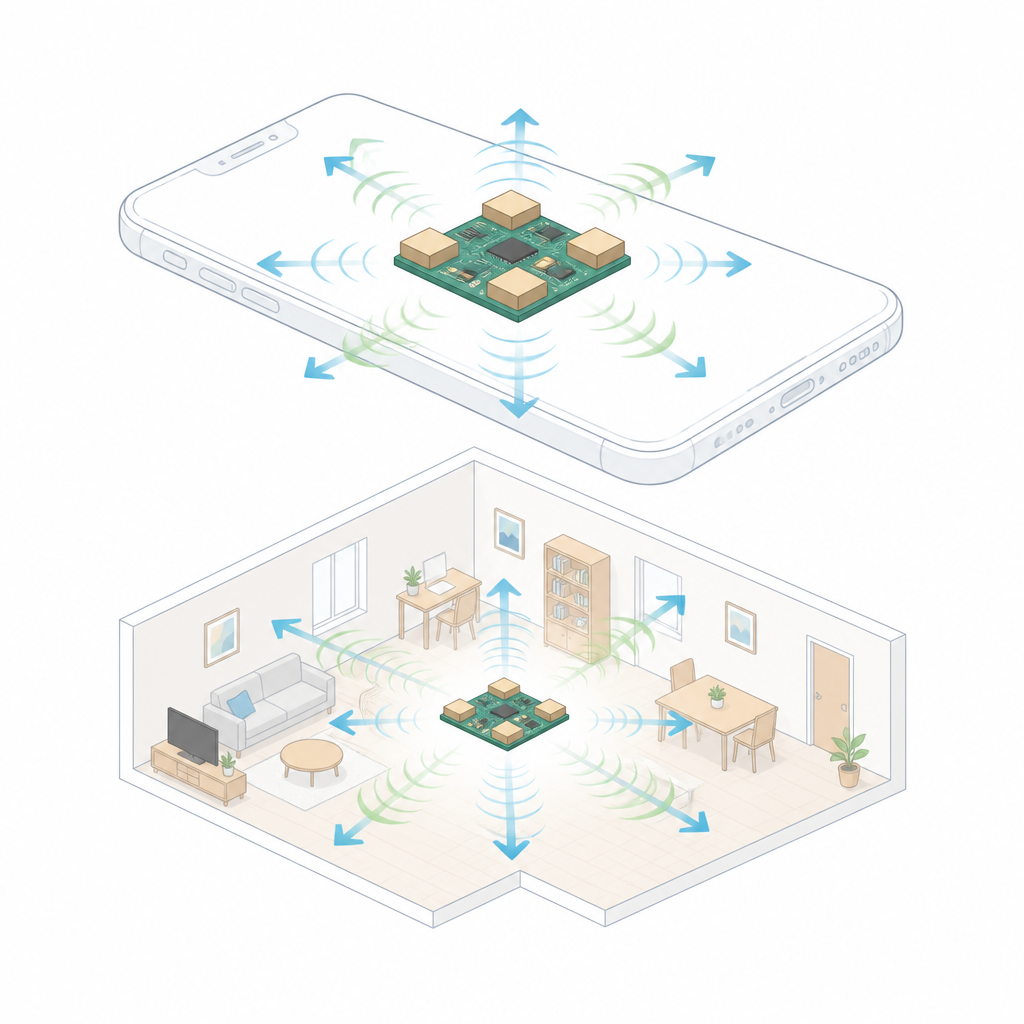
As our phones, home routers, and smart gadgets move to 5G, they must move more data, stay connected in busy spaces, and still fit into slim cases. This study describes a small new antenna layout that helps future sub-6 GHz 5G devices talk more clearly in crowded airwaves without needing extra bulky parts, making it attractive for compact user gear and indoor network spots.
Sharing the air without crosstalk
Modern wireless devices often use several antennas at once, a scheme known as MIMO, so they can send and receive separate data streams over the same channel. A common problem is that these antennas tend to interfere with each other when packed tightly together, like people talking over one another in a small room. Designers usually add extra metal patterns or special cuts in the circuit board to quiet this crosstalk, but those fixes can make the antenna larger, harder to build, or less stable.
A different kind of antenna block
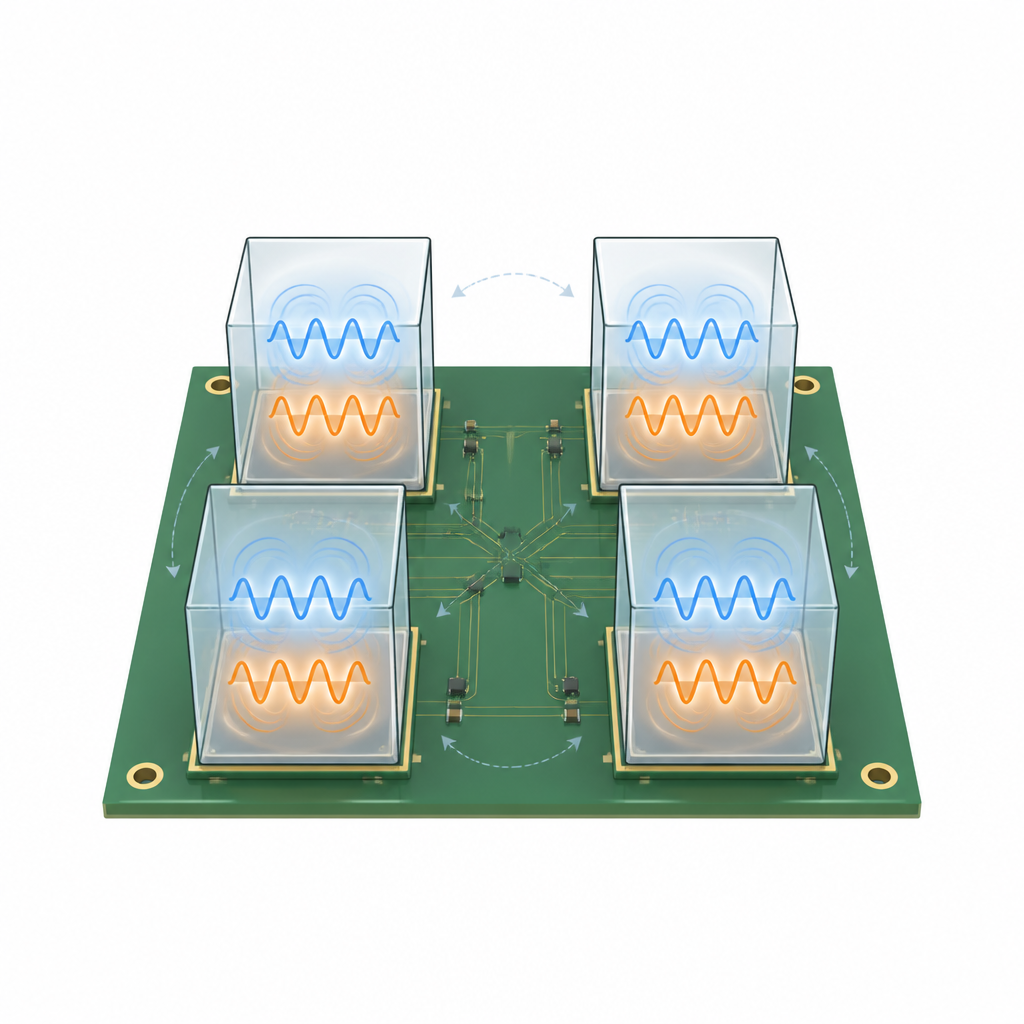
The team built their design around dielectric resonator antennas, which are small ceramic blocks that guide radio waves without using large metal plates. These blocks waste less energy as heat and can support several types of internal wave patterns. In the new design, each block is mounted on a standard circuit board and excited through a carefully shaped opening in the metal ground layer underneath. By tuning this cross-shaped slot and the size of the block, the antenna naturally supports two useful 5G frequency bands around 3.5 and 3.9 gigahertz, all within an area small enough for space-limited devices.
Four antennas working together
Four identical antenna blocks are then arranged in a square to form a quad-port MIMO layout. Instead of using added isolation parts, the authors rely on the way the waves behave inside each block and on the spacing between them. Different wave patterns at the two operating bands help keep signals on one port from leaking into the others, while the physical layout reduces surface waves on the circuit board itself. Measurements in a test chamber show that signals from one port arrive at the others at more than one hundredth of their strength, a level of isolation better than many earlier designs that needed extra hardware tricks.
Putting the design to the test
The researchers fabricated the antenna on a common FR-4 board and used lab instruments to verify how well it matched the intended frequencies, how it radiated, and how independent the four ports were in practice. The antenna produced nearly even coverage around itself, a moderate but useful gain suited to indoor cells and user devices, and high radiation efficiency close to 89 percent. Key MIMO quality numbers, such as how similar the signal paths are between ports and how much data capacity is lost due to coupling, all stayed in the low range that engineers seek for reliable multi-stream links.
What this means for future 5G gear
In simple terms, this work shows that a small, four-antenna module can serve two sub-6 GHz 5G bands while keeping the antennas from talking over one another, and it does so without extra isolation add-ons. By using the natural wave patterns inside a ceramic block and a smart floorplan on the circuit board, the design delivers clean, efficient links in a compact footprint. That makes it a practical building block for next-generation phones, indoor access points, and small 5G cells that need strong connections in tight spaces without growing in size.
Citation: Patel, A., Upadhyaya, T., Pandey, R. et al. A compact quad-port dielectric resonator MIMO antenna with intrinsic isolation for sub-6 GHz 5G network. Sci Rep 16, 14755 (2026). https://doi.org/10.1038/s41598-026-47167-5
Keywords: 5G antennas, MIMO, dielectric resonator, sub-6 GHz, wireless communication