Clear Sky Science · en
Study on physico-mechanical properties and damage constitutive model of sandstone-like materials
Why engineers care about fake rocks
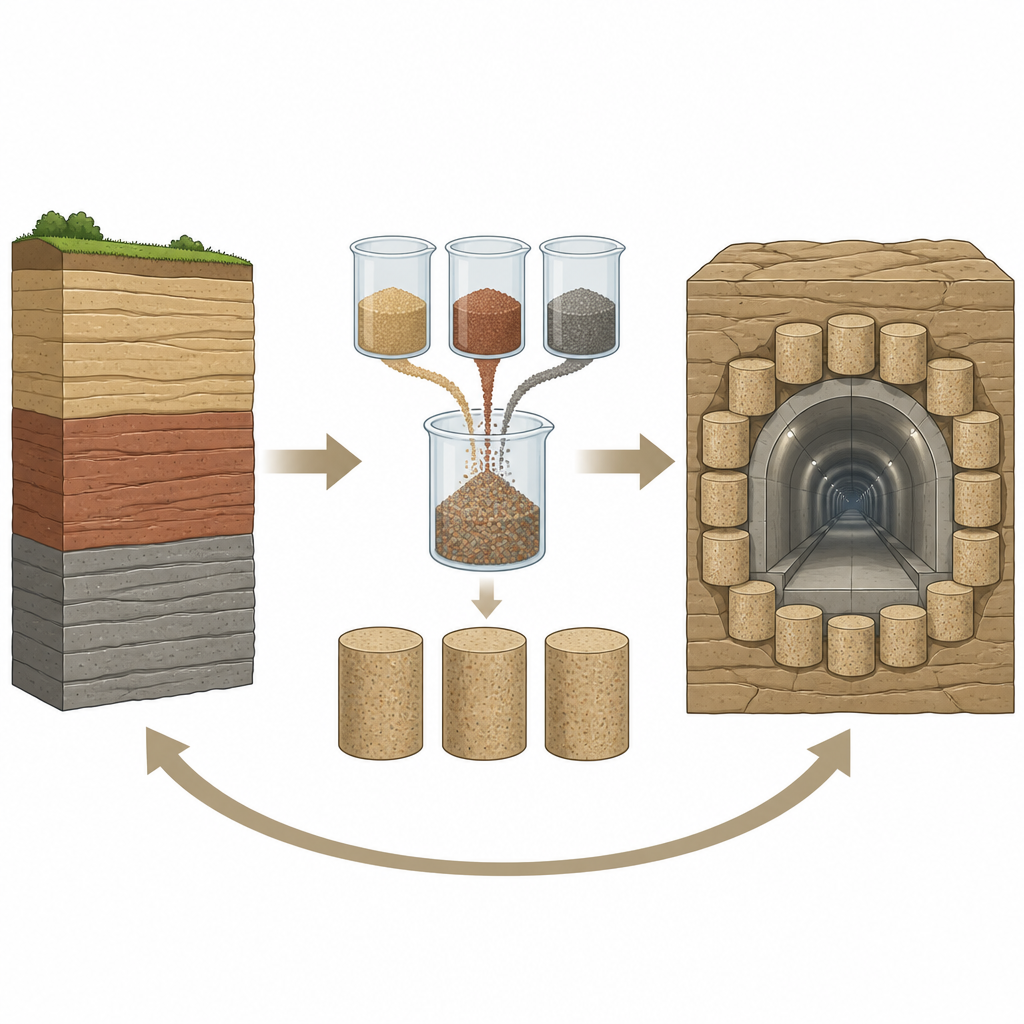
From deep tunnels to subway lines and dams, many of our biggest engineering projects are carved into or surrounded by rock. Before anyone digs into a real hillside, engineers often build scaled-down physical models to see how the rock around a tunnel or slope might crack and fail. This study asks a deceptively simple question: can we build an artificial sandstone that behaves so much like the real thing that it gives trustworthy answers in these model tests?
Looking closely at real sandstone
The researchers began by examining real sandstone taken from nearly a kilometer below ground in a Chinese coal mine. They separated it into three types based on grain size: coarse, medium, and fine. Under the microscope they found that all three are mainly made of the same ingredients, such as quartz and feldspar, but the grains are packed and sized differently. Fine sandstone holds the most quartz and has the smallest, tightest grains. The team also measured how the rocks absorb water and how strong they are in crushing tests, both with and without the extra pressure that deep rocks normally feel underground.
How water changes the rock inside
Water is a quiet but powerful player in rock behavior. By soaking the sandstone samples and then imaging them with a high-resolution electron microscope, the team watched how the internal pores and flaky particles changed. In coarse and medium sandstone, what once looked like a dense, layered structure loosened as water seeped in, dissolved some of the material between grains, and opened new pathways. The fine sandstone, by contrast, barely changed in pore structure, although some clay-like particles on its surface swelled. These differences help explain why coarse sandstone can take in more water and why its strength and cracking patterns differ from the finer material.
Building a convincing stand in for rock
Armed with this knowledge, the authors set out to design a rock-like material that mimics these properties. They mixed quartz sand, iron powder, cement, gypsum, and water in carefully planned combinations, then cast and cured 243 cylindrical samples with different grain sizes. Each batch went through crushing tests under no pressure and under two levels of surrounding pressure to see how stiff, how strong, and how brittle the material was. They also measured how much water each mix could absorb. By comparing these results to the behaviors of the natural sandstones, they identified an optimal recipe: a solid made of 70 percent aggregate, with twice as much quartz sand as iron powder, cement as the only binder, and water equal to a quarter of the solid mass.
Capturing how damage builds up
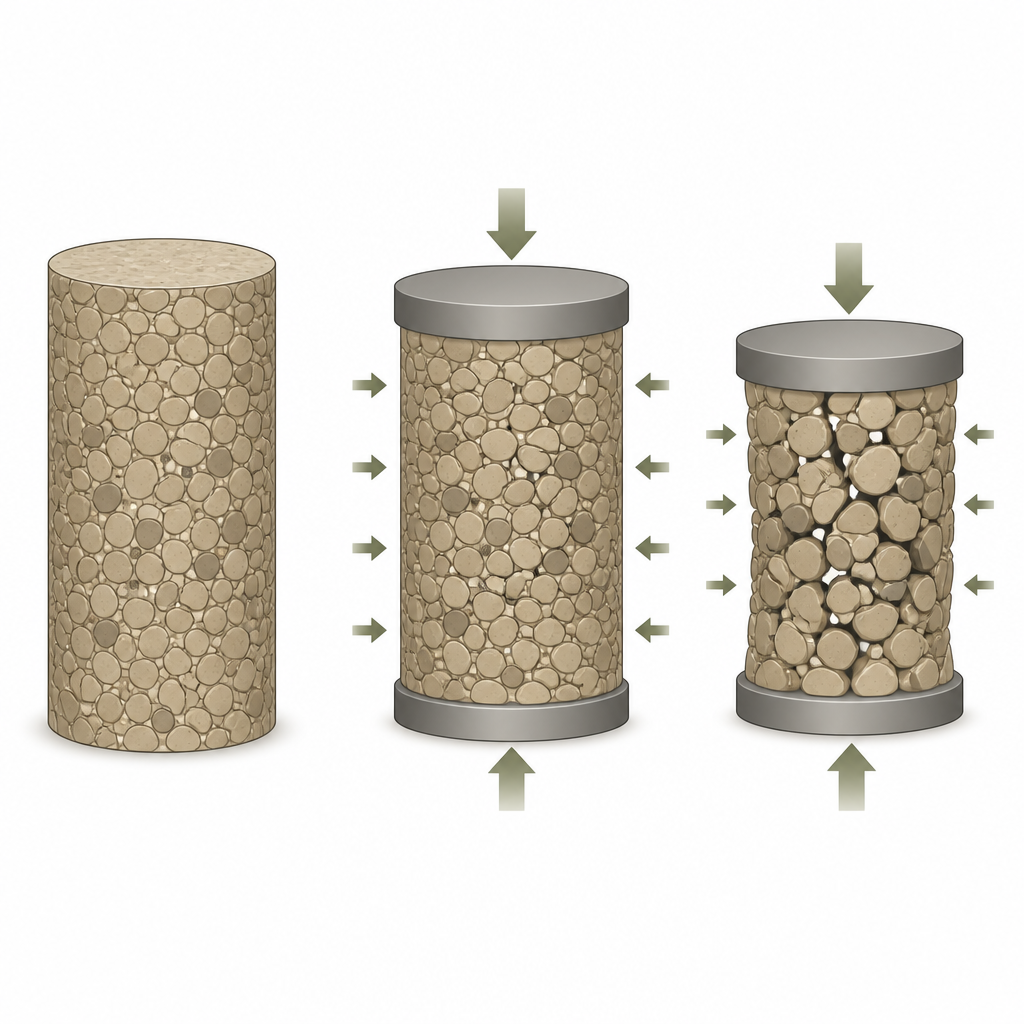
Matching simple strength numbers is not enough; engineers also need to know how damage starts and grows inside the material as it is squeezed. The team analyzed how the artificial sandstone deforms in three stages: an initial elastic phase, a gradual plastic phase where microcracks spread, and a final failure phase where strength drops off. They translated this behavior into a mathematical damage model that treats the rock as a collection of tiny elements that can fail one by one. A key insight is that the material shows a clear threshold: below a certain strain, no real damage occurs, and above it, damage accumulates in a predictable way. By fitting the model to their test data, they showed it can reproduce both the rising and falling parts of the stress–strain curves under different pressures.
What this means for tunnels and slopes
For non-specialists, the takeaway is that the study delivers not just a recipe for a realistic fake sandstone, but also a way to describe how it weakens under load. The chosen mixture behaves very much like real sandstone in strength, stiffness, water uptake, and cracking style, and the new damage model reliably tracks its response as it moves from intact to fractured. This combination gives engineers a more trustworthy laboratory stand in for real underground rock, helping them explore how future tunnels, mines, and slopes might behave before any real excavation begins.
Citation: Zhang, S., Qiao, W., Song, W. et al. Study on physico-mechanical properties and damage constitutive model of sandstone-like materials. Sci Rep 16, 15561 (2026). https://doi.org/10.1038/s41598-026-46993-x
Keywords: sandstone, rock like material, geotechnical model tests, damage constitutive model, triaxial compression