Clear Sky Science · en
True triaxial hydraulic fracturing experiments and FDEM simulation study of coal-measure rock strata
Why rock cracks matter for energy and safety
Hydraulic fracturing is widely used to extract gas from coal seams and other deep rocks, but underground layers are rarely uniform. Coal beds are stacked with harder and softer rocks, separated by natural planes of weakness. When pressurized fluid is pumped underground, the resulting cracks do not always travel in the directions engineers intend. This study explores how fractures really behave in such layered coal formations, helping improve gas production while reducing risks like unwanted water inflow or roof collapse in mines. 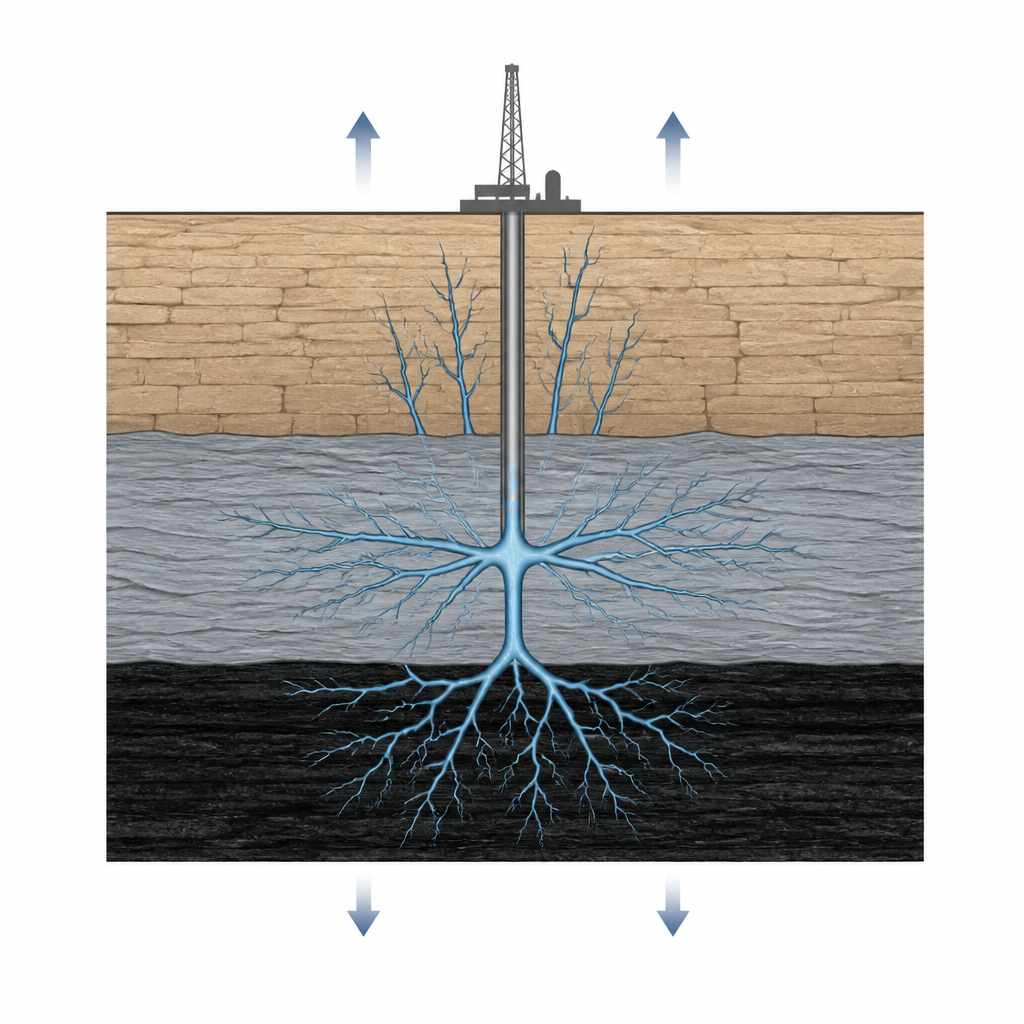
How the team recreated deep rocks in the lab
The researchers built block-shaped samples from real coal and sandstone collected in the field. They stacked three layers with different strengths, arranging them in several patterns that mimic common coalfield geology: combinations of hard and medium sandstone, softer siltstone, and coal. A drilled central hole acted as the wellbore. The blocks were then placed in a true triaxial press, which can squeeze them from three directions to reproduce the stresses found kilometers underground, while a pump injected water at controlled rates to create fractures.
Watching cracks spread through layered rocks
After each test, the surfaces of the blocks were examined to reveal where fluid-filled fractures had travelled. The team saw that fracture patterns were highly uneven from top to bottom. Instead of a single neat vertical crack, the samples displayed seven main shapes: simple straight fractures, intersecting crosses, T and plus shapes, and more intricate patterns. Whether a fracture cut across a boundary, stopped at it, or turned to run sideways depended strongly on two things: the direction and difference of the in-place stresses, and how much stronger one layer was compared with its neighbor. 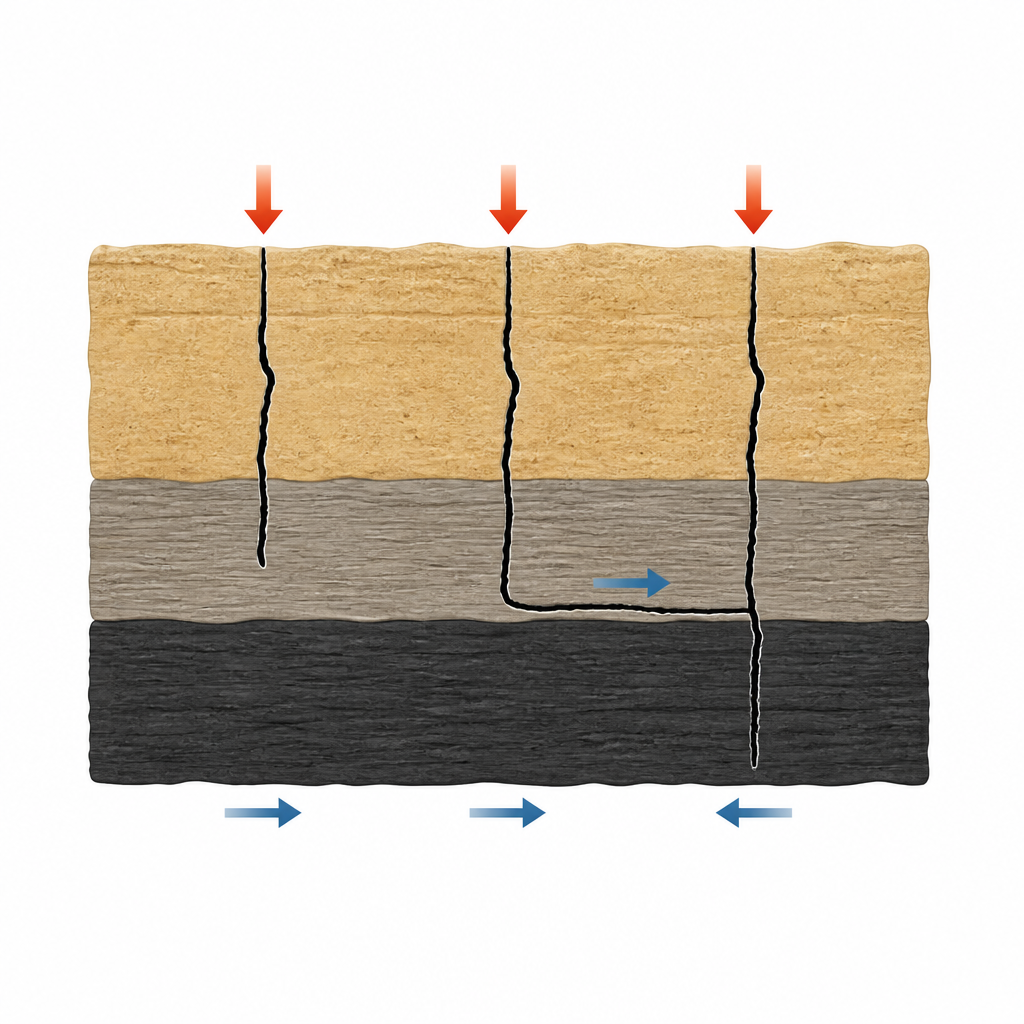
Linking pressure signals to hidden crack networks
During each experiment, the pump pressure was recorded in real time. The pressure always rose quickly to a peak when the rock first broke, then dropped and settled into a fluctuating level before falling again when pumping stopped. When a growing fracture hit a natural weak plane or a layer boundary, the pressure curve showed sharp drops or extra wiggles. The study found that large, clean pressure drops tended to be associated with simpler fracture shapes, while noisy, strongly fluctuating pressure traces signaled more complex, branching fracture networks that either hugged the interfaces or crossed them.
Simulating cracks to see inside the rock
To look beyond the surfaces, the authors used a numerical technique that combines aspects of finite element and discrete element methods. In simple terms, they split the rock into many small pieces and allowed virtual cracks to open or slide along the joints between them as fluid pressure increased. By tuning the input parameters to match laboratory tests, the simulations reproduced how fractures start in a given layer, interact with interfaces, and either pass through, turn, or branch. The team introduced a single index, called a lithology strength difference coefficient, to capture how different the two sides of each boundary are in stiffness and resistance to being pulled apart.
What controls whether cracks cross or turn
The combined experiments and simulations show that both stress and rock contrast steer fracture paths. When vertical stress is the largest stress, and its difference from the horizontal stress is high, fractures more easily grow upward or downward through boundaries. If a crack begins in softer rock and meets a harder layer, it tends to slow or turn and travel along the boundary. When it starts in harder rock and moves toward softer material, a larger strength contrast makes it more likely to punch straight through, often forming T or similar shapes. Weak interfaces encourage sideways growth along the boundary, producing T and comb-like patterns rather than tall fractures.
What this means for energy production and mining
For a non-specialist, the takeaway is that underground rock layering and stress are as important as pumping power in deciding where hydraulic fractures go. By measuring how strong different layers and their interfaces are, and by choosing whether to start fracturing in a hard or soft layer, engineers can better guide cracks to stay within a coal seam or to connect several layers when desired. Reading the pressure curve during a job can also provide clues about how complex the hidden fracture network has become. Together, these insights help design safer and more efficient stimulation of coalbed methane and other layered reservoirs.
Citation: Ma, J., Dong, G., Wang, H. et al. True triaxial hydraulic fracturing experiments and FDEM simulation study of coal-measure rock strata. Sci Rep 16, 15372 (2026). https://doi.org/10.1038/s41598-026-46948-2
Keywords: hydraulic fracturing, coalbed methane, layered rock, fracture propagation, rock mechanics