Clear Sky Science · en
A low-profile high-isolation dual-polarized base station antenna based on AMC
Smaller cell towers for a more connected world
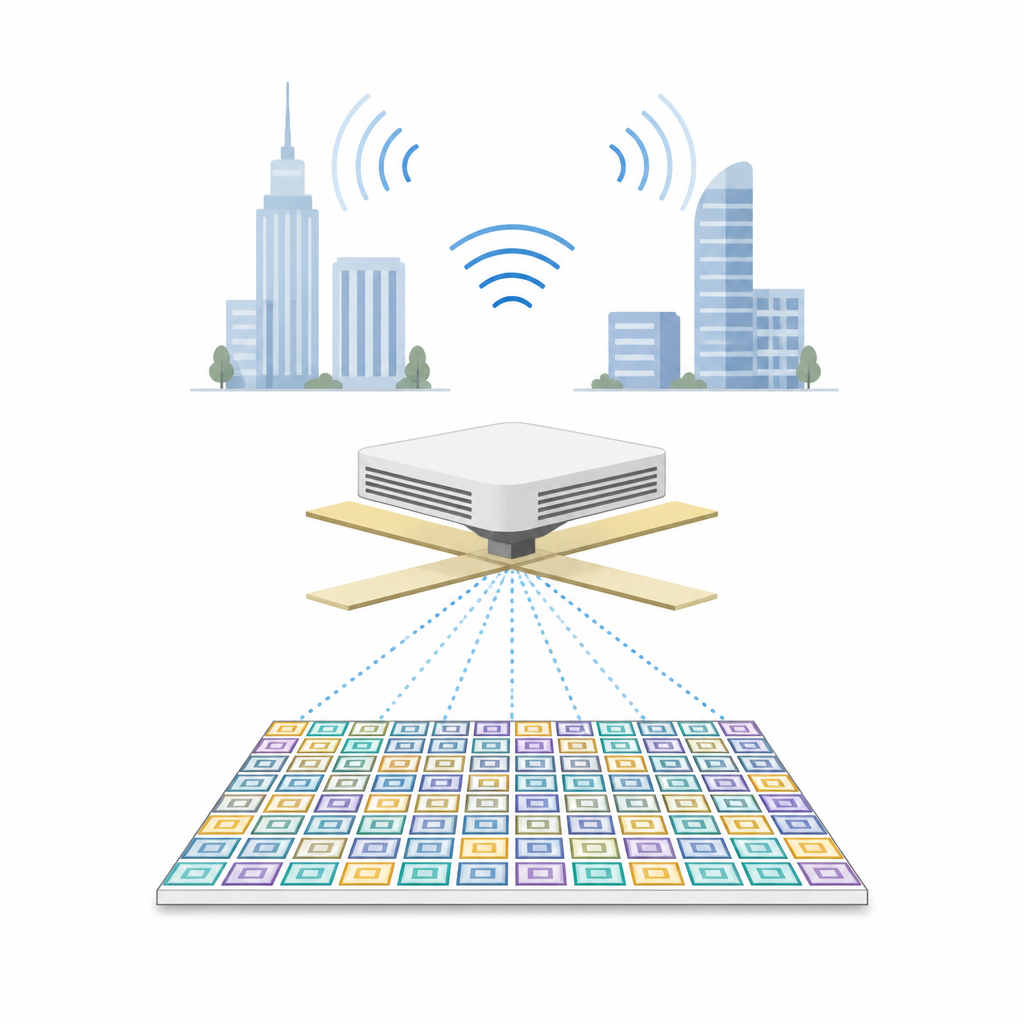
As our phones, smart sensors, and wireless gadgets multiply, the boxes of metal and electronics that link them to the network must keep up. This study tackles a quiet but important part of that puzzle: how to build base station antennas that are smaller, easier to deploy, and still handle heavy data traffic reliably. The authors show a way to shrink the height of a 5G base station antenna while keeping strong signals and cutting interference between channels, which helps networks work better in crowded cities.
Why antenna size and clarity matter
Modern systems such as 5G, the Internet of Things, satellites, and defense radios all rely on base stations that can work over wide ranges of frequencies and send and receive in more than one direction of polarization. Using two polarizations at once makes it possible to carry more data in the same slice of spectrum and improves reception when signals bounce off buildings and other obstacles. But there is a tradeoff: many antennas that offer wide bandwidth and dual polarization are bulky, which raises costs, makes them harder to hide on rooftops, and limits how many can be packed into an array. The goal of this work is to keep the wide operating band and dual-polarized capability while cutting the vertical size and further reducing unwanted interaction between the two ports of the antenna.
A new way to spread out the signal
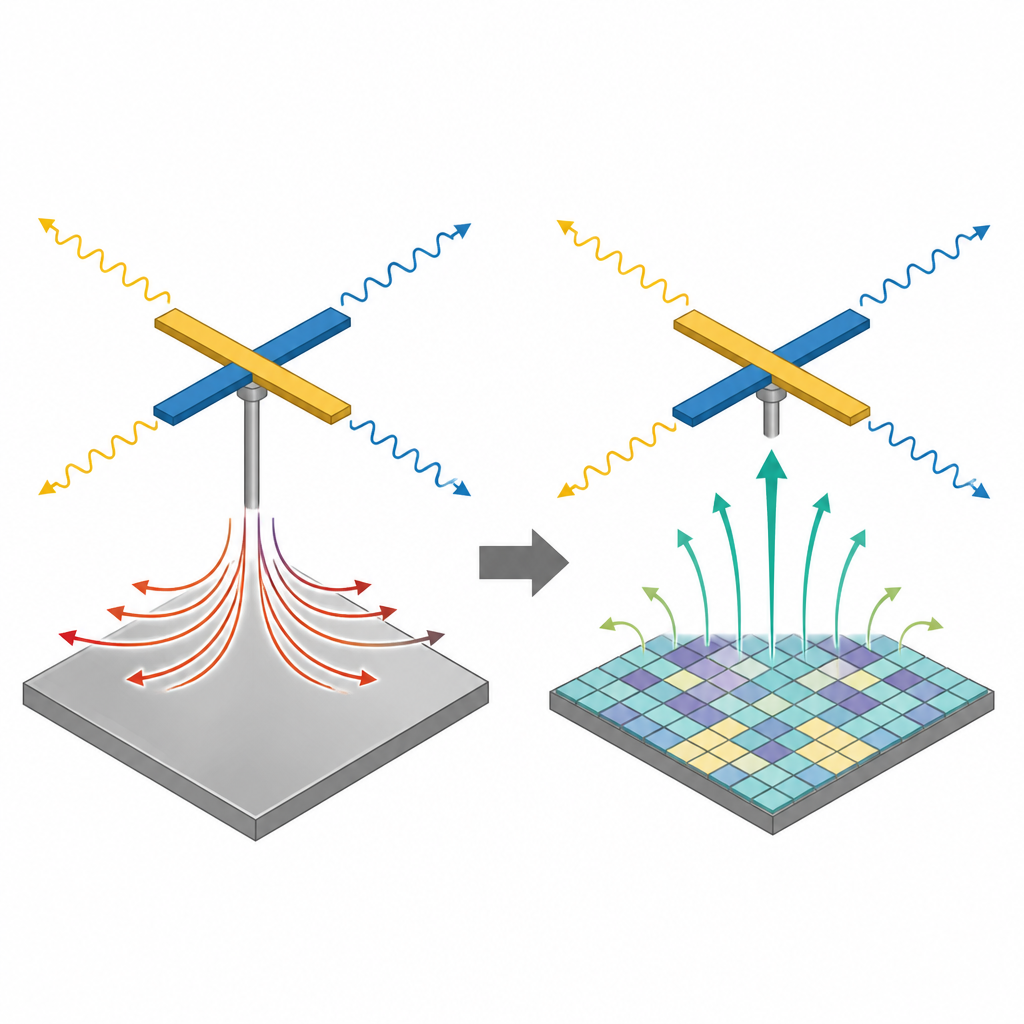
The researchers begin with a flat cross-shaped metal pattern that acts as the radiating part of the antenna. By carefully trimming the corners of this patch and carving narrow slots into it, they create several nearby resonances that blend into one wide operating band between 3.1 and 4.1 gigahertz, a range used by many Sub-6 GHz 5G services. This shaping of the current path on the metal patch allows the antenna to stay compact without losing bandwidth. They also design a clever feeding layout with two perpendicular microstrip lines, stacked at different levels, so that the two input ports do not sit directly on top of each other. This arrangement provides two independent polarizations while limiting direct coupling between the feeds.
Using a smart mirror instead of a metal plate
Traditional base station antennas sit about one quarter of a wavelength above a solid metal plate, which acts like a mirror for radio waves. That fixed spacing is what sets much of the vertical size. The team replaces this simple mirror with an engineered surface called an artificial magnetic conductor, built from an array of small patterned tiles separated from a ground plate by a thin air gap. Within the target frequency band, this surface reflects waves back in phase, rather than flipping them, so the antenna can sit much closer and still radiate efficiently. The special surface also blocks sideways surface waves that would otherwise spread along the plate and carry energy from one port to the other, which is a key source of interference in dense antenna arrays.
Testing performance in the lab
Through computer simulations, the authors study how the height of the air layer, the thickness of the boards, and the size of each tile affect the reflection behavior of the artificial surface. They show that including an air gap greatly widens the useful reflection band while keeping material loss and cost under control. After choosing an arrangement of 11 by 11 tiles, they build a physical prototype and measure its behavior. Across the band from 3.1 to 4.1 gigahertz, the antenna maintains good matching to the feed lines, delivers at least 8.5 decibels of gain, and keeps the leakage between the two ports below a very low level. The measured radiation patterns remain stable as the frequency changes, and unwanted polarization components stay much weaker than the main signal.
What this means for future networks
The finished design has a footprint that is about one quarter of a wavelength on a side and a height only about one tenth of a wavelength, which is notably thinner than many comparable dual-polarized base station antennas. At the same time, it offers strong isolation between channels, reasonable gain, and simple construction based on printed boards and a regular grid of metal tiles. For network builders, this kind of low-profile, high-isolation antenna could make it easier to fit more elements into a given space, improve the quality of service in 5G arrays, and reduce visual impact on the urban landscape. The work shows how shaping both the radiating patch and the reflecting surface beneath it can help balance size, bandwidth, and signal clarity in practical wireless systems.
Citation: Zhang, L., Wang, Y., Dang, W. et al. A low-profile high-isolation dual-polarized base station antenna based on AMC. Sci Rep 16, 15822 (2026). https://doi.org/10.1038/s41598-026-46941-9
Keywords: 5G antennas, dual polarization, artificial magnetic conductor, base station design, low profile antenna