Clear Sky Science · en
Double flower is associated with defects in a Phantastica-like gene in Catharanthus roseus
Why some garden flowers grow an extra ring of petals
Gardeners have long prized double flowers, whose extra petals give blooms a lush, rose-like look. In Madagascar periwinkle, a common bedding plant that also yields important medicinal compounds, some varieties keep their normal stamens and pistils yet grow an extra ring of petals and slightly twisted leaves. This study uncovers the key gene change that produces these ornate blossoms, revealing a new way plants can reshape their flowers and offering breeders a fresh handle for creating showy varieties.
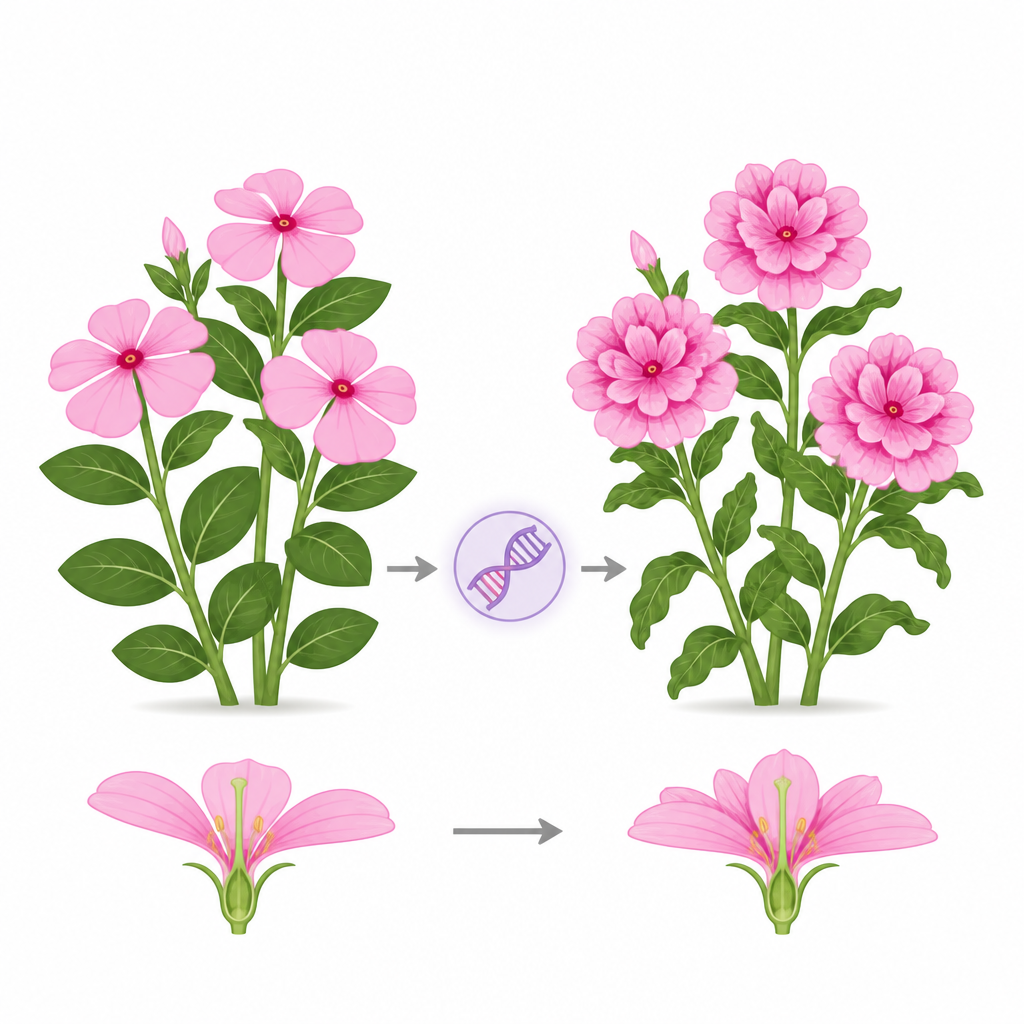
From neat five-petal blooms to frilly doubles
In wild-type Madagascar periwinkle, each flower has five sepals, five petals, five stamens, and one pistil, arranged in a simple star. The double-flower cultivar, sold under names such as Sunny Princess, keeps this basic set but adds one extra petal at the base of each original petal, creating a second ring of color. These plants also show twisted leaves caused by reduced leaf elongation as they grow. Earlier work suggested that this double-flower trait behaves like a single recessive gene, and here the authors confirmed this by crossing single and double plants and following the traits in hundreds of grandchildren plants.
Hunting the gene behind extra petals
To find the gene responsible, the team used a powerful mapping approach that compares DNA from many double-flower plants with DNA from single-flower plants. They sequenced whole genomes from pooled groups of each type and looked for regions where genetic variants strongly tracked with double blooms. A single region on chromosome 1 stood out. By adding classical marker mapping in a large second-generation family, they narrowed this area to a stretch containing 82 genes. One gene in particular showed a dramatic change in double-flower lines: a tiny one-base deletion early in the gene that shifts the reading frame and cuts the encoded protein down to a short, likely useless fragment.
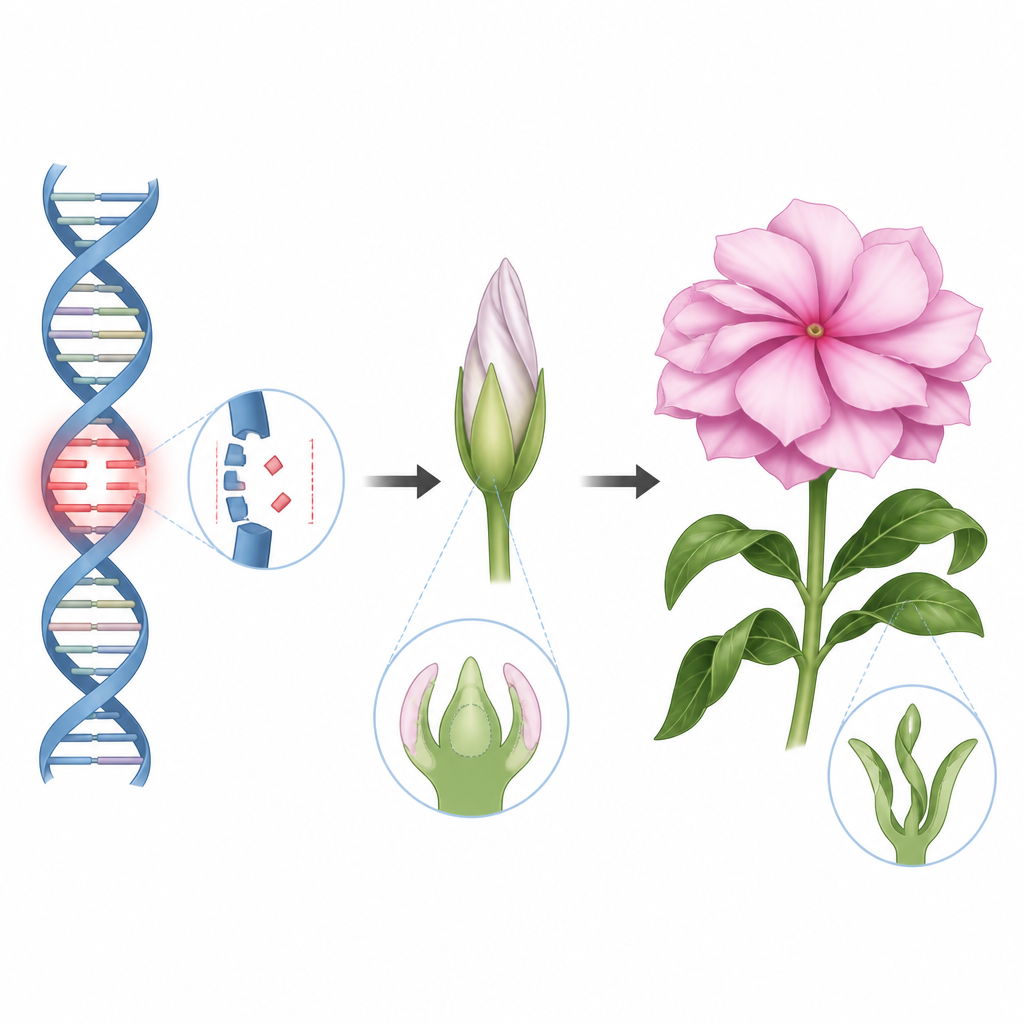
A “phantastic” gene with a special twist
The damaged gene turned out to be a relative of PHANTASTICA, a well-known plant gene family that helps shape leaves and other organs. The authors named this periwinkle gene PHANTASTICA-like, or CrPHAL, and found a second related gene they called CrPHAN. While CrPHAN closely matches classic PHANTASTICA genes from other species, CrPHAL forms its own branch in the family tree and carries extra segments in its protein sequence, hinting at a distinct role. In all tested double-flower lines from breeding programs, CrPHAL was broken either by the same frameshift change or by an independent early stop mutation, whereas CrPHAN showed no obvious damaging mutations. This strong link between nonworking CrPHAL and double flowers suggests that losing CrPHAL function is what allows the extra petals to form.
How this pathway differs from classic flower “identity” genes
Many double flowers in other species arise when the core “ABC” flower identity genes misfire and convert stamens or carpels into extra petals, often sacrificing fertility. Periwinkle double flowers are different: all four organ types remain present and recognizable, and the plants still produce viable stamens and pistils. The authors compared their findings with studies in Arabidopsis, tomato, snapdragon, tobacco, maize, and other plants where PHANTASTICA-like genes mainly control leaf shape and the flat growth of the leaf blade. In tomato and some other cases, reducing PHANTASTICA activity can increase petal number but often also reduces stamens. In contrast, periwinkle plants with broken CrPHAL add petals without losing stamens, and experiments in Arabidopsis mutants did not reproduce the periwinkle-like double flowers across different temperatures. Together, these comparisons show that CrPHAL and its relatives have partly shared but also diverging roles across species.
What this means for gardens and plant evolution
To a non-specialist, the takeaway is that a subtle defect in a single gene that helps guide leaf and flower development can turn a plain five-petal periwinkle into a fuller, double-flower plant with only mild side effects on leaf shape. Because these plants still make seeds and pollen, breeders can easily cross them and stack the double-flower trait with other desirable features like new colors or growth habits. The work also reveals that plants can reach similar-looking double blooms through routes other than the classic flower identity genes, hinting at hidden flexibility in how flowers evolve new forms.
Citation: Tomomatsu, K., Tsuji, T., Koyama, T. et al. Double flower is associated with defects in a Phantastica-like gene in Catharanthus roseus. Sci Rep 16, 15239 (2026). https://doi.org/10.1038/s41598-026-46883-2
Keywords: double flowers, Madagascar periwinkle, flower genetics, ornamental breeding, PHANTASTICA-like gene