Clear Sky Science · en
Extensive screening of ten bacteriophage cocktails revealed an optimal combination with potent therapeutic activity against Acinetobacter baumannii
Why hospital germs are so hard to beat
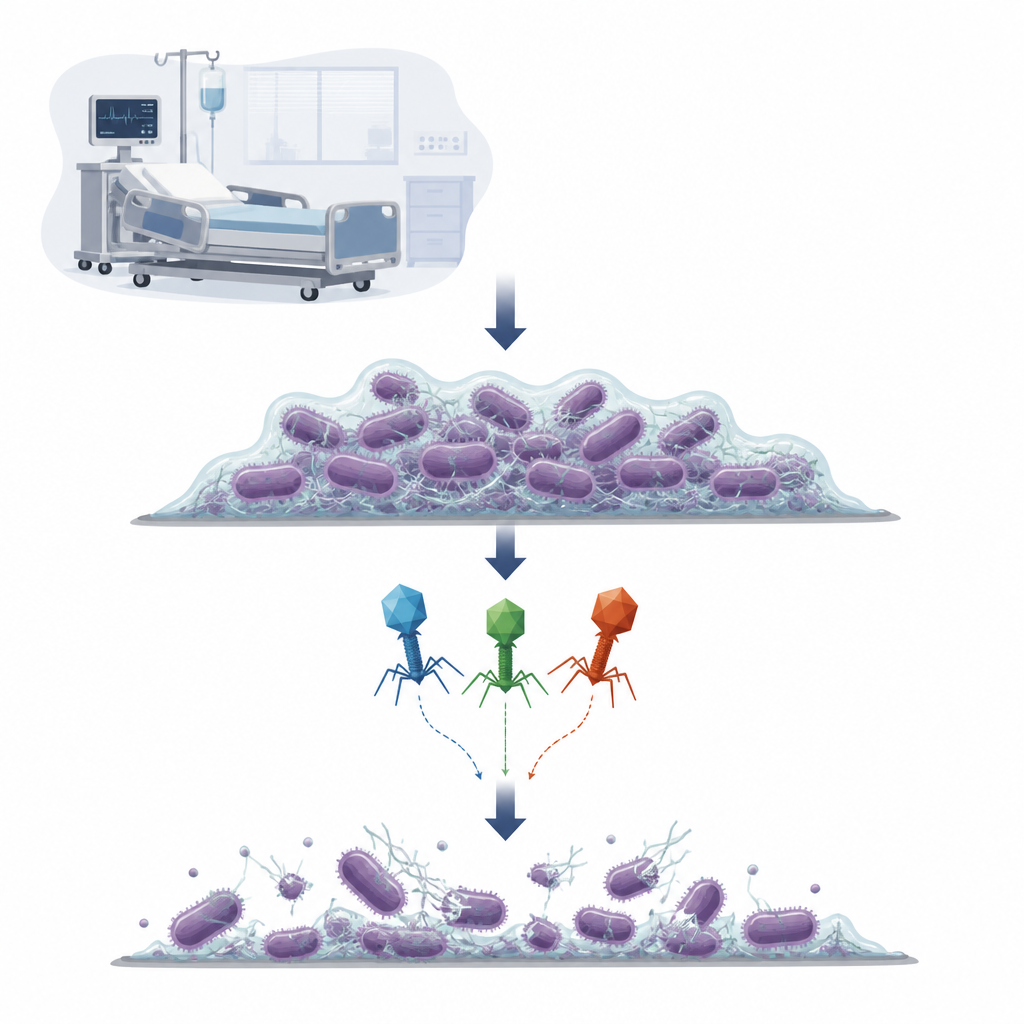
In intensive care units around the world, a bacterium called Acinetobacter baumannii has become a persistent menace. It thrives on medical devices, shrugs off many antibiotics, and hides inside slimy biofilms that cling to tubes and catheters. This study explores whether carefully chosen mixtures of viruses that infect bacteria, known as bacteriophages or phages, can be combined into a "cocktail" that attacks this hard-to-treat germ more effectively than any single virus alone.
Tiny viruses with a big job
The researchers began by collecting sewage samples in Thailand, a rich hunting ground for phages that naturally prey on bacteria. From 100 samples they isolated five different phages that attack A. baumannii. Each phage, however, could kill only a limited fraction of 135 clinical strains tested, reflecting a key challenge of phage therapy: most phages are picky eaters. Genetic and microscopic analyses showed that these five phages are quite different from one another and use varied tools to latch onto and break open bacterial cells, suggesting that they might complement each other if used together.
Mixing phages to widen the attack
To overcome the narrow reach of single phages, the team created ten three-phage cocktails, labeled A through J, and tested how many of the 135 clinical strains each mixture could kill. The best performers were cocktails A, D, and E, each able to infect just over half of the strains, far more than any lone phage. All three successful cocktails shared the same two core members, named vB_AbaSI_1 and vB_AbaSI_3, which turned out to be central to the overall strength of the mixtures. A third phage in cocktail A, vB_AbaSI_2, replicated quickly and in large numbers, helping sustain the attack once the infection started.
Breaking down stubborn slime layers
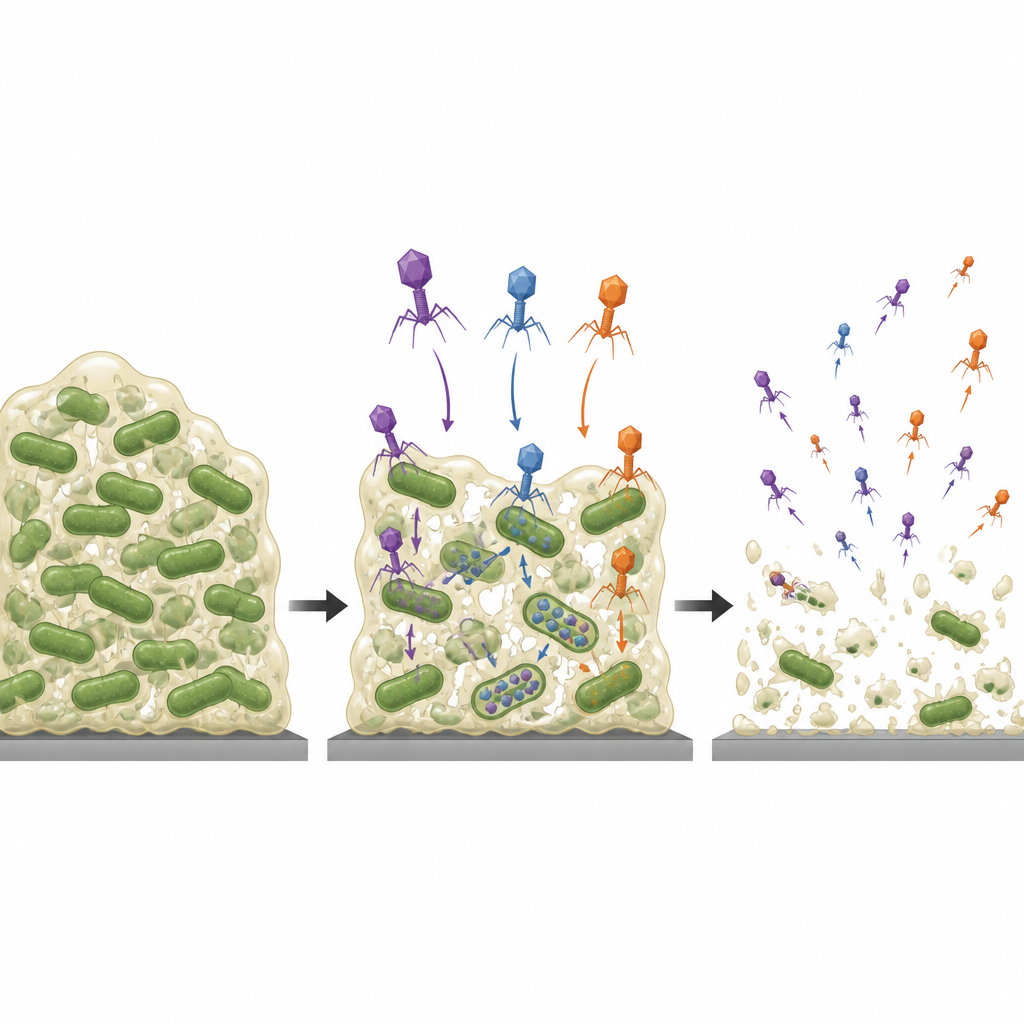
A particularly important test was whether the cocktails could handle biofilms, the protective layers that A. baumannii builds on plastic and other surfaces. In lab dishes, the scientists allowed two strains of the bacterium, one antibiotic-sensitive and one extensively drug-resistant, to form biofilms. They then treated these layers with individual phages or cocktails. Cocktail A stood out: it almost completely blocked biofilm formation when added early and was also the most effective at chewing away already formed biofilms, cutting the remaining biomass to a small fraction of the untreated level. This strong effect likely stems from combining phages that carry enzymes to nibble at the biofilm material with others that rapidly burst bacterial cells.
Testing protection in a living host
To see whether these promising lab results might translate into living organisms, the team turned to larvae of the wax moth Galleria mellonella, a commonly used infection model. Larvae were infected with either a standard lab strain or a highly drug-resistant clinical strain of A. baumannii and then treated with individual phages or cocktails. Without treatment, most larvae died within a few days. Single phages offered limited protection, with one exception that modestly improved survival. In contrast, larvae given cocktail A after infection had survival rates of about 60 to 65 percent after seven days for both strains, significantly better than untreated animals and better than the other cocktails tested.
What this means for future treatments
Taken together, the study shows that a small, well-chosen mix of three phages can tackle a wide range of A. baumannii strains, punch through their slimy protective layers, and improve survival in an animal model. While this cocktail is not ready for use in patients and will require further safety adjustments and broader testing, it illustrates how blending the right viral "specialists" can turn them into a coordinated team against dangerous hospital bacteria. For people facing infections that no longer respond to common drugs, such tailored phage combinations may one day offer a valuable new line of defense.
Citation: Sawaengwong, T., Janesomboon, S., Lerdsittikul, V. et al. Extensive screening of ten bacteriophage cocktails revealed an optimal combination with potent therapeutic activity against Acinetobacter baumannii. Sci Rep 16, 15589 (2026). https://doi.org/10.1038/s41598-026-46878-z
Keywords: bacteriophage therapy, Acinetobacter baumannii, phage cocktail, biofilm disruption, antibiotic resistance